
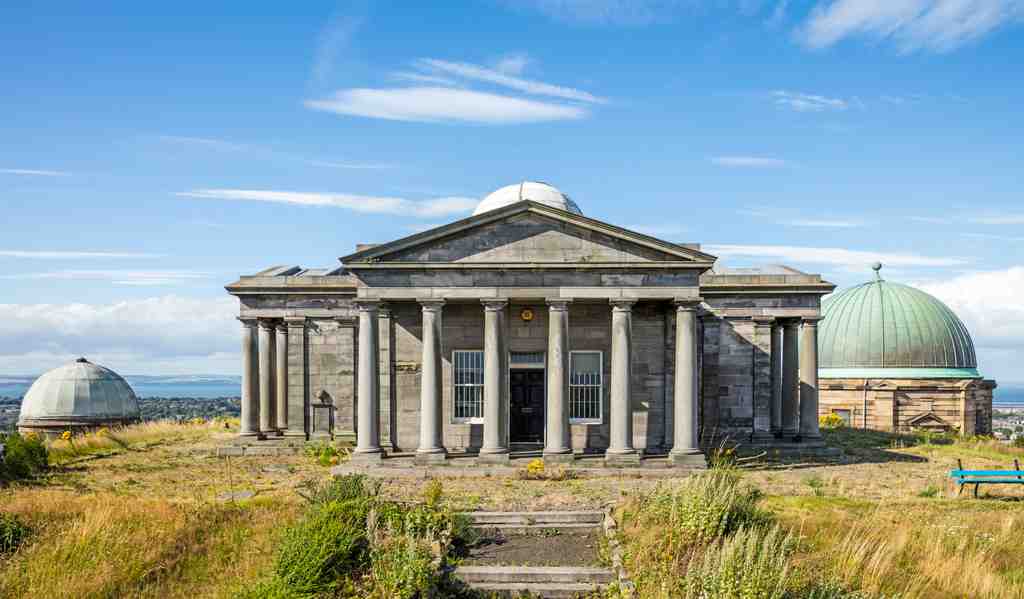
Up ahead, you’ll spot the City Observatory as a cluster of stone buildings and domes, with the Playfair Building standing out like a miniature Greek temple-just follow your gaze past the monuments to the grand, columned structure at the heart of Calton Hill.
Alright, take a breath and look all around-the air up here is always fresher, as if the sky approves of all the stargazing that’s happened on this hill! The City Observatory in front of you isn’t just Edinburgh’s answer to a Greek temple; it’s a time machine, holding stories about curious astronomers, city riots, and enough scientific ambition to reach the moon (if only their telescopes were pointed the right way).
Back in 1776, imagine the city buzzing below with horse-drawn carts, church bells, and the clang of shipbuilding at Leith Docks. Up on this rock, Thomas Short marched with a giant 12-foot telescope. Not the sort you could slip in your pocket-this one basically needed its own address. Short’s goal? To wow the public with glimpses of distant planets, and-perhaps-not go bankrupt in the process. Edinburgh’s city fathers handed him a plot right here and some donated money, which, after the riots and the Jacobite uprising, nobody seemed sure how to spend. Short’s family kept things running after his death, then opticians tried their luck, until all fell suddenly quiet and the observatory sat abandoned.
But wait! Enter James Craig, designer of the first Gothic Tower-if you look to the southwest, facing Princes Street, you’ll spot its pointed shape peeking above the wall. It doesn’t just look fortress-like; it was meant to be. I think it also doubled as a really fancy “Do Not Disturb” sign. Eventually, more hopeful astronomers trickled in, though they mostly ran out of money before reaching the stars.
Jump ahead to 1812, and the astronomers get their hands on a new, splendid centre: the Playfair Building. William Henry Playfair, a celebrated architect, gave it its Greek Revival look-imagine arriving here and seeing that portico rise up, the city at your back and galaxies overhead. By 1822, King George IV was so impressed that he gave the place a shiny new title: the Royal Observatory. When funds were low, the scientists had to sometimes fundraise just to buy telescope parts-astronomers, it turns out, are very resourceful, if not always rich. It took until 1831 for a brilliant new transit telescope, built by Fraunhofer, Repsold, and eventually Repsold’s son (nobody could finish a telescope on time!), to finally arrive.
Step inside your own imagination: the click of brass dials, the quiet shuffle of paper, and the sharp tick of a sidereal clock keeping perfect cosmic time. Astronomers up here would watch the stars swing by, adjusting their clocks to help mariners from Leith port keep perfect time-a vital service long before everyone had a phone in their pocket. By 1854, the time ball on Nelson’s Monument, just next door, would drop at exactly one o’clock every day, controlled by an electric pulse zipping from the observatory. Later, a wire ran all the way to Edinburgh Castle, firing the famous One O’Clock Gun with a thunderous boom that echoed across the city. Nowadays, these are beloved traditions, set “by hand” rather than cosmic precision-but the city still listens.
By the late 1800s, though, technology had raced ahead and the old site grew too noisy and cramped. In 1896, the Royal Observatory packed its scientific bags and moved to Blackford Hill, leaving Calton Hill’s buildings for future dreamers. Soon after, the City Observatory took over, with domes housing splendid new telescopes-one with a mirror so big, it had trouble keeping up with expectations. The famous City Dome you see in the northeast was once home to a giant 22-inch refractor, though sadly, it worked better as a lecture hall than a stargazing window in the end.
Here, eccentric city astronomers and sticklers for rules like William Peck and John McDougal Field held court, running lectures, observing stars, and founding the Astronomical Society of Edinburgh. But resist the urge to look for aliens: by the late 20th century, vandals and leaky roofs forced the astronomers to abandon ship. The whole site fell silent-until a creative rescue mission arrived.
In 2018, after years gathering dust, the stone was scrubbed, the paint touched up, and the Observatory was born anew as “Collective”-an art centre mixing cosmic ideas with very earthly creativity. The City Dome now hosts installations by international artists, inviting imagination to travel as far as any telescope ever did-though with less chance of bumping your head on a brass lever.
Feel the stones underfoot, picture Victorian astronomers arguing about Saturn’s rings, or artists hatching plans for a new exhibit. Even Observatory House in the corner has become a holiday let; if only Thomas Short could know. And as you look across the city with the wind in your hair and echoes of history swirling, just imagine what stories are still waiting to begin.
Now, is it possible to spot Uranus from here these days? Only if the clouds and the city lights are on their very best behavior. But one thing’s for sure-the City Observatory is where Edinburgh’s imagination and the universe still meet for a chat.


