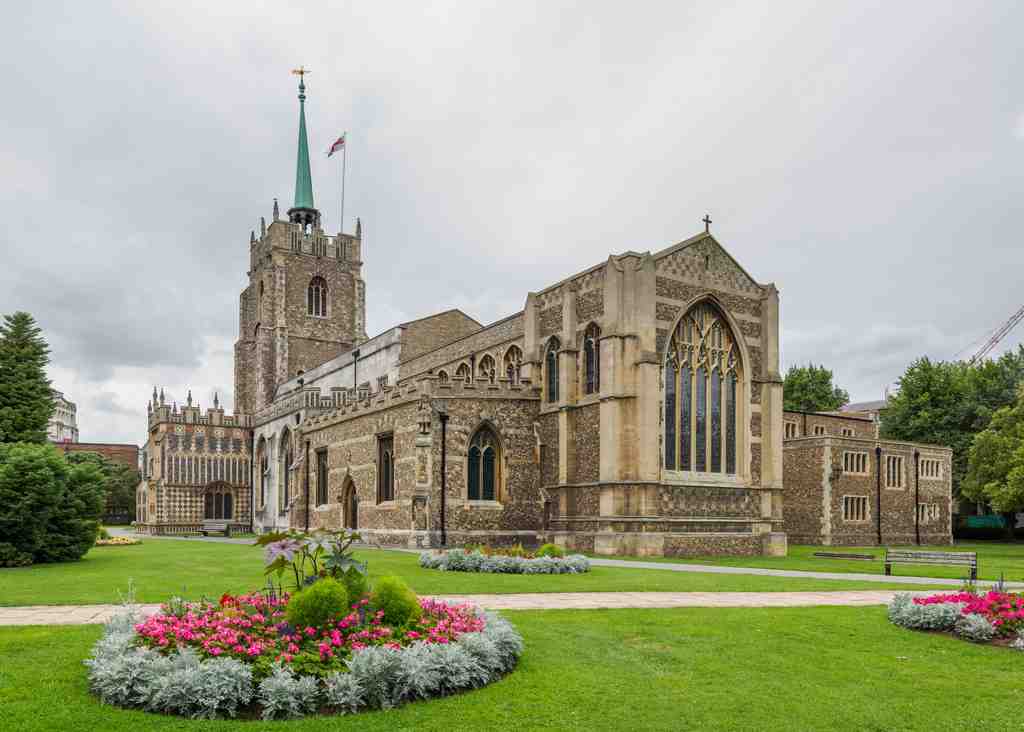
On your left, look for the long flint, stone and brick church, its square tower lifting into a slender spire, with a projecting south porch set slightly forward from the main wall.
At first glance, Chelmsford Cathedral seems calm, almost self-possessed. But this building has earned that poise. A church likely stood here by about twelve hundred, growing with the town itself, and the late medieval rebuilding stretched on for decades because local loyalties kept pulling in different directions. The Yorkist Bourchier family and the Lancastrian de Vere family both funded work here, and their rivalry slowed progress so badly that the project dragged on for nearly a century. If you look at the masonry image in the app, that mingling of flint, stone and brick begins to make perfect sense: not one neat campaign, but a long argument written into the walls.
Now let your gaze rise to the south porch and the rooflines above it. This is where the cathedral starts keeping secrets. A stone staircase inside that porch leads to an upper room above the street, and there, tucked into the medieval fabric, sits a notable library of medieval theological books and decorated manuscripts. Most people standing here never suspect that scholarship is perched just overhead, as quietly as a held breath.
The cathedral’s full dedication opens an even older door: Saint Mary the Virgin, Saint Peter and Saint Cedd. Cedd was a seventh-century missionary bishop, one of the figures who helped root Christianity across Essex long before this market-town church took shape. When the cathedral added his name in nineteen fifty-four, it reached back beyond parish records and noble feuds to claim kinship with the region’s earliest Christian life. His presence here is not decorative. It reminds you that this site belongs to a much longer spiritual map.
One man still attached to this doorway is Thomas Hooker. He served as Chelmsford’s town lecturer from sixteen twenty-six to sixteen twenty-nine, and his sermons drew such crowds that local memory never quite released him. A blue plaque near the south porch marks the spot. Then Hooker left for New England, founded Hartford in Connecticut, and became one of the figures later associated with American democracy. That is rather extraordinary: a preacher at this church carrying ideas from Essex across the Atlantic.
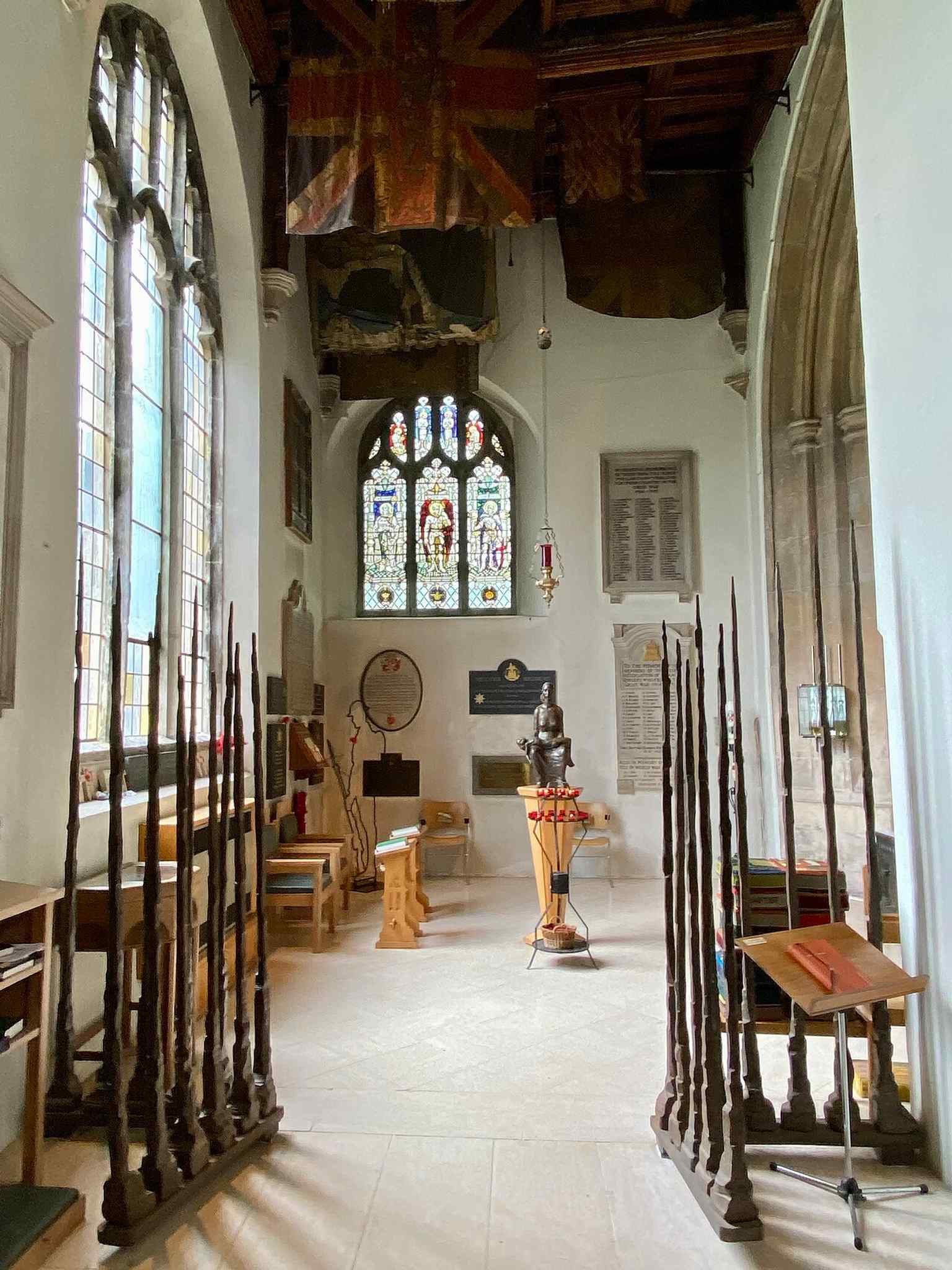
The building itself has survived harsher tests. In eighteen hundred, the nave, the central hall of the church, partly collapsed. County architect John Johnson rebuilt it, keeping the Perpendicular Gothic feel, the late medieval style of strong vertical lines and broad windows, but using Coade stone piers and tracery, with a plaster ceiling above. If you glance at the interior view on your screen, you can see how the rebuilt nave still holds that older rhythm, even after catastrophe and repair.
Then came nineteen fourteen, when a new regional church structure needed a cathedral, and this parish church was chosen as its seat. Later generations kept reshaping it: the south porch extension of nineteen fifty-three honoured Anglo-American friendship and the many U-S airmen stationed in Essex during the Second World War, while new art and organs inside carried the story forward.
In a moment, we’ll follow that widening reach outward to the Diocese of Chelmsford itself, just a one-minute walk away, where this church’s local history becomes a regional one. If you wish to return later, the cathedral is generally open from early morning until early evening, with a slightly earlier close on Sundays.