
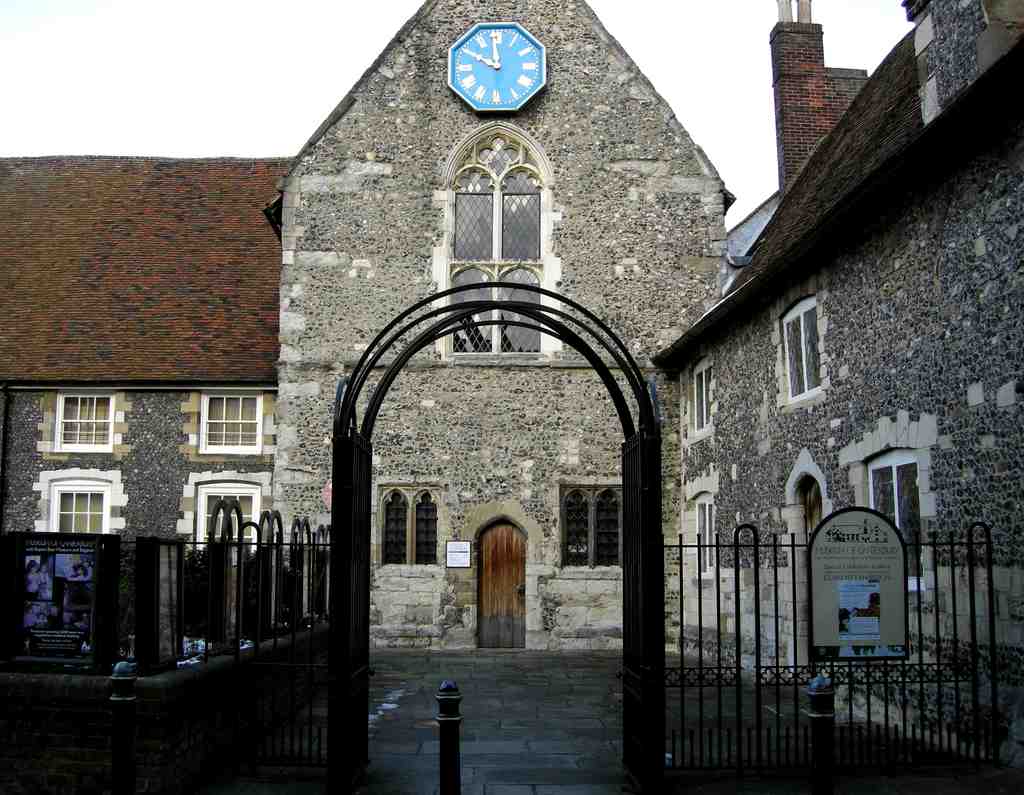
Look ahead and you’ll spot the Canterbury Heritage Museum by its distinctive flint stone walls, cream window frames, and that nearly triangular roof right above a big, old wooden door. The blue clock with its gold hands sits high above the entrance, looking grand and giving you a hint of the history clocking away inside. There’s a black iron gate arched over the path, inviting you right up to the doorway-don’t worry, it won’t swing shut on you like the dungeons of old.
Standing here, you’re about to step into a story that started way back in the 12th century. This place once buzzed with the shuffling feet of priests and the crackle of a giant fire right in the hall. Can you imagine old priests snoring away and someone accidentally burning the evening stew while the River Stour flowed quietly behind them?
Here’s a funny twist-the building was first a stone house for a tanner, then a rich minter, then the minter’s son who decided it’d make a good almshouse for poor priests. Maybe he wanted extra prayer points! Priests lived, ate, and slept in one big space together-talk about sharing everything, even your midnight sneezes.
Later, they added splendid rooms called the solar and undercroft to give the head priest some privacy. Believe it or not, by 1575 all things spiritual were out, and the building became secular: a school, clinic, poorhouse, and even a workhouse-hopefully with less snoring and more studying.
Fast-forward to the 1980s, and the museum opened its doors wide to Canterbury’s treasures. Inside, you’d have found everything from Saxon brooches, like the mysterious Canterbury Cross, to a sun-shaped pendant that could only tell the time when the sun was right overhead-great if you never lose your hat.
The exhibits ranged from prehistoric bones-yes, there were reconstructed faces staring out!-to wartime raids and even a detective game about the legendary Christopher Marlowe. And for anyone who believes in magic, picture original artwork and stories of Rupert the Bear, whose creator made Canterbury her home.
Once crowds filled these halls-more than 30,000 people in a good year. But as numbers fell, the doors closed quietly, and the city nearly lost a lovable piece of its soul. Luckily, the community wasn’t having that! Thanks to a lively campaign, the museum transformed into the Marlowe Kit escape room and creative space, mixing modern adventure with medieval bones.
So, as you stand outside and look at those weathered walls, just imagine all the laughter, secrets, and feet that have crossed this threshold-priests, inventors, kids, and history itself. If these stones could talk, I think they’d have plenty of tales… and maybe a few complaints about cold winters by the river!




