
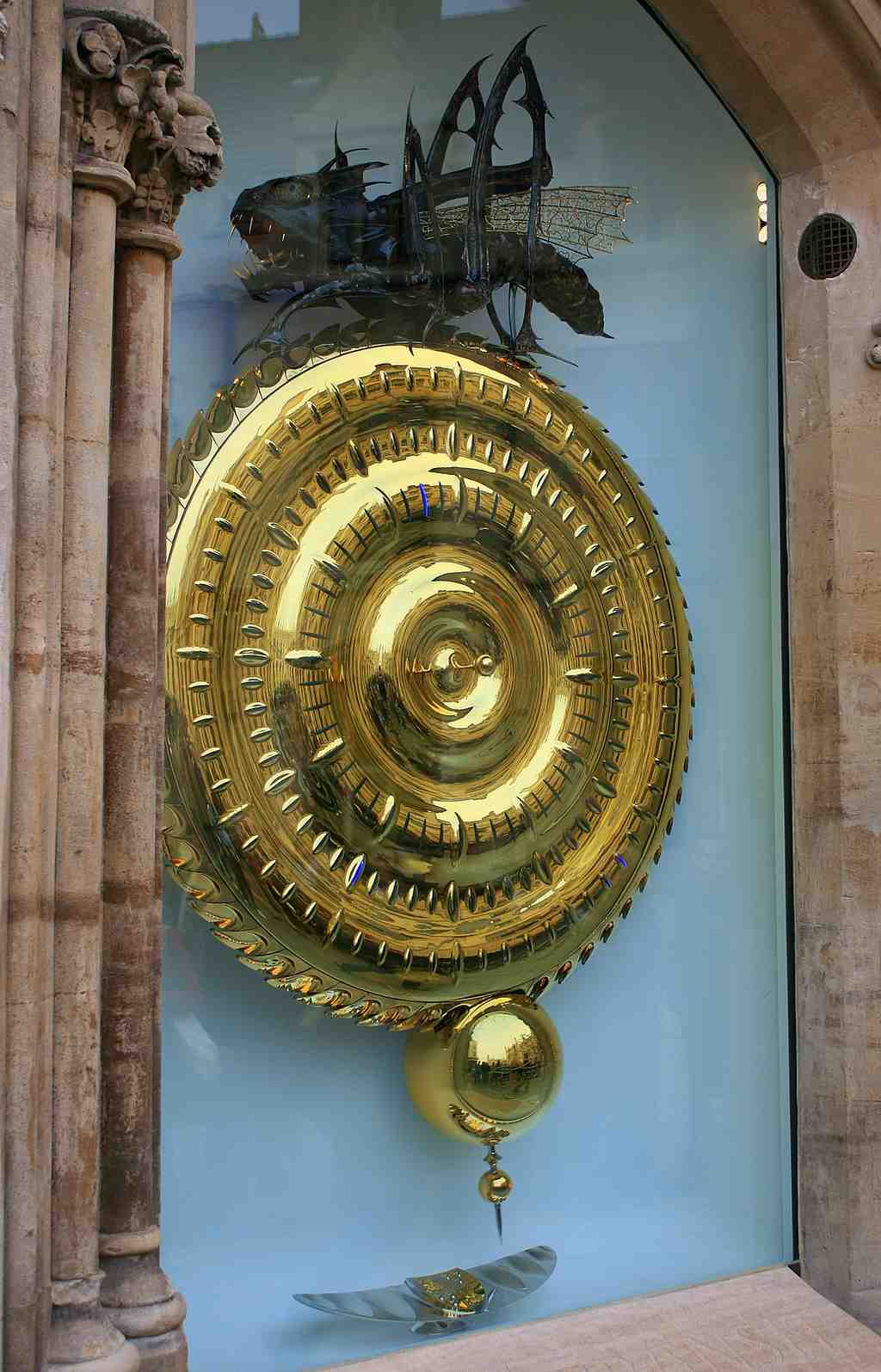
Look to your left and you will spot a massive rippling gold-plated disc mounted in the stone wall crowned by a nightmarish metal insect with razor-sharp teeth. This is the Corpus Clock, a brilliant disruption of Cambridge's serene ancient architecture. While the university usually celebrates comfortable, ordered traditions, this machine was built to remind us that time is an absolute monster.
Take a peek at your screen to see the massive crowd gathered here in two thousand and eight. The man who officially unveiled this unsettling masterpiece was none other than Cambridge physicist Stephen Hawking, a fiercely fitting choice for a monument obsessed with the physics of time. While the university treated the event as a joyous spectacle, the clock's creator, John Taylor, had to be coaxed into speaking by a public relations team. He actually wanted to hide quietly at the back of the crowd.
Taylor was an alumnus who made his fortune inventing the little thermostats used in electric kettles. He poured a million pounds and five years into this project, intending it to be a tribute to early clockmakers, but with a highly rebellious twist. Traditional clocks hide their inner workings safely away, but Taylor turned this one entirely inside out. He took the escapement, which is the internal mechanism that catches and releases the gears to make a clock tick, and transformed it into the dominating visual feature.
That grim creature sitting on top is the escapement itself. Taylor named it the Chronophage, which literally translates from Greek as time eater. Have a look at your app for a close-up of its terrifying face. It actually bites down on the seconds as they pass, occasionally blinking in grim satisfaction. Underneath, an eerie grinding noise plays, and the hour is marked by a chain clanking into a hidden wooden coffin.
Notice how it does not tick perfectly. The pendulum catches, lags, and suddenly races ahead. This is completely intentional. Taylor engineered the erratic movement to reflect life's irregularity. His message is starkly unsentimental. He designed it to be terrifying because, in his words, time is not on your side, and as soon as one minute is gone, the beast is salivating for the next. The golden ripples on the clock face were even formed using underwater explosives, symbolizing the chaotic birth of time itself at the Big Bang.
Despite its horror, the students affectionately call the beast Hopsy. It is hypnotically beautiful, deeply disturbing, and undeniably brilliant. Now, from this strange modern mechanism, we are going to walk to an infamous wooden one. Our next stop is the Mathematical Bridge, just a seven-minute walk away. Oh, and since the clock sits right here on the street, you can come back to watch the beast feast twenty four hours a day.




