
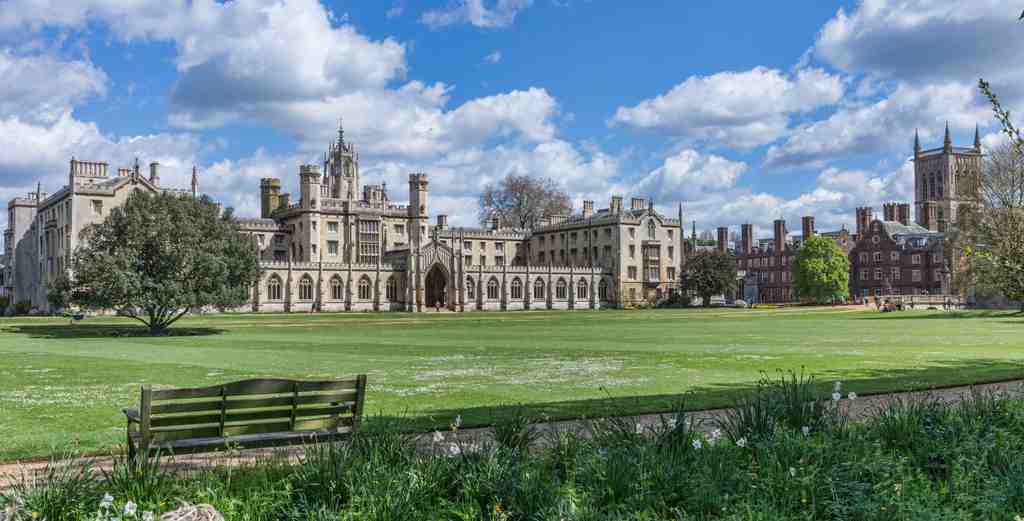
Gaze ahead and you’ll spot a grand stone building with pointed spires and a commanding gatehouse right in the center, surrounded by lush lawns and framed by an impressive medieval chapel tower to the right-yep, that’s St John’s College!
Now, as you stand here, imagine winding the clock back over 500 years. St John’s College was dreamed up by Lady Margaret Beaufort, the powerful mother of King Henry VII. But founding a college back in 1511 wasn’t simple! After Lady Margaret died, it took cunning negotiation, papal approval, and even the King’s blessing before the doors finally opened. The college rose from the ashes of a crumbling medieval hospital, with its impressive gate built to keep out more than just chilly winds-those heavy doors slammed shut every evening, sealing the scholars in for a quiet night of study... or maybe some ghostly moans according to legend!
If you look up at the Great Gate, notice the quirky animals perched above it. Those aren’t your average college mascots! They’re yales-strange creatures from legend with elephant tails, goat-like heads, and magical swiveling horns. And see the red rose? That’s the mark of Lady Margaret, still watching over her scholars to this day. Keep your eyes peeled for the college’s motto too: “Souvent me souvient,” which means, “Often I remember.” Or maybe, “Don’t forget to duck under the Latin!” depending on how you read it.
St John’s is a place where history is woven into every stone. Hear the echo of footsteps as you walk under the archways-those might have been the poet William Wordsworth heading to class, or William Wilberforce and Thomas Clarkson, plotting to change the course of history by ending slavery in the British Empire. Even modern royalty couldn’t resist; Prince William took classes here in estate management, which sounds much fancier than my attempts to mow the lawn.
See that chapel with its sky-high tower? It’s one of the tallest buildings in Cambridge and a real slice of Victorian drama. The stained glass glows, and if you listen closely, you might hear the hauntingly beautiful sounds of St John’s choir, a tradition since the 1670s. And just so you know, the choir was the first at Oxford or Cambridge to welcome boys and girls into both its children’s and adult choirs-progress marches on, even in ancient halls.
If the walls could talk, they’d tell stories of Nobel Prize winners, prime ministers, saints, and a few princes. Some say lost spirits wander the courts at night, including the ghost of James Wood, a scholar so poor he worked by the light in the stairways. During the English Civil War, First Court was used as a prison-imagine the clanging of chains and echoed whispers as rebels paced the ancient stones. In fact, Queen Elizabeth II herself stopped by in 2011 to open a new path-though I doubt she was searching for ghosts.
The college buildings are like a timeline in stone. Step through Second Court, called the finest Tudor court in England, where treaties were signed and D-Day landings planned. Cross the legendary Bridge of Sighs-so photogenic even Queen Victoria said it was “pretty and picturesque.” If you find a window with nothing behind it, that’s not a magic trick, just creative architecture! The statues standing in chapel tabernacles aren’t just decoration-they’re famous alumni, forever carved into the college memory.
St John’s is famous for its sporting rivalry with neighbouring Trinity College. The two try to outdo each other at every turn-even the eagles above their buildings are said to turn away from their rivals, and rumor has it that the blank clock faces on New Court were left deliberately unfinished just to irritate Trinity. And as for the swans, well, apparently St John’s fellows are the only folks, other than the royal family, allowed to eat the unmarked mute ones. Don’t worry, no swans were harmed in the making of this tour.
Today, thousands of students from all over the world wander these courts, study in rooms lined with ancient wooden panelling, punt on the River Cam, and yes, sometimes stumble across more than a few eccentric traditions. Threads of history, music, rivalry, and memory connect them all-and you, lucky visitor, get to stand here and soak it all in, under the watchful gaze of Lady Margaret and her fierce yales. If these walls could gossip, imagine the tales they’d tell!
Interested in knowing more about the buildings and grounds, college choirs or the traditions and legends




