
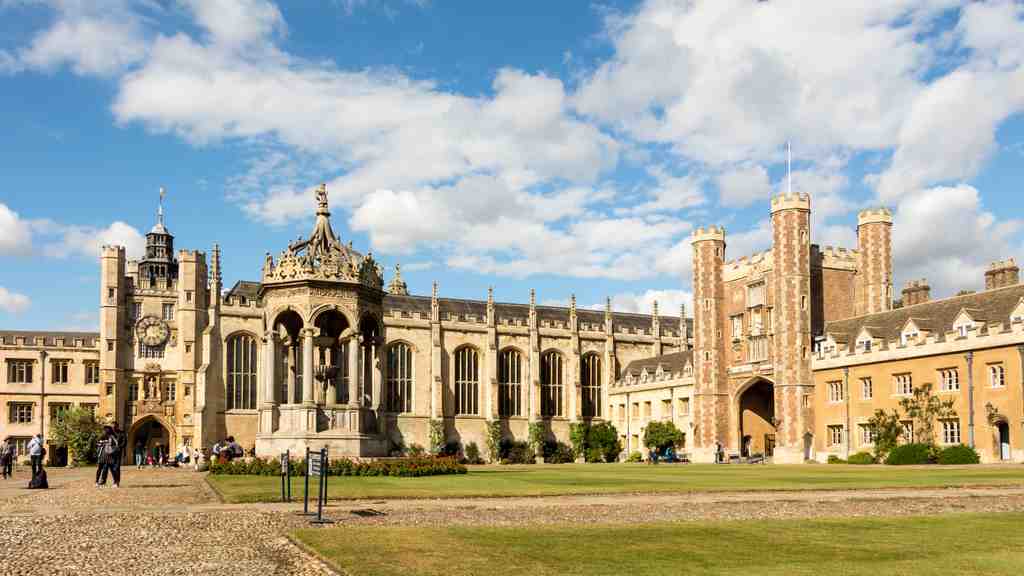
In front of you, Trinity College rises with majestic golden stone, castellated towers, a clock tower to your left, and a grand arched gateway right at the center-just look for the ornate statue of Henry VIII above the Great Gate and the enormous sunlit courtyard stretching beyond.
Imagine standing here in 1546: England is full of whispers and worries, because mighty King Henry VIII is seizing church lands left and right, making even the wealthy colleges at Oxford and Cambridge nervous that they might be next. The story goes that Trinity College was born out of that tension-Henry’s sixth wife, Catherine Parr, convinced him not to shut the university down, but to build something new instead. So, right where you’re standing, two older colleges-King’s Hall and Michaelhouse-were mashed together in one royal sweep to form Trinity, a new college with such ambition that you can almost feel it echoing in the stones.
Take another look up at the Great Gate-the statue of King Henry VIII should technically be holding a scepter, but legend tells us that, for a cheeky while, he was holding a chair leg swapped in by a mischievous student! These grounds have seen centuries of pranks and protests, from students scaling dizzying rafters to reposition an artificial duck in the hall-or, more recently, demonstrators with shovels digging up the immaculate lawn to protest fossil fuel investments.
Trinity doesn’t just have stories-it has presence. This is the richest college in Cambridge, fueled by property, science parks, and even a stake in the O2 Arena in London! But money isn’t everything; prestige and tradition here are almost as thick as the walls. Famous faces have roamed these paths: think Isaac Newton imagining apples and gravity, Lord Byron wandering with his pet bear (yes, a bear-because a dog would have been too ordinary), and six British prime ministers pondering the affairs of the nation.
Walk through the Great Court if you get the chance. It’s so vast it’s said to be Europe’s largest enclosed courtyard. And if you’re brave, try your luck running the Great Court Run-sprinting around the perimeter in the time it takes the clock to strike twelve. Olympic athletes have tried and failed to beat it; one wrong foot on the slippery cobbles and you might find yourself flying less like Newtonian physics and more like slapstick comedy.
You might hear snippets of Latin grace drifting from the hall at dinner, or the echo of the college choir floating down during the beautiful traditions of Singing from the Towers and Singing on the River. Half the choir belts from atop the Great Gate, the other half answers from the clock tower across the court-listen for the contrast as antiphonal music sweeps over the court. Later, lantern-lit punts drift across the Cam, the choir’s voices fading into the night.
Trinity’s walls are alive with stories of academic rivalry, especially with St John’s College next door-rumor has it that cannons even point in their direction, “just by coincidence,” of course. And since only Fellows can walk on the grass (unless you’re a Scholar, in full academic dress), there’s always a sense of mystery about what goes on atop these manicured lawns.
Even the architecture is full of surprises. Thomas Nevile, Trinity’s ambitious 16th-century master, rebuilt and expanded much of the college, adding the beautiful cloisters and the celebrated Wren Library-designed by Christopher Wren himself and housing treasures like two of Shakespeare’s First Folios and handwritten notes from Isaac Newton. Meanwhile outside, students once competed to hang bicycles in the branches of the iconic New Court tree, which is definitely not Newton’s apple tree, despite persistent myths!
This is a college of firsts: more Nobel prizes than any other Oxbridge college, a boat club with legendary May Balls, the oldest university mathematical society in the UK, and a ceaseless supply of scholars whose names echo through history, from mathematicians to poets to royalty. These stones have soaked up secrets, rivalries, the tributes of monarchs, and the rebellious laughter of students for nearly 500 years.
So as you stand here, take a slow breath, and let Trinity College’s grand towers, its sun-drenched courts, and its swirling mix of mischief and intellect welcome you into a world where history still has a very real pulse.
To delve deeper into the buildings and grounds, academic profile or the traditions, simply drop your query in the chat section and I'll provide more information.




