Cambridge Audio Tour: Collegiate Legends and Hidden Enclaves
Within Cambridge's honeyed stone, generations have whispered secrets that shaped empires, sparked rebellions, and hid scandals behind ancient archways. Hidden beneath the storied spires of St John's College, Trinity College, and King's College, untold tales wait for those who listen closer. Embark on a self-guided audio tour that transforms cobbled lanes and ivy-clad courtyards into a treasure map of intrigue. Uncover the stories most visitors never hear and explore corners passed by the hurried crowds. Why did bitter rivals duel in the very heart of Trinity's court? What shadowy pact unfolded under King's College's world-famous chapel? Which misplaced student prank once sent ripples through Parliament itself? Trace footsteps across centuries where kings lost crowns, scientists rewrote the universe, and students plotted far more than their degrees. Each moment brings the city into brilliant, unpredictable focus. Ready to hear Cambridge as only the stones remember? Begin the journey where secrets wait behind every gate.
Tour preview
About this tour
- scheduleDuration 50–70 minsGo at your own pace
- straighten1.7 km walking routeFollow the guided path
- location_onLocationCambridge, United Kingdom
- wifi_offWorks offlineDownload once, use anywhere
- all_inclusiveLifetime accessReplay anytime, forever
- location_onStarts at University Pitt Club
Stops on this tour
lock_open 3 free previews · 5 unlock with purchase
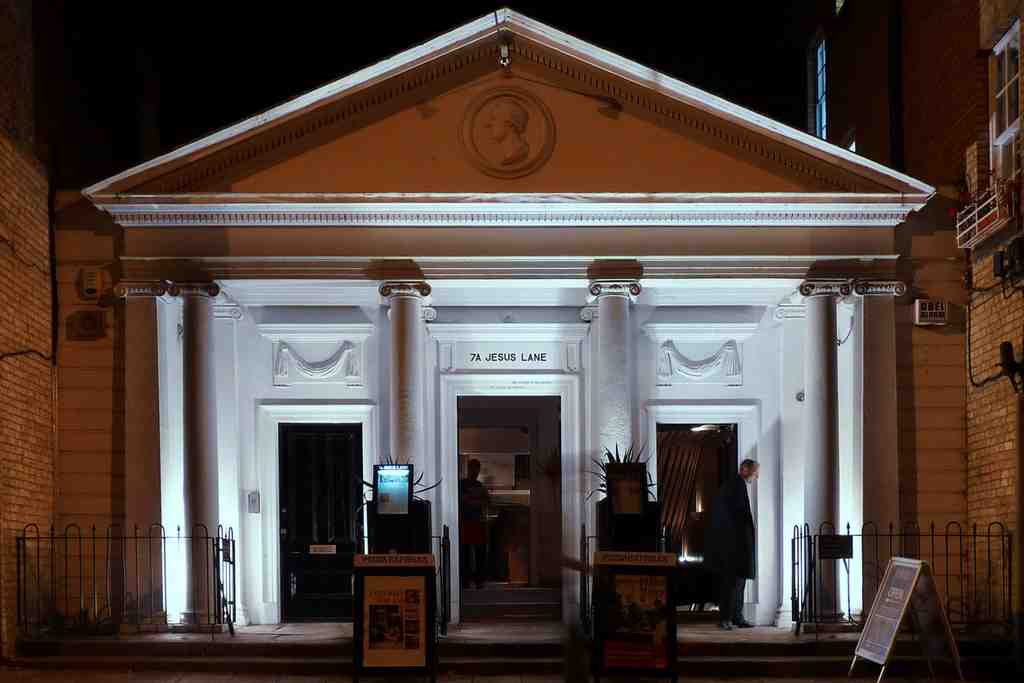
Look for a dramatic, white neo-classical building with grand pillars and a large coin-like medallion of a man’s profile over the door-right on Jesus Lane, just where the glow of…Read moreShow less
Look for a dramatic, white neo-classical building with grand pillars and a large coin-like medallion of a man’s profile over the door-right on Jesus Lane, just where the glow of the lights cuts through the dark. Welcome to the University Pitt Club-though with its history, some might call it the Hogwarts of supper clubs, minus the broomsticks but with a good deal more port. Now, if you’re standing outside, picture the scene back in the wintry days of 1835: top hats bobbing past, the streets echoing with clattering hooves, and sharp Cambridge scholars plotting not just their studies, but the political shape of Britain. The club was originally founded in honor of William Pitt the Younger, Cambridge alumnus and Prime Minister-imagine everyone toasting to “the immortal memory of Mr. Pitt!” after dinner. Though its first purpose was as serious as a cold British winter-helping rally Tory votes in the Cambridge elections-apparently good food and laughter have always had the power to spoil even the best political plots. Within a few decades, dinner parties and speeches won over debates, and the Pitt Club became less about politics and more about enjoying hearty meals, perhaps spiced up with a witty tale or two. The building you see wasn’t its first home; it wandered town like a restless undergrad, meeting above booksellers and furniture shops, until finally settling here on Jesus Lane in 1866. But its origins? Not so glamorous-this pillared marvel was actually meant to be “Roman (improved Turkish) Baths.” Now that’s a steamy surprise! They lasted less than a year-apparently not every Victorian was ready for improved Turkish-style relaxation. After the baths flopped, the building was auctioned, acquired by the club’s own architect, and half was soon filled with the laughter and clinking glasses of the Pitt Club, while the other half became Orme’s Billiards Rooms. Here’s a twist worthy of a Cambridge ghost story-during World War I, the club closed its doors, whisky almost vanished (the horror!), and its members were scattered. Even the Second World War saw its doors commandeered for public use and a gigantic “British Restaurant” sign hung outside. A. S. F. Gow commented that Pitt himself, whose proud profile you can still see up on the pediment, looked down from above, nose wrinkled in distaste at the common folk queueing for shepherd’s pie. Through all this, the club changed with the times. After fires and several renovations-including a posh dining room and a big plaque of William Pitt’s head moved from his former house in Putney-the club held fast to tradition, but with its own sense of humor about bizarre events and changes around it. Model members marched through its doors-kings and princes, masters of Cambridge, olympians, spies, comedians, and at least one Bond (sadly, not the secret agent kind, but the ornithologist who lent James Bond his name). The club famously admitted only men for 182 years, often causing more drama than a rabbit in a punting race. But, in 2017, after a heated vote (and trial runs where women were only allowed in after dark-cue secret agent music...), the club finally opened its membership to women. And if you catch a whiff of pizza or Japanese food, you’re not going mad-these days, the ground floor is a restaurant, while the Pitt Club has retreated to the first floor, probably keeping an eye on the dessert. So as you stand in front of these glowing columns, think of the centuries of laughter, arguments, secret handshakes, and-of course-a passionate debate over the last slice of cake. The Pitt Club might hold its secrets close, but its doors-at least for this story-are wide open. On to the next stop we go! Fascinated by the clubhouse, notable members or the women? Let's chat about it
Open dedicated page →To spot St John’s College, just look ahead for the grand, turreted stone building stretching wide across a lush green lawn, with its tall gatehouse in the centre and an impressive…Read moreShow less
To spot St John’s College, just look ahead for the grand, turreted stone building stretching wide across a lush green lawn, with its tall gatehouse in the centre and an impressive chapel tower rising to your right-all set against the open sky. Now, take a deep breath and imagine yourself standing here over 500 years ago when this very ground was filled not with students, but the beds and whispers of an old hospital. You’d have heard the soft shuffle of monks sandals and the distant clang of the ancient chapel bell. Back then, the sick and weary would come here to rest, and by the time the Tudor era swept in, the hospital was so run-down it might as well have been held together by a prayer and hope! In steps Lady Margaret Beaufort-matriarch, mother to Henry VII, and a woman determined enough to found not just one college, but two. She chose this very spot, at the advice of her chaplain, John Fisher. After a tangle of legal dramas, papal approvals, and more red tape than you’d find at a medieval scroll shop, St John’s College finally earned its charter on the 9th of April, 1511. Now feast your eyes on the Great Gate before you: those tall spires topped with the mythical yales-half-antelope, half-elephant with horns that can swivel (yes, even the statues in Cambridge have to be flexible)! Look up, and you’ll see the arms of Lady Margaret and a miniature figure of St John himself, cradling his symbolic eagle and chalice. It’s about as subtle as a Tudor selfie. As you step closer, imagine Queen Elizabeth I herself riding straight into the college hall on horseback-no one told her about “no hats or horses indoors.” And, over the years, these ancient courts have held far more than royal hoofprints: St John’s has nurtured 12 Nobel Prize winners, seven Prime Ministers, archbishops, abolitionists, poets, and-just to keep things lively-a couple of ghosts. Maybe you’ll hear the creak of floorboards where the ghost of James Wood, the frugal master, used to work by the stairwell’s light because he couldn’t afford candles. It’s not all solemn faces here, either. The students of St John’s have a reputation for sporting triumphs, punting mischief, and throwing one of the most dazzling May Balls in town (imagine fireworks reflected on the River Cam, as laughter spills beneath the night sky). And if you listen closely, you might catch the haunting, beautiful harmonies of the world-renowned St John’s Choir drifting from the chapel, which towers above much of the city. Don’t miss the Bridge of Sighs behind these very courts, a neo-gothic masterpiece described by Queen Victoria as “so pretty and picturesque.” Rather cheekily, the students say it’s named for the sighs of those walking from their rooms to exams. In truth, the college has humor stitched into its bricks: legends claim the reason the clock tower has no faces was to avoid losing a race with Trinity, their ever-playful rival across the lawn. And by the way, St John’s fellows are said to be the only people outside the royal family allowed to eat unmarked mute swans-though if you see someone trying, it’s probably best not to ask… So as you look across these peaceful lawns and ancient stones, picture centuries of scholars, dreamers, and legends all leaving their mark-and know that just by standing here, you’re now a part of St John’s story, too. Seeking more information about the buildings and grounds, college choirs or the traditions and legends? Ask away in the chat section and I'll fill you in.
Open dedicated page →Directly in front of you, you’ll spot Trinity College by its dramatic clock tower, the ornate stone fountain at the centre of the vast courtyard, and the imposing Great Gate, all…Read moreShow less
Directly in front of you, you’ll spot Trinity College by its dramatic clock tower, the ornate stone fountain at the centre of the vast courtyard, and the imposing Great Gate, all framed by golden stone walls and rows of tall windows. Imagine yourself here in the shadow of Britain’s most legendary thinkers and dreamers, as sunlight dances off ancient stones and laughter drifts across the Great Court. Trinity College was founded by none other than King Henry VIII in 1546-don’t worry, no one’s expecting you to marry six times or dissolve any monasteries! Instead, Henry combined two existing colleges and a smattering of hostels to create what would become the academic giant before you. Rumour has it, his wife Catherine Parr managed to persuade the king not to shut Cambridge down, but to create something magnificent instead-proving that marital diplomacy really was part of the curriculum. Now, look up above the Great Gate. There's a statue of Henry himself, still clutching a chair leg, though-if you believed the local legend-a notorious prank swapped it for a bicycle pump in the 1980s! On his 75th birthday, they finally swapped it for a sceptre, probably to spare the royal wrist any more surprises. Trinity has never been short on drama, whether it’s constructing the largest courtyard in Europe or surviving wild student escapades, like the day Extinction Rebellion dug up the lawn to protest investment decisions. The buildings themselves stretch the story even further. Most you see were shaped by Thomas Nevile in the late 1500s and early 1600s. Nevile must have loved a good home renovation show-he tore down, rebuilt, and extended until Trinity’s Great Court became a vision of grandeur. The Master’s Lodge, where the monarch would stay on a visit, sits nearby, while the elegant cloisters of Nevile’s Court pull you toward the river and the legendary Wren Library-a place stuffed with treasures from Newton’s notebooks to Shakespeare’s First Folios. Speaking of Newton, he’s perhaps Trinity’s most famous alum, alongside six British prime ministers, poets like Lord Byron and Tennyson, and scientists who practically invented modern physics. Trinity’s alumni have racked up more Nobel Prizes than some countries-34, if you’re counting-and a glittering array of Fields Medals and other prizes. Byron is said to have kept a pet bear when he lived here, proving that college animal policy was once more interesting than most. Oh, and if you ever taste a creamy dessert called “Trinity burnt cream,” yes, this college claims it invented the English version of crème brûlée. Not all breakthroughs require calculus! The traditions at Trinity have a habit of growing grander with retelling. Picture the clock strikes twelve on matriculation day: students sprint desperately to circle the whole court in the time it takes-43 seconds, if you’re quick (and don’t slip on the cobbles). Even Olympic runners found it a bit much-Sebastian Coe tried in 1988, but legend is faster than feet. Rivalry with neighbouring St John’s College runs deep, but don’t worry, the cannons on the bowling green probably aren’t loaded! If you savor secrets, Trinity has plenty. The college is linked with the Cambridge Apostles-an elite, mysterious intellectual club-provided the place for the early rules of football, and gave refuge to mischievous ducks in the Great Hall rafters. Its lawns can only be walked by Fellows and scholars, which, for ordinary visitors, inspires equal parts envy and relief if you’ve forgotten to mow your own garden back home. Today, Trinity still leads academically and boasts financial clout big enough to include London’s O2 Arena among its assets. Yet for all its size and fame, the sense of tradition, surprise, and ambition lingers in the air. So as you stand at the heart of Great Court, imagine the echoes of debates, the rush of runners, the secret societies plotting in shadowy corners-and somewhere, perhaps, Lord Byron’s bear pacing behind a column, ready for its next exam. Interested in knowing more about the buildings and grounds, academic profile or the traditions
Open dedicated page →
Show 5 more stopsShow fewer stopsexpand_moreexpand_less
Directly in front of you stands Trinity College Chapel, with its pale stone walls, tall arched windows filled with delicate tracery, and a tower crowned by a weather vane; just…Read moreShow less
Directly in front of you stands Trinity College Chapel, with its pale stone walls, tall arched windows filled with delicate tracery, and a tower crowned by a weather vane; just look for the imposing entrance porch set in the middle, flanked by battlemented walls and intricate stonework. Welcome to the grand Trinity College Chapel, a place where history feels just a touch more dramatic-as if the statues are secretly whispering to one another when no one’s looking. Here’s a chapel that owes its existence to not one, but two strong-headed queens: started by Queen Mary in 1554 and finished by her famous half-sister, Elizabeth I, a few years later. If you ever wanted a family with architectural ambition, well, the Tudors certainly built big! The style you’re seeing is Tudor-Gothic, with those unmistakable vertical lines shooting upwards like a cathedral stretching for the clouds, and see those spiky bits along the top? Those are called pinnacles-no climbing allowed. The roof is a bit of a time traveler-it might have been borrowed and reused from King’s Hall, the college that came before Trinity right here on this patch of grass. Only the roof and these stout walls are truly Tudor; the smooth stone cladding was a 19th-century makeover, the Victorian equivalent of a fancy new paint job. An architect called Edward Blore got busy restoring it in 1832, and then another, Arthur Blomfield, added bits like the vestry and choir room. They even gave the place a new roof and stained glass, as you do. Now, about those windows: peer through them and you’re seeing the handiwork of Henry Holiday, a Pre-Raphaelite artist, whose vision was brought to life with a lot of help-and a lot of money-from Trinity alumni. Each window tells a story, with rows of saints, scholars, and historic figures glittering in the colored glass. Back when these Victorian renovations were done, the total bill was so big it would make your wallet weep even now-over two million pounds in today’s money! Inside, you’d find memorials for scholars and fellows, many who left their mark on the world. Some are remembered in the stained glass, others in gravestones there or at the Ascension Parish Burial Ground. And at the heart of it all, you have the choir and that formidable organ, with pipes so large they once couldn’t be shoehorned into the loft-so they just sat grandly in the corner. Every Sunday, the music soars, just as it has for centuries, swelling through arches where queens and scholars once stood, wondering if their next big idea would change the world. So, when you look at Trinity College Chapel, you’re not just seeing a building-you’re looking at layers of ambition, artistry, rivalry, and a dash of royal determination. And honestly, what else did you expect from a place where Queens finish each other’s construction projects? Want to explore the building and architecture, windows or the organ in more depth? Join me in the chat section for a detailed discussion.
Open dedicated page →Just ahead of you, you’ll spot a grand building of honey-coloured stone, with classic sash windows and a lantern hanging over an arched doorway-look for the row of bicycles cozied…Read moreShow less
Just ahead of you, you’ll spot a grand building of honey-coloured stone, with classic sash windows and a lantern hanging over an arched doorway-look for the row of bicycles cozied up along the wall and you’ll know you’ve found Trinity Hall. Let’s set the scene: imagine the year is 1350. The air is thick with uncertainty-England is reeling from the Black Death, the great pestilence that swept through, taking half the population and, among them, nearly 700 of Bishop Bateman’s priests. Picture the Bishop of Norwich, grim-faced but determined, setting foot on land formerly owned by Gonville Hall (which, as luck had it, was already in a financial pickle) and declaring, “We shall make this a haven not just for learning, but for rebuilding the priesthood and the spirit of the country!” It must have felt like a bold new chapter starting in the middle of ruins. Bishop Bateman’s choice of site meant this became the fifth-oldest college in Cambridge, founded as the College or Hall of the Holy Trinity. It was meant to churn out clergymen fluent in canon law to help steer the kingdom back to stability. For generations, the air here has been thick with the scent of old books, candle wax, and the faint trace of academic sweat. Over the centuries, Trinity Hall shifted and grew, its medieval buildings later dressed up with a baroque façade-if you’re a fan of a makeover montage, imagine teams of workers under Sir Nathaniel Lloyd in the 1700s, slapping on fresh walls and carving dramatic ornamentation while grumbling about the English weather. The Chapel, which stood ready for worship as early as 1366, hides a secret: behind a secret door, there’s the original piscina, tucked away during a 19th-century extension, almost like a medieval “Easter egg.” If you ever get inside, check out the ceiling-just don’t get caught craning your neck for too long, or someone might think you’ve lost a contact lens. The Dining Hall is dominated by a portrait of Lloyd, almost as if he personally wanted to supervise every meal for centuries to come. Legend says the portrait is impossible to remove-he made sure of it-so, in a way, his spirit is forever scrutinizing student portions at supper. Libraries here have their own flavor of drama. The Old Library is one of the country’s last chained libraries, where each rare book is literally attached by a chain-perhaps proof that Cambridge takes losing library books very seriously. The new Jerwood Library, gleaming by the river since 1999, contains all the books you could possibly want, and maybe a few you’ve never heard of (because someone borrowed them in 1612 and never brought them back). Student life is lively-worth popping in if you’re handy with an oar, since the Trinity Hall Boat Club dominated the river in the 1890s, holding bragging rights for years as king of the Mays. Even today, you’ll find the boat house just a stroll away, echoing with laughter, sometimes cheers, and occasionally the sound of someone realizing they’ve forgotten their socks… again. Not everything has been rowing races and dining feasts, though. More recently, the college had to face headwinds with controversies around handling of serious complaints, which led to major changes, including new leadership and reforms. Just this past year, Mary Hockaday stepped up as Master, charged with guiding the college into its next era, making sure every voice is heard and every student safe. And if you ever read a book by Marshall McLuhan, marvel at the mind of Stephen Hawking, or watch Rachel Weisz on the big screen, you’re witnessing Trinity Hall’s far-reaching impact. It’s a place of reinvention, resilience, and the kind of quirky charm that only comes from almost 700 years of surviving plague, politics, and the peculiarities of college life. Now, on to your next stop! If you're keen on discovering more about the buildings, student life or the gallery, head down to the chat section and engage with me.
Open dedicated page →Look ahead past the sweeping green lawn, and you'll spot King's College Chapel dominating the skyline with its towering stone walls, grand stained-glass windows, and a forest of…Read moreShow less
Look ahead past the sweeping green lawn, and you'll spot King's College Chapel dominating the skyline with its towering stone walls, grand stained-glass windows, and a forest of ornate spires-just to the left of the white neoclassical building beside the trees. Here you are, standing in front of what might be the most famous view in Cambridge: King's College Chapel. Take in that breath-taking sight-the stonework soaring upwards, spires sharp against the sky, and the mighty window twinkling like a giant jewel box. Before this crowd of tourists, bicycles, and students bustling by, imagine 584 years ago, a very anxious King Henry VI marching up to this grassy patch by the River Cam. He wanted to outshine his rivals, so he founded this place in 1441, already dreaming of making it greater than Eton, his other project. Back then, things started small: twelve “poor scholars” crammed into simple rooms, walls only half-resembling the magnificent court we see now. But it didn’t go all smoothly. Civil war rumbled across England-yes, the Wars of the Roses meant more swords than students around here for a while. Construction halted, and as funds dried up and bricks stopped arriving, the chapel sat as a half-built shell for decades. Picture stone masons grumbling about unpaid wages and half-finished walls. By 1461, Henry was out of power, and only the east end of the chapel soared above head height, while the west was an embarrassingly low eight feet-awkward for a building with such royal ambitions! You can even see where the stonework changes color, marking the line between Henry’s hopeful start and the dashed dreams that followed. It wasn’t until Henry VII-keen to prove himself as England’s new king-picked up the project that momentum came roaring back. Builders swarmed as the Tudors added their mark with the Tudor rose, even though Henry VI’s will had forbidden such branding. Finally, under Henry VIII, the glorious roof was finished, and the chapel’s famous ceiling-an elaborate, webbed fan vault-spread out like a stone canopy above. If you could climb up inside and whisper, the words would bounce around in a dizzying dance of echoes. But the story doesn’t stop there, oh no! Through the centuries, the rest of King’s College slowly grew around the chapel. Neoclassical and Gothic Revival buildings filled in the quadrangle, with students and professors dashing between them. You might hear tales of eccentric Life Fellows from Victorian times-one was famous for prodding worms on the lawn, muttering darkly about sneaky enemies in the grass. Reforms swept through, finally admitting students who’d never even glimpsed Eton, and women joined the ranks in the 1970s. Now, take a moment to listen: if you’re here in December, you might catch voices floating from those vast stained-glass windows. Every Christmas Eve, millions tune in to the Festival of Nine Lessons and Carols from inside this very chapel-a tradition begun for solace after the trauma of World War I and carried on even in the darkest years of World War II, when the windows rattled under sheets of tar paper and the choir sang to an invisible audience. Don’t miss the treasures inside, either: the world’s largest fan vault, Rubens’ masterpiece painting “The Adoration of the Magi” perched behind the altar, and 26 vast medieval windows glittering with stories in colored glass. The library is full of rare books and manuscripts, and there’s even a unique “Elephant of Wisdom” gracing the crest of their rugby team-something you don’t see every day! King’s College has welcomed everyone from kings to Nobel laureates, poets, spies, economists, and even the man who invented the flush toilet. It’s a place where history is not just remembered, but lived-sometimes with a little chaos, a lot of music, and, let’s be honest, more than a few student parties. As you stand here, you’re part of its ongoing story, right at its iconic doorstep. If you're curious about the buildings and grounds, academic profile or the intake and access profile, the chat section below is the perfect place to seek clarification.
Open dedicated page →Right before you, standing tall in all its elegant glory, is the Senate House - Cambridge’s grand stage for the drama of degrees, ancient ceremony, and, well, the occasional…Read moreShow less
Right before you, standing tall in all its elegant glory, is the Senate House - Cambridge’s grand stage for the drama of degrees, ancient ceremony, and, well, the occasional rooftop car! Crafted between 1722 and 1730, this spectacular building was designed by James Gibbs, who clearly had a soft spot for the neoclassical look and a handy slab of Portland stone. Back then, constructing the Senate House wasn’t as straightforward as popping down to the shop for bricks. This land was originally sprinkled with houses, all of which had to be bought up by a special act of Parliament in 1720. Then, with all the formal finery, the first stone was set in place by the Vice-Chancellor, Thomas Crosse, on a warm June morning in 1722. Now, picture the Senate House as it was on its grand opening day in July 1730-except, and here’s a Cambridge plot twist, they never quite finished the western end until 1768. Even more, this magnificent structure was supposed to be just one side of a much larger quadrangle. Alas, the quadrangle never materialized, but what Cambridge ended up with is now a Grade I listed gem-one of the city’s most cherished sights. Most days, this place is serenely majestic. But come graduation, it transforms. Robes flutter, Latin chants echo, and nervous students march inside, clutching dreams and sometimes each other. It’s here, in the Senate House, that the end of those long Cambridge days officially becomes a brand-new beginning. There’s a spectacular order to these ceremonies. Graduates wear the gowns tied to their pre-graduate status-imagine turning up dressed as your ‘old self’ to get your brand-new self confirmed. Inside, each college is announced in order of their foundation, except of course for the royal colleges, who always like to stand out! Let’s say you were a graduand (that’s Cambridge-speak for someone about to graduate). You’d be led forth by your college Praelector-the kind of academic who always walks briskly and has a command of Latin to boot. They’d clasp your right hand and present you with a grand Latin declaration to the waiting Vice-Chancellor and the presiding academics, vouching not only for your learning but also for your character. Once your name is whispered-well, more like announced-you’d kneel, offer your hands, and hear another ancient Latin phrase before rising as a graduate, certificate in hand, probably with a beaming smile or maybe a nervous hiccup. Cambridge takes it seriously-each graduation is actually an official act of the university’s governing body, meaning the Regent House has to give it a proper vote just like any big university decision. But this old house isn’t just about serious business and ceremonial solemnity. It’s also graced by the lighter, sometimes mischievous heart of Cambridge tradition. At the end of each year, those scary-sounding “Tripos” exam results are posted on the outside walls for everyone to see. But when it comes to the Mathematical Tripos, imagine an eager sea of students below as results are read aloud from the balcony, followed by gleeful showers of class lists tossed down like academic confetti. Of course, what’s a historic university without a little mischief? On a June morning in 1958, locals were astonished to spot a battered old Austin Seven van perched right on the apex of the Senate House roof. No, parking enforcement didn’t get wind of this one-rather, it was the handiwork of a daring group of engineering students from Gonville & Caius. With a little mechanical wizardry, some removed bits to lighten the load, and enough stolen scaffolding to scandalize King’s College, they pulled it off under the cover of darkness, sparking national headlines and a legend that’s been retold ever since. The tradition of surprising rooftop decorations has continued, with feats like a festively decorated Christmas tree appearing on the roof as recently as 2022, thanks to Cambridge's creative night climbers. The Senate House has even played host to modern debates, like when the BBC staged the UK’s 2017 Election Debate right here. So whether it’s Latin rituals, floating exam results, or the odd van with a suspicious view, this place is where Cambridge’s sense of occasion and playful spirit come together in perfect harmony. The Senate House - always ready for the next chapter, ceremony, or prank.
Open dedicated page →Take a good look at Corpus Christi College, or as its mother would call it, “The College of Corpus Christi and the Blessed Virgin Mary”-which I promise is the longest nickname on…Read moreShow less
Take a good look at Corpus Christi College, or as its mother would call it, “The College of Corpus Christi and the Blessed Virgin Mary”-which I promise is the longest nickname on this tour! Now, take a deep breath. Imagine the street here in 1352: the air is full of anticipation, and the bubonic plague has just swept through Cambridge. In the thick of such tough times, a group of local townsfolk-yes, local tradesmen and not posh nobles-decided to build a college. Maybe they figured, “If you survive the Black Death, you deserve a bit of education and a nice new building.” The Guild of Corpus Christi and the Guild of the Blessed Virgin Mary merged, acquired land right here in the center of town, and thus Corpus was born. It’s the only Cambridge college founded by townspeople, not royals or bishops-a truly homegrown creation. In the beginning, the college was so modest that it could only house the Master and two fellows. Students? They weren’t even officially mentioned in the college statutes for the first 200 years. I guess you could say students were the “understudies” of the college for quite a while. Picture the first annual Corpus Christi procession in its medieval heyday: a glittering parade of treasures, priests, professors, and the grand host itself, snaking through the winding streets to Magdalene Bridge and back, all before tucking in for a celebratory feast. It sounds more fun than a May Ball-and with less dancing! This tradition continued until the Reformation, when, with a nod to religious caution, the Master shut down the parade, but the big dinner never vanished. Corpus Christi’s Old Court, if you peek inside, is one of the most ancient, continually-inhabited college courtyards in the UK. It even has sills and jambs, throwbacks to the days before window glass, when linen soaked in oil would be stuffed into these stone slots to keep the draught out. The tradition here is that only fellows are allowed to walk on the lawns-unless you’re lucky enough to be here for a summer garden party or you have extremely convincing shoes. Right beside you stands St Bene’t’s Church-the college’s original chapel and the oldest building in Cambridge, with roots even deeper than the college itself. For centuries, the chapel and college were as tightly linked as a set of conjoined twins. The church’s tower reaches up like a watchman, standing guard, while inside Old Court you’ll find reminders of Christopher Marlowe, the great playwright and suspected Elizabethan secret agent. He started his journey at Corpus in 1580-imagine a young Marlowe, quill in hand, perhaps plotting a little poetry or espionage. But the history here isn’t always peaceful. In 1381, during the Peasants’ Revolt, townspeople and even some rebellious students stormed the college, burned charters, and made off with its treasures. One wonders if it was an early version of a student rent strike. Hundreds of years later, during the English Civil War, Corpus managed to keep its legendary silver safe by divvying it up among cautious fellows. When peace returned, so too did the silver-and, after being melted down, it paid for much-needed repairs. The Parker Library is the college's crown jewel. Begun in the 1300s and greatly expanded by Archbishop Matthew Parker, it now houses over 600 medieval manuscripts, including the 1,400-year-old St Augustine Gospels. These delicate treasures are so strictly accounted for that losing just a few would see the whole collection whisked away to another college-talk about pressure for the librarian! Rumor has it that Parker’s legendary nose for rare books might be the origin of the phrase “Nosey Parker.” Fast-forward to today, and Corpus still keeps making headlines. It’s one of the wealthiest colleges in Cambridge, thanks to those famous silver stores, and its academics punch well above their weight: in recent years, Corpus is consistently in the top ranks of Cambridge, even finishing first in 2024 for final-year students. Don’t overlook the modern wonders, either. In 2008, the college unveiled the “Chronophage” clock-wait for it-a gold monster that “eats time.” It’s accurate only once every five minutes, and yes, it really is in a hurry. So, whether you’re here for the stories of secret tunnels, mysterious portraits of Marlowe, or just the legendary Eagle Pub (where Watson and Crick once announced they’d “discovered the secret of life” over a pint), Corpus is a college brimming with drama, learning, and a touch of mischief. Not bad for a place founded by townsfolk and built for survivors. Shall we continue our wandering, or pause for a moment to imagine dinner in Old Court with Cambridge’s greatest minds? Ready to delve deeper into the buildings, student life or the traditions and anecdotes? Join me in the chat section for an enriching discussion.
Open dedicated page →
Frequently asked questions
How do I start the tour?
After purchase, download the AudaTours app and enter your redemption code. The tour will be ready to start immediately - just tap play and follow the GPS-guided route.
Do I need internet during the tour?
No! Download the tour before you start and enjoy it fully offline. Only the chat feature requires internet. We recommend downloading on WiFi to save mobile data.
Is this a guided group tour?
No - this is a self-guided audio tour. You explore independently at your own pace, with audio narration playing through your phone. No tour guide, no group, no schedule.
How long does the tour take?
Most tours take 60–90 minutes to complete, but you control the pace entirely. Pause, skip stops, or take breaks whenever you want.
What if I can't finish the tour today?
No problem! Tours have lifetime access. Pause and resume whenever you like - tomorrow, next week, or next year. Your progress is saved.
What languages are available?
All tours are available in 50+ languages. Select your preferred language when redeeming your code. Note: language cannot be changed after tour generation.
Where do I access the tour after purchase?
Download the free AudaTours app from the App Store or Google Play. Enter your redemption code (sent via email) and the tour will appear in your library, ready to download and start.
If you don't enjoy the tour, we'll refund your purchase. Contact us at [email protected]
Checkout securely with