
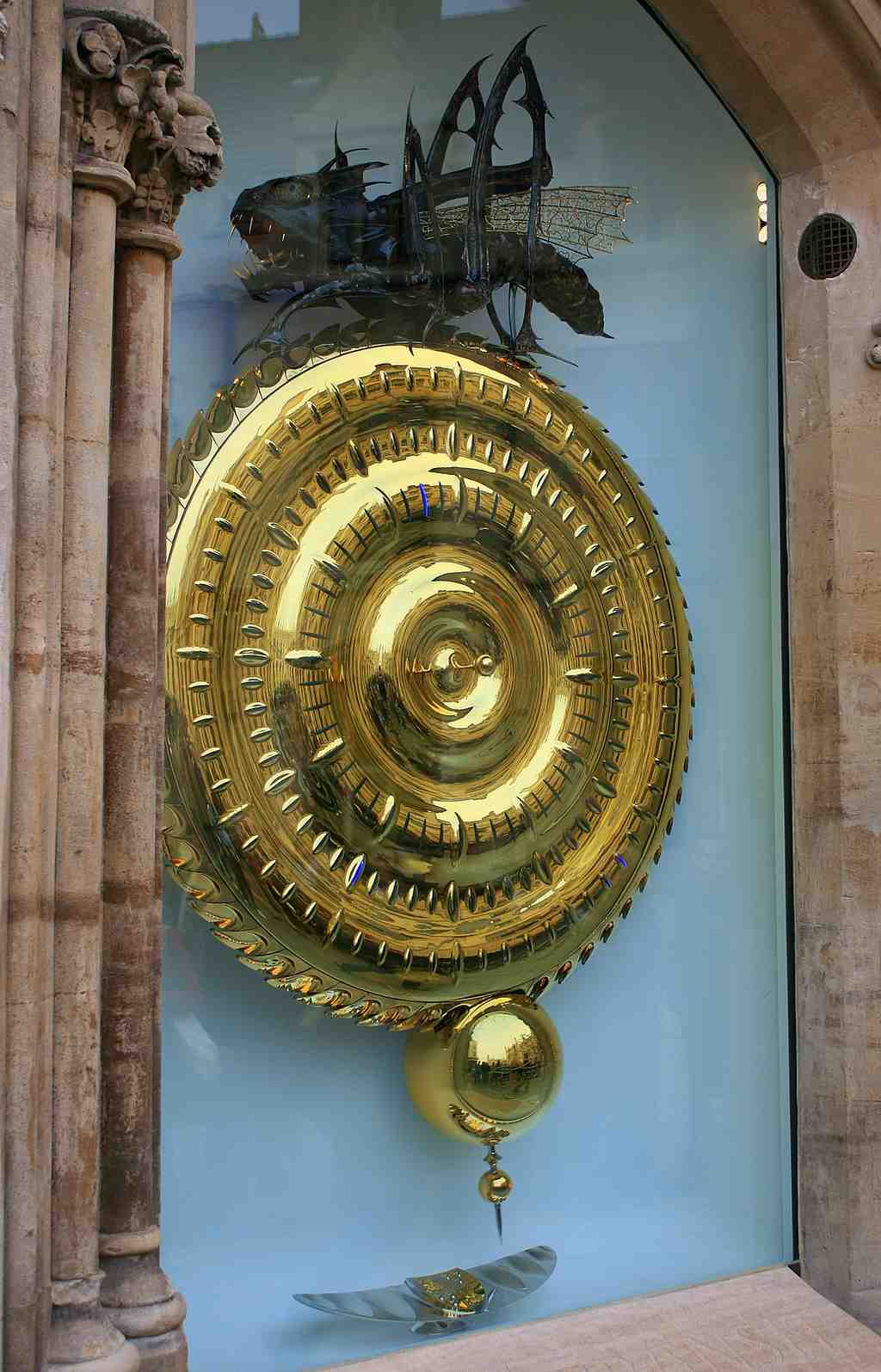
If you look ahead, you’ll see a glass window in the stone wall of the Taylor Library, right at the junction of Bene’t Street and Trumpington Street. Behind the glass, a huge disc catches your eye-it shimmers gold, shaped almost like a rippling coin, surrounded by rings of teeth-like ridges. The size of it is hard to miss, roughly as wide as a grown person is tall. Sitting on top of that gold circle, you’ll spot a fearsome, insect-like creature made of metal-spiked legs, a bulging body, sharp teeth-and behind it, wings like a grasshopper. If you’re close enough, you might even see a flicker of blue light darting around the rings, marking time. That’s the Corpus Clock. Stand here for a moment and let yourself take in its details; there’s nothing else like it in Cambridge.
The Corpus Clock is a modern marvel with an old soul. Funded by John C. Taylor-himself a former student-it was unveiled by Stephen Hawking in 2008. It didn’t take long for the world to notice; Time Magazine called it one of the year’s best inventions. The entire face of the clock is pure spectacle: 24-carat gold steel, no hands, no numbers-just those glowing blue slits, flickering to mark the hours, minutes, and seconds.
But that isn’t what draws most eyes. Looming over everything, the “Chronophage”-which literally means “time eater”-stalks above the dial. Taylor, the inventor, made this looming grasshopper both the soul and the engine of the clock. Its mouth clicks open and shut, savoring every second as it passes, its eyes occasionally blink-so quick that you might miss it unless you stare. Even the sound it makes, that grinding noise, hints at its true purpose: eating away at time.
Every hour, hidden from view, a chain drops with a harsh clank into a quiet, secret coffin. It’s a little unsettling-a reminder that time, once lost, never returns.
Look below the dial, and you’ll find a Latin phrase: “The world passeth away, and the lust thereof.” This clock doesn’t bother to comfort you. In fact, it’s only completely accurate once every five minutes. The rest of the time, the lights and pendulum rush or lag behind, showing life’s unpredictable pace.
All of this is deeply intentional. Taylor wanted the Chronophage to be dramatic and terrifying, a piece of art as much as a machine-a reminder that time waits for no one. If you watch long enough, you might feel it too: the subtle pressure of seconds slipping away, the strange, almost hypnotic beauty of gold and blue, the sense that beneath the glass, something alive is forever hungry for the minutes you have left.
The Corpus Clock is a handshake between the past and the present. Its grasshopper escapement-a clever bit of engineering invented in the 1700s-is turned inside-out, displayed for the world to see. And yet there’s something unsettling here, a mystery in every blink and every bite, a tension between its beautiful face and what it means to lose time.
So, as you stand in front of this extraordinary clock, let yourself wonder just how much time it’s consumed since you arrived. And remember-the Chronophage is always hungry for a little more.
Exploring the realm of the appearance, mechanics of the clock or the funding and realisation? Feel free to consult the chat section for additional information.




