
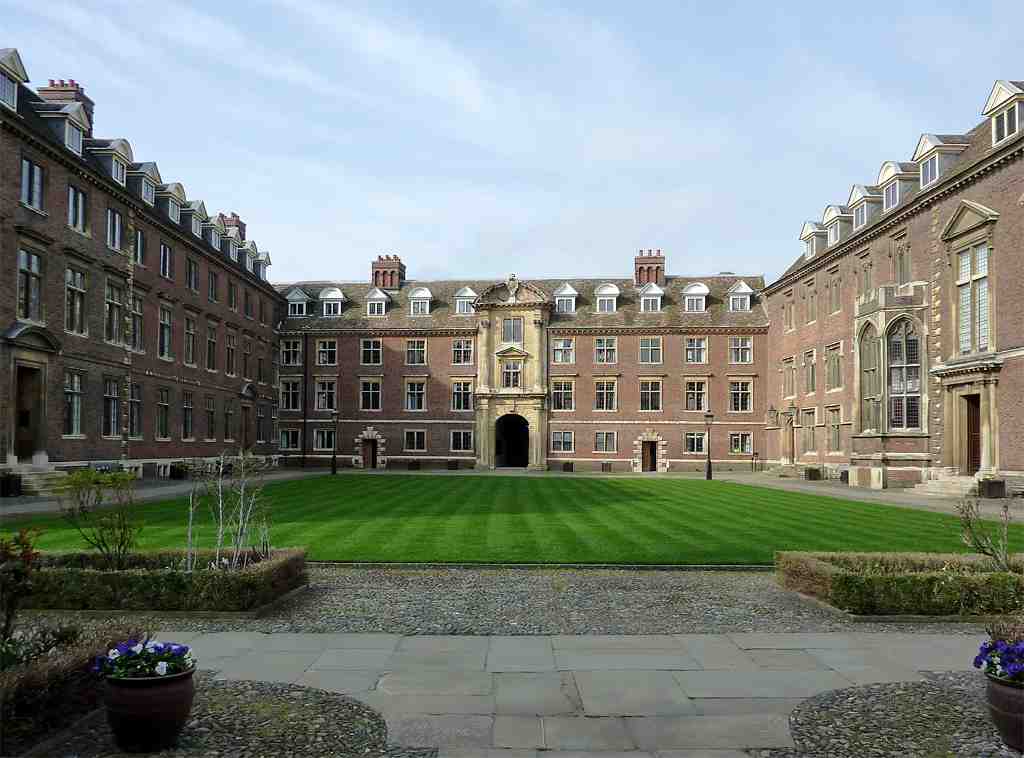
In front of you rises St Catharine’s College, its reddish brick halls forming a large open court that faces the street. To spot it, look ahead for a stately row of tall windows and sturdy wooden doors, with a green lawn stretching wide behind old-fashioned lamp posts. The building stands out with its traditional English appearance-straight lines, symmetrical windows, and neat stone edging, all lit under a clear sky.
The story of St Catharine’s College begins over five centuries ago. Imagine the street outside as muddy and busy with traders, when Robert Woodlark, determined but perhaps a bit anxious, sold part of his own fortune to build this college. In 1473, students here studied nothing but theology and philosophy-no undergraduates at first, only a handful of fellows scribbling notes by candlelight.
But times changed. By 1550, laughter of young scholars started to echo through these walls. Imagine tight-lipped seriousness turning slowly into a bustling hub of learning. In the 1600s, buildings began crumbling, so the college tore them down and built the elegant court you see before you. Not closed in like a secret, but open, welcoming the world to look in from Trumpington Street.
Sometimes history here is more than books and bricks. For a time, this college owned an old inn with a famous stable. The manager, Thomas Hobson, wouldn’t let anyone choose a horse except the one nearest the door. If you wanted a horse, it was “Hobson’s choice”-take it or leave it. You can almost hear the sound of hooves and laughter from the past, rolling over the cobbles.
The college nearly vanished in an odd twist of fate in the 19th century. This place was so small and thinly funded that serious talk began of merging it entirely with King’s College. For a moment, the future of St Catharine’s balanced on a single thread. But in the end, it survived-sometimes, just one vote made all the difference, as happened when the mastership was contested in 1861.
Today, St Catharine’s College stands strong, home to about a thousand people-fellows, students, staff-all led by a Master. The current Master, Sir John Benger, took up office recently, carrying forward a story that began on St Catherine’s Day in November 1473. If you look up, perhaps you can spot the Catharine wheel on the college arms, a quiet symbol of the saint’s story and endurance. Through centuries of change, this open court remains, a place full of stories-some serious, some mysterious, and some just a little bit strange.
For a more comprehensive understanding of the academics, student life or the notable alumni, engage with me in the chat section below.




