
Cambridge Audio Tour: From the Bridge of Sighs to the Mysteries of the Market
A conical roofed church that looks like a wizard’s hat. A riverside lock with echoes of midnight adventures. A legendary lido where locals dive into icy waters on a dare. Cambridge brims with secrets behind every stone and stream. This self-guided audio tour reveals the extraordinary stories and overlooked corners that escape most visitors. Trace paths once traveled by monks, swimmers, rebels, and riverfolk—all at your own pace. Which disaster toppled a beloved church tower and nearly bankrupted its saviors? What midnight mischief haunted the old lockkeeper’s house? Who filmed an unexpected cult movie beside ice-cold swimming lanes? Wander through nine centuries of drama, reinvention, and quirky tradition. Glide from medieval chapels to leafy lawns where history hides in plain sight, each turn unfolding untold tales and unexpected wonders. Ready to unlock the true character of Cambridge? Listen in—and let the city show its hidden face.
Tour preview
About this tour
- scheduleDuration 40–60 minsGo at your own pace
- straighten5.1 km walking routeFollow the guided path
- location_onLocationCambridge, United Kingdom
- wifi_offWorks offlineDownload once, use anywhere
- all_inclusiveLifetime accessReplay anytime, forever
- location_onStarts at Church of the Holy Sepulchre, Cambridge
Stops on this tour
To spot the Church of the Holy Sepulchre, head for the corner where Round Church Street meets Bridge Street. There it is: a stout little stone church that’s gloriously,…Read moreShow less
To spot the Church of the Holy Sepulchre, head for the corner where Round Church Street meets Bridge Street. There it is: a stout little stone church that’s gloriously, unapologetically round, topped with a cone roof that looks like it ought to come with a wand and a spellbook. This place began around 1130, when a group of monks called the Fraternity of the Holy Sepulchre decided Cambridge needed a chapel inspired by the famous round church in Jerusalem. Think of it as a medieval souvenir from the Holy Land-only heavier, and much harder to fit in your luggage. Back then, a Roman road called the Via Devana ran right in front of you, carrying travelers, traders, and the occasional hungry knight looking for his next meal. Originally it served those passersby, but by the 1200s it had graduated from chapel to full parish church, linked with Barnwell Priory, a local monastery. Look at the west door: it’s Norman architecture, meaning early medieval English design with chunky stonework. Notice the little columns and those zigzag carvings in the arch-like a stone mason got very excited with a chisel. Inside, eight big columns circle the central space to hold up the roof vault. Their capitals-the carved tops of the columns-don’t match, so if you like details, it’s a built-in spot-the-difference game. In the 1400s, the narrow Norman windows were replaced with larger Gothic ones, letting in far more light-and, yes, probably the odd curious pigeon. Around then, the wooden angels appeared up in the roof: some play instruments, others gaze down like solemn medieval music supervisors. The 1600s brought trouble during the English Civil War, when “idolatrous” images and statues were smashed. By the 1800s things were so bad that part of the church collapsed. Enter the Cambridge Camden Society and architect Anthony Salvin: he removed the too-heavy bell tower, restored a near-original roof, added new Norman-style windows, and even built a south aisle-an extra side section-to fit a growing congregation. The bill came to twenty times the estimate, proving that building projects have always had a sense of humor. In the 1900s a north vestry was added-a room where clergy vest and church items are kept-and later the Cambridge Union Society built its headquarters right over the old graveyard. During World War II, a bomb destroyed the east window, later replaced with an image of Christ in Majesty. Today the Round Church is one of only four medieval round churches in England, and it still has plenty to show off: an exhibition on Christianity’s role in English history and even an old-style scriptorium, a writing room where books were copied by hand. Nearly 900 years on, this little circle has welcomed more stories than a whole shelf of Cambridge textbooks-and in a round church, there are no corners for dust… or secrets.
Open dedicated page →Right in front of you is a long, narrow outdoor pool: bright blue water stretched out like a ribbon, tucked between trees and those practical concrete paths. To spot it, just look…Read moreShow less
Right in front of you is a long, narrow outdoor pool: bright blue water stretched out like a ribbon, tucked between trees and those practical concrete paths. To spot it, just look straight ahead past the paved area to the open-air lane that seems to go on forever. Welcome to the legendary Gesù Verde Piscina, which everyone happily calls the Jesus Green Swimming Pool. And I’ve got to ask: have you ever seen a pool built like a skinny runway? If it makes you feel a bit like a sardine in a tin, that’s kind of the point. When it opened in 1923, the builders wanted to recreate the feeling of swimming in the River Cam right beside you, but without the surprise of a mischievous duck or an overconfident river swimmer drifting into your path. Now, look at the numbers: it’s 100 yards long, about 91 metres. The width is just 14 metres. Honestly, it can feel easier to cross an ocean than to pick a straight line across this pool. And then there’s the real test: the water isn’t heated. It’s fully outdoors, no cozy boiler in sight. It opens from May through September for anyone brave enough to hop in. Outside those months, if you see someone taking a dip, you’re looking at a certified ice hero. The staff even post the water temperature daily on the official website, which is a polite way of saying, “Check before you squeal.” Set on the Cam’s bank between Jesus Lock and the Victoria Avenue bridge, it’s a hangout for swimmers and lawn-loungers alike. One side is paved for the grass-averse and flip-flop worriers; the other is pure green for stretching out and daydreaming. They’ve tried to close it more than once, but locals rallied to save it like a grumpy old friend you can’t help loving. In 1997, the showers and toilets were upgraded, though some folks still claim the plumbing left a few mysteries. And in 2004, an amateur filmmaker even made a movie about this very pool, shown at the Cambridge Film Festival. Here, you don’t just swim laps-you swim through stories.
Open dedicated page →

Show 10 more stopsShow fewer stopsexpand_moreexpand_less
Right in front of you is Cambridge’s own Bridge of Sighs: a covered stone bridge with pointed Gothic arches and those delicate lattice windows (that’s the crisscross stonework…Read moreShow less
Right in front of you is Cambridge’s own Bridge of Sighs: a covered stone bridge with pointed Gothic arches and those delicate lattice windows (that’s the crisscross stonework that looks a bit like a net). It links university buildings over the River Cam-look toward the stretch where the water slides quietly between two grand old college blocks. Now, here’s the tale. Back in 1831, with builders thumping away and stonemasons shaping blocks by hand, this bridge was finished at St John’s College. Henry Hutchinson designed it to connect the Old Court and the New Court, saving scholars a long detour. Almost immediately, people started calling it the “Bridge of Sighs,” after the famous one in Venice. Truth be told, they mainly share a roof and a reputation for romance-Cambridge doesn’t really do exact copies. Local legend says Queen Victoria often passed by and named this her favorite little corner of Cambridge. Picture her carriage rolling along, the Gothic windows catching the light, and the faint idea of royal footsteps echoing in your imagination. Did she sigh for love? For beauty? Or because someone made her sit through another earnest university speech? We’ll never know. But Cambridge being Cambridge, it’s also a stage for legendary student mischief. One night in the 1960s, students used boats to haul a small Austin 7 under the bridge and hang it up with ropes. No damage-just a story that still gets laughs. A few years later they tried again with a Reliant Regal. Same result: bridge unbothered, students delighted. It’s had its film-star moments too: scenes from Elizabeth: The Golden Age and The Theory of Everything were shot here, and even Pink Floyd used it for a music video. So as you look up, imagine the sighs, the jokes, the cameras-and the occasional misplaced car. In Cambridge, boredom rarely gets a degree.
Open dedicated page →Right in front of you is a broad sweep of rolling green running along the banks of the River Cam. Big old trees, neatly kept lawns, and-over on the left-cows taking their job as…Read moreShow less
Right in front of you is a broad sweep of rolling green running along the banks of the River Cam. Big old trees, neatly kept lawns, and-over on the left-cows taking their job as professional grazers very seriously. To get your bearings, just look across the water: historic bridges and those polished college façades line up like a postcard that Cambridge somehow manages to look like every single day. Welcome to the Backs-Cambridge-speak for “the back” of the colleges. Which is hilarious, because this “back” is absolutely the show-off side. Picture it a few centuries ago: no cars, no city roar, just the quiet glide of the Cam… and maybe a cow offering a thoughtful moo in protest at yet another Latin lesson. This green corridor is the university’s outdoor catwalk. Seven colleges open their gardens and courts right here, letting their historic buildings drift down to the water’s edge. You’ll spot St John’s with its graceful bridges, Trinity with its turrets, plus Clare, King’s, and Queens’-each with its own look, and those tempting bridges that practically dare you to cross and wander straight into another era. Back in the 16th century, though, it was much more practical: plain pasture for sheep and cattle, a few orchards, and not much like today’s immaculate lawns-except for the color green… and the occasional animal cameo. In fact, the lawn behind King’s College still has placid cows on it, to the delight of tourists, students, and, yes, probably someone studying cows. In Cambridge, anything can become a subject. Over time, the colleges decided the river crowd deserved a good view, so they planted tree-lined avenues, built prettier and prettier stone bridges, and landscaped these grounds like open-air drawing rooms. But there was drama: in the 1700s, the famous landscape designer “Capability” Brown wanted to remake the whole area into a grand English park-removing some historic bridges to spotlight King’s College. Thankfully someone said, “Absolutely not,” or you might be staring at a huge lake instead of the Cam. By 2013, the Backs were named among the ten most beautiful views in all England, according to the president of the National Trust. And there’s a little mystery too: in the 1970s, many elm trees died from a serious disease, and the college gardeners banded together-like leafy knights-forming the Backs Committee to cut infected trees, replant, and debate what species should thrive for centuries. The committee later dissolved, but the Backs endured. Today there’s a plan to make it even greener, with more trees, hedges, and wildlife corridors-so even a fox or an owl can feel like it belongs at the university. Take a good look around. If you hear a whisper in the branches, don’t panic. It’s probably just a retired professor trying out life as a squirrel. If you want details on the name, past and future development, or the gallery, the in-app chat is the perfect place to ask.
Open dedicated page →Ahead of you is a broad courtyard with a remarkably round lawn at its heart, framed by those classic Cambridge honey-colored buildings. Look for the white-trimmed windows, the…Read moreShow less
Ahead of you is a broad courtyard with a remarkably round lawn at its heart, framed by those classic Cambridge honey-colored buildings. Look for the white-trimmed windows, the flowers perched on sills, and the little clock turret keeping watch like a polite but judgmental chaperone. If you’re facing the green and spot the ivy-clad frontage on your right, congratulations: you’ve found Christ’s College. This place has serious pedigree. It all began in 1437, when William Byngham founded a college with a wonderfully blunt name: God’s House. His plan was forward-thinking for the time: train teachers for grammar schools, which were scarce enough in England that you’d brag about finding one. But Cambridge history loves a plot twist. After only a few years, the original site was sold off to King’s College, and the young institution had to relocate and reinvent itself. The big makeover came in 1505, thanks to the formidable Lady Margaret Beaufort, mother of Henry VII, whose generosity turned God’s House into Christ’s College. The name, apparently, was suggested by a bishop who also happened to be Lady Margaret’s personal confessor. Nothing like a spiritual advisor with branding instincts. As you stroll around this round court, picture the generations who’ve paced these stones before you. Two headline alumni: John Milton, author of Paradise Lost, and Charles Darwin, the father of evolutionary theory. Toss in a healthy number of Nobel Prize winners, and you may feel tempted to inhale deeply-purely for the academic benefits, of course. The oldest ranges, built between the 1400s and 1500s, wrap around the court: the Great Gate, the Master’s Lodge (that’s the head of the college’s official residence), and the Chapel. The lawn is almost perfectly circular-almost-because students still occasionally attempt the timeless scientific experiment of punting a football from one end to the other. Also, take a look at the main entrance: the gate looks oddly “cut off” at the bottom because the street level has risen over the centuries, leaving the doorway with steps that now go down rather than up. On the right is the grand dining hall, restored in the 19th century by architect George Gilbert Scott. People still argue in there about philosophy, mathematics, and-inevitably-what’s for dinner. And here’s a quirky local rule: unlike in some colleges, students don’t stand up every time a fellow (that is, a senior academic member of the college) enters or leaves. Supposedly it’s a hard-won tradition dating back to a long-running dispute around the time of the English Civil War. Even Cambridge has its rebellions. Don’t miss the wisteria curling around the Master’s Lodge. In Second Court you’ll find the Fellows’ Building, put up in the 1640s. Through an arch lies the Fellows’ Garden, home to two mulberry trees-one planted in 1608, the year Milton was born. They’ve survived fierce storms, and though they now lean more than they stand, they still produce fruit every year. Tougher than a PhD thesis. And Christ’s best secret? A swimming pool. Yes, really: one of the very few historic university pools in England, fed by Hobson’s Conduit, and probably the oldest outdoor pool in the UK, dating to the 17th century. Christ’s is big on tradition: the Marguerites Club for top athletes, the oldest Boat Club in Cambridge, choirs, drama, and Shakespearean flair during the themed May Balls. Every two years the courts transform into a dreamscape-1920s Paris, Brazilian carnivals, even the Emerald City or A Midsummer Night’s Dream. So take a look around. You’re standing on centuries of stories, mysteries, and just a dash of brilliant madness. My advice? Don’t try to out-Darwin Darwin. Just enjoy the roundest-and maybe the cleverest-courtyard in Cambridge. If you want more details on the buildings, academics, or student life, open the chat section below and ask away.
Open dedicated page →Look toward the river and you’ll spot a graceful wooden arch bridge made from crisscrossed straight planks, linking two historic buildings of Queens’ College on the Cam. Welcome…Read moreShow less
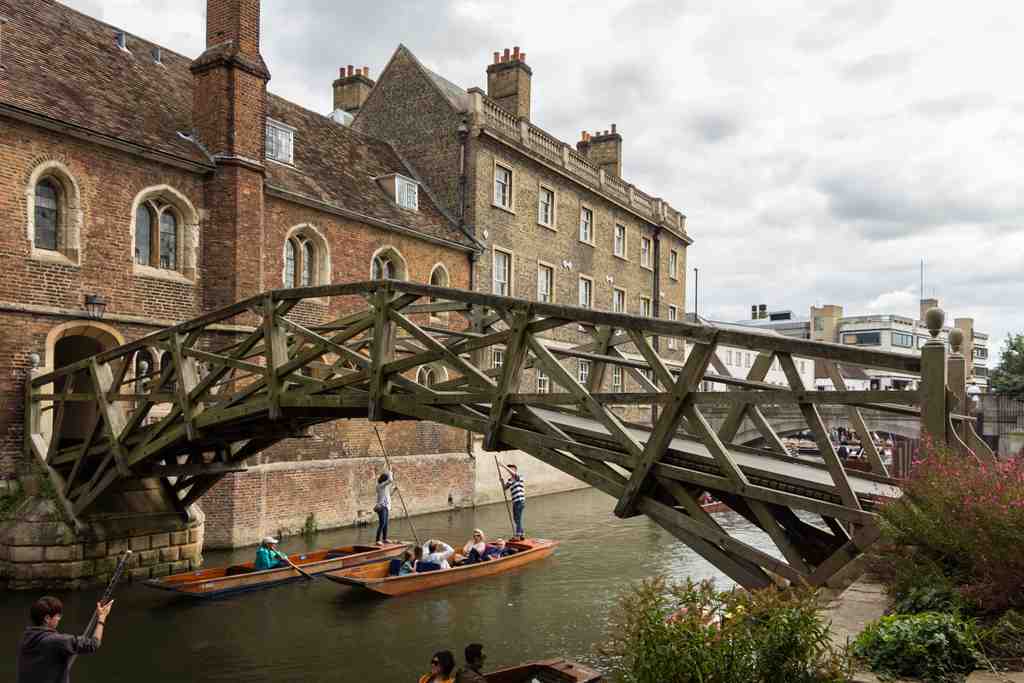
Look toward the river and you’ll spot a graceful wooden arch bridge made from crisscrossed straight planks, linking two historic buildings of Queens’ College on the Cam. Welcome to our thirteenth and final stop: the famous Mathematical Bridge. And yes, I can hear your brain gearing up: “Mathematical? Where’s the giant calculator?” The trick is the engineering. Even though it curves like a wooden smile, it’s built entirely from straight timbers. It’s the sort of thing that makes you suspect a magician is hiding under the deck, or a math professor is pulling a prank. Picture Cambridge in 1749: rattling carriages, serious scholars, and the challenge of connecting the two sides of Queens’. The design came from William Etheridge, and it was built by James Essex, a craftsman celebrated for his skill with wood. Listen for a moment: water sliding beneath the bridge, and the chatter of people punting along the Cam. For centuries, students and visitors have crossed here wondering how straight pieces can form such a perfect arc. The secret is in the joinery, meaning the way the pieces lock together. The planks follow tangent and radial lines: in plain English, they’re set along directions that “hug” the curve and point toward its center, spreading the load so no single beam has to bend too much. Now, the legends. One tale claims Isaac Newton invented it using no bolts, and that curious students later took it apart and couldn’t rebuild it without adding bolts. Fun story… except Newton had already died before the bridge was built. And those bolts? They were there all along, cleverly hidden. It’s so iconic Oxford even made a copy in 1923. Not bad for a bridge that turns mathematics into a little bit of poetry over the Cam. Thanks for walking with me, explorer. If you ever need a bridge joke, you know who to call.
Open dedicated page →


Frequently asked questions
How do I start the tour?
After purchase, download the AudaTours app and enter your redemption code. The tour will be ready to start immediately - just tap play and follow the GPS-guided route.
Do I need internet during the tour?
No! Download the tour before you start and enjoy it fully offline. Only the chat feature requires internet. We recommend downloading on WiFi to save mobile data.
Is this a guided group tour?
No - this is a self-guided audio tour. You explore independently at your own pace, with audio narration playing through your phone. No tour guide, no group, no schedule.
How long does the tour take?
Most tours take 60–90 minutes to complete, but you control the pace entirely. Pause, skip stops, or take breaks whenever you want.
What if I can't finish the tour today?
No problem! Tours have lifetime access. Pause and resume whenever you like - tomorrow, next week, or next year. Your progress is saved.
What languages are available?
All tours are available in 50+ languages. Select your preferred language when redeeming your code. Note: language cannot be changed after tour generation.
Where do I access the tour after purchase?
Download the free AudaTours app from the App Store or Google Play. Enter your redemption code (sent via email) and the tour will appear in your library, ready to download and start.
If you don't enjoy the tour, we'll refund your purchase. Contact us at [email protected]
Checkout securely with 


