
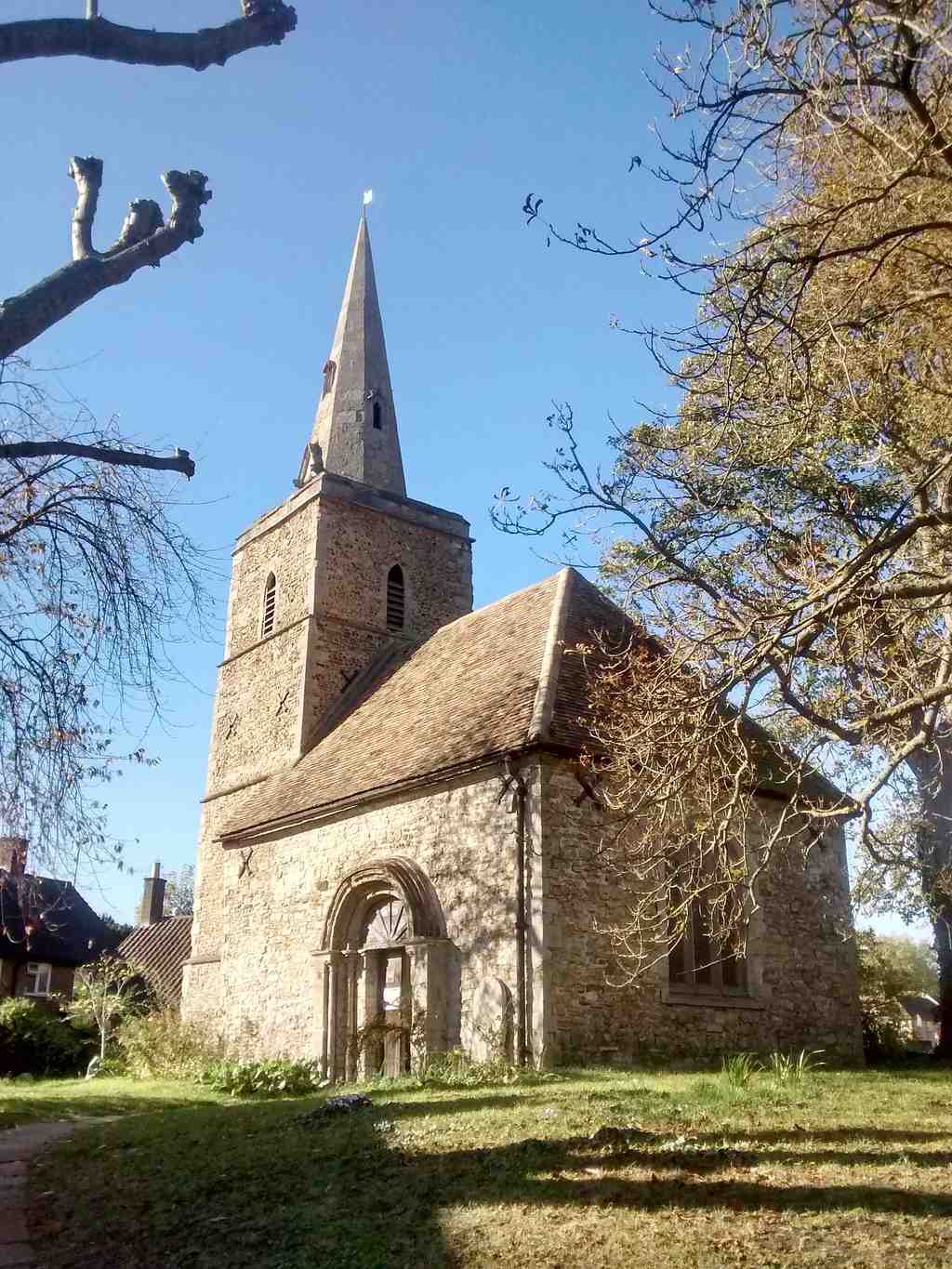
You’re looking for a small, ancient stone church with a tall, pointed spire topped by a weather vane, nestled among trees-just ahead on your right you’ll spot it rising above the grass, its rough stone walls shining softly in the daylight.
Now, step a little closer and imagine: you’re standing in front of St Peter’s Church, a time traveler’s pit stop in Cambridge! This little church, “St Peter by the Castle,” has hung around since the twelfth century-or maybe even longer, if you believe the whispers about Anglo-Saxon roots. With its chunky stone walls and a tower capped by an octagonal spire (that’s right, eight sides-count if you like!), St Peter’s has stood as a guardian between eras, just across the old Roman road from mighty St Giles’.
Once, this church was the heart of a bustling parish, with a nave, aisle, tower, and probably its fair share of medieval gossip. Even Queen Elizabeth I herself got involved, handing the church over to the See of Ely! But in 1650, the town commissioners took one look and declared, “There’s neither parsonage nor vicarage here!”-no priest’s house, nothing. So, it merged into St Giles’ parish, making this perhaps one of the earliest examples of “closing accounts” in Cambridge.
Look closely at the entrance-a worn but wonderful south doorway from the thirteenth century still greets visitors, and inside is a curious font from the twelfth, decorated with mermen! Yes, mermen: medieval proof that merfolk made a splash even in church decor.
Through the centuries, St Peter’s dodged ruin by the skin of its stone teeth. By 1900, it was teetering on dereliction, but the 1930s saw it patched up with fresh stone, a little like Cinderella’s glass slipper-if Cinderella had been a Norman church. And atop it all, the weather vane is cheekily marked “AP”-initials said to flip between ‘A Papist’, ‘A Protestant’, or ‘A Puritan’-just whichever way the wind blows, really!
Now, St Peter’s opens its doors for art, linking the ancient stones with modern creativity, in collaboration with the nearby Kettle’s Yard. So next time you hear the wind whistle here, imagine it carrying stories from twelve centuries of Cambridge life, secrets, and probably a medieval joke or two.


