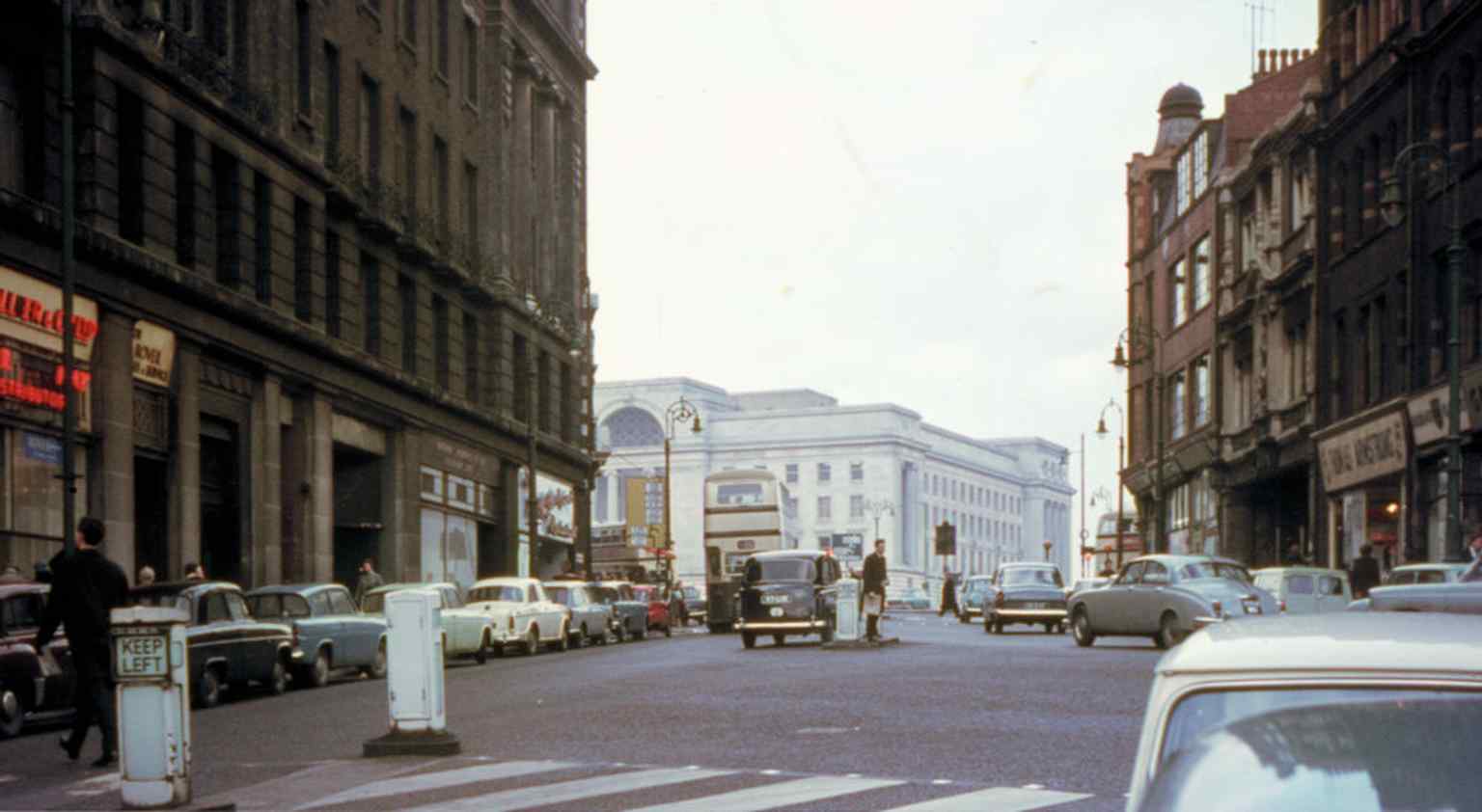
On your left is a broad pale-stone building with a rounded corner, a formal classical front, and two set-back steel-and-glass top floors, finished with Birmingham’s coat of arms.
Baskerville House looks settled now, but this ground has never stayed still for long. Before the offices, before Centenary Square, this was part of Easy Hill, where John Baskerville lived. He was Birmingham’s great printer and type designer, and in a final act of stubborn independence he refused burial in a churchyard, so his family buried him in his own garden nearby.
Then the city started digging.
When canal construction came through, Baskerville’s body was exhumed and, rather disturbingly, found to be in good condition. Curious locals treated that less like a solemn moment and more like an attraction. His remains were reportedly displayed in a cellar, later shown again at Marston’s warehouse, and only after magistrates stepped in did he finally get reburied at Christ Church. Birmingham’s archive still keeps a drawing of his remains and even part of his shroud, which says a lot about how thoroughly his grave entered local folklore. The man became civic folklore by refusing to stay neatly buried.
The land itself followed the same pattern. Industry took over. The Birmingham Aluminium Company cut in Baskerville Basin nearby, and Gibson’s Basin served the rolling mills. Then the council bought the area for a grand new civic centre and filled the basins in. In the nineteen twenties, Birmingham held a design competition, but many entries were judged, rather wonderfully, “too ambitious.” So the city asked T. Cecil Howitt to design this building instead. Construction began in nineteen thirty-eight.
And then war stopped everything.
Baskerville House ended up as the only real piece of a much larger civic dream. The rear brick wall was supposed to be temporary, just a practical wartime expedient, and after the war the heavy Roman imperial style no longer felt quite right for public buildings. If you want, take a quick look at the old civic-centre model in the app; it shows how much more Birmingham once meant to build here.
Later, even this survivor nearly lost its purpose. The council moved out in nineteen ninety-eight. One idea turned it into a hotel. Another tried to make it the Central Library, but the verdict was brutal and fairly funny: the structure was not strong enough for all the books. In the two thousands, developers gutted it, added the extra steel-and-glass floors you can see now, and gave the old civic shell a second life. The comparison image is worth a glance here.
So here’s the question this place leaves hanging: when a city keeps rebuilding over graves, canals, offices, and abandoned plans, is the real Birmingham the newest surface... or the older layers still pressing upward underneath?
Maybe the truest map of this city is not just what stands in front of you, but what has been moved, buried, renamed, and somehow saved.