
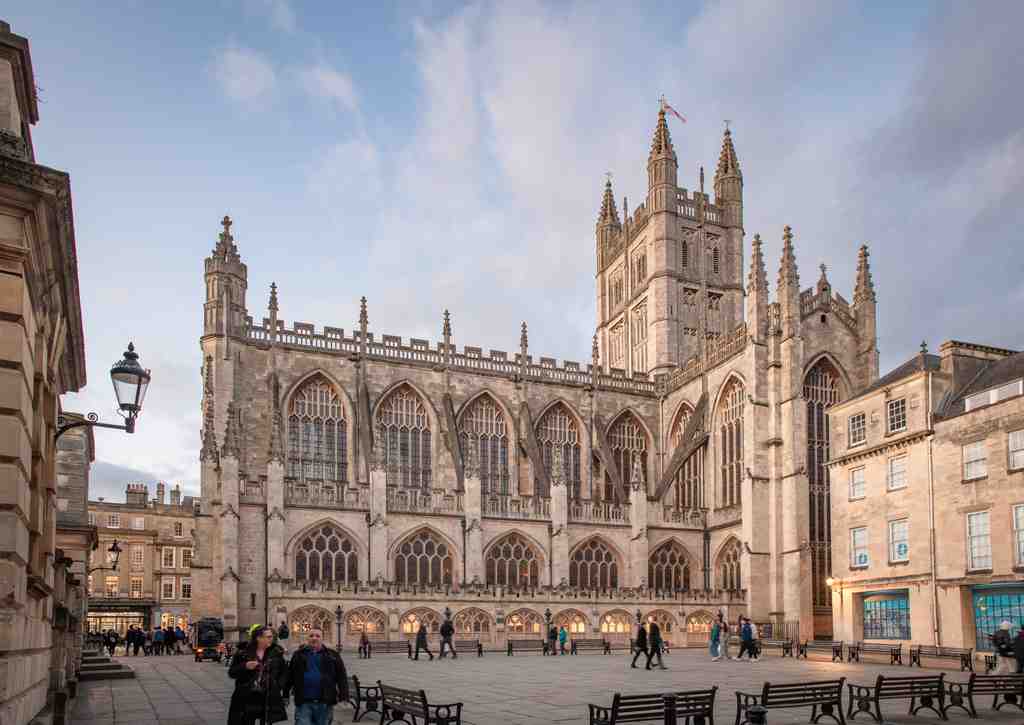
As you walk closer, you’ll see Bath Abbey rising ahead of you like a giant, creamy stone birthday cake with towers instead of candles. Look up! The building is hard to miss: intricate pointed windows, soaring walls streaked by centuries of weather, and a west front with two long rows of stone angels clambering up ladders to the sky. If you see heads craning upward and cameras snapping, you’re definitely there.
Take a moment and imagine standing in front of this grand church as the bells ring out over the city. The Abbey’s walls hold more tales than most gossip columns. Founded way, way back in the 7th century, this spot started as a humble convent and kept transforming-rebuilt, restored, and rescued by many hands, including the famous architect Sir George Gilbert Scott. He spruced things up in the 1860s, but let’s be honest, it’s been getting makeovers longer than any celebrity.
Over the years, Bath Abbey has seen almost everything-crowns placed on kings, choirs singing their hearts out, even royal rivalries. Legend says King Edgar was crowned “King of the English” right inside, back in 973. Picture it: the smell of incense, flickering candlelight, and velvet robes swishing as the monks chanted. Not exactly your average Sunday service!
The inside is just as jaw-dropping, famous for its “fan vaulting”-ceilings that look like huge stone fans, all delicately carved. It has enough seats for 1,200 people, though I doubt all the former monks would have found anywhere to stash their sandals.
Keep an eye out for memorials and stained glass dedicated to Bath’s people, as well as the striking Jacob’s Ladder sculptures outside, where stone angels climb steadily upward (I say “climb”-some look like they’re struggling with a leg cramp).
But it hasn’t all been heavenly harmony. The Abbey has seen some serious drama: Vikings raiding, kings squabbling over power, even monks fleeing from reforms in France. When the Dissolution of the Monasteries hit in the 1500s, the Abbey’s doors nearly closed forever-but Bath rallied, and the Abbey survived.
Today, Bath Abbey isn’t just a landmark-it’s alive with music, civic ceremonies, and echoes of centuries past. If you listen closely, maybe you’ll catch whispers of the past in the air, or is that just the organ warming up for its next big moment? Either way, you’re at the heart of Bath’s story.
For a more comprehensive understanding of the architecture, choir or the discovery centre museum, engage with me in the chat section below.




