
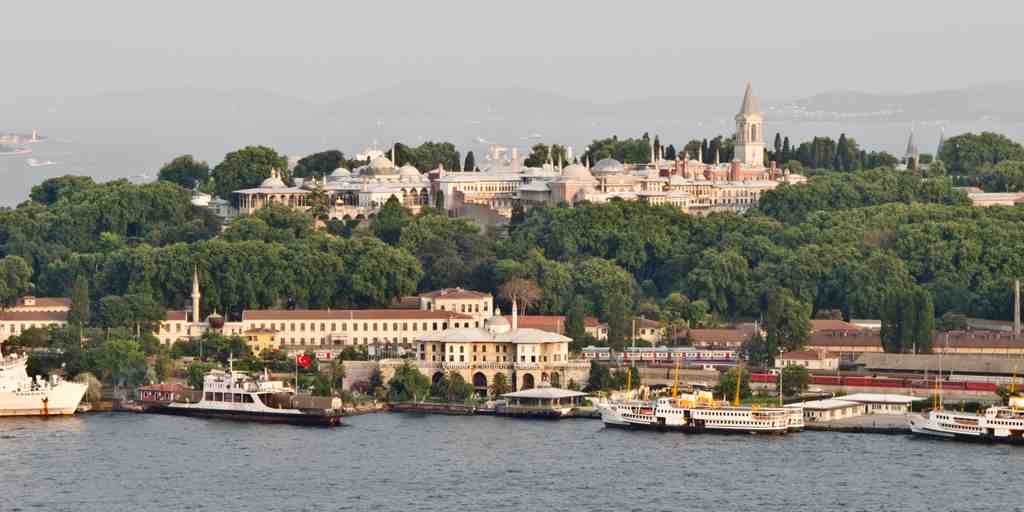
The Topkapı Palace, also known as the Seraglio, is a significant historical site located in Istanbul, Turkey. It served as the administrative center of the Ottoman Empire from the 1460s until the completion of Dolmabahçe Palace in 1856, and was the primary residence of the sultans during that time.
Construction of the palace was commissioned by Sultan Mehmed the Conqueror in 1459, just six years after the conquest of Constantinople. Originally called the "New Palace," it was intended to differentiate it from the Old Palace in Beyazıt Square. It acquired the name "Topkapı," meaning Cannon Gate, in the 19th century. Over the centuries, the complex has undergone significant expansion and renovation, including reconstruction after the 1509 earthquake and the 1665 fire. Today, it encompasses four main courtyards and numerous smaller buildings.
Within the palace, the harem housed female members of the Sultan's family, while the Imperial Council building served as a meeting place for important state officials, including the Grand Vizier. However, following the 17th century, Topkapı gradually lost its significance as the sultans preferred to spend more time in their newly constructed palaces along the Bosphorus. Eventually, in 1856, Sultan Abdulmejid I decided to relocate the court to the newly built Dolmabahçe Palace. Nevertheless, Topkapı continued to fulfill certain functions, such as housing the imperial treasury, library, and mint.
After the dissolution of the Ottoman Empire in 1923, Topkapı Palace was transformed into a museum through a government decree dated April 3, 1924. Presently, the Topkapı Palace Museum is under the administration of Turkey's Ministry of Culture and Tourism. While the palace complex boasts hundreds of rooms and chambers, only the most important ones are open to the public as of the year 2020. These include the Ottoman Imperial Harem and the treasury, known as the hazine, where visitors can view notable artifacts like the Spoonmaker's Diamond and the Topkapi Dagger. Additionally, the museum collection features a variety of Ottoman clothing, weapons, and other historical objects.


