
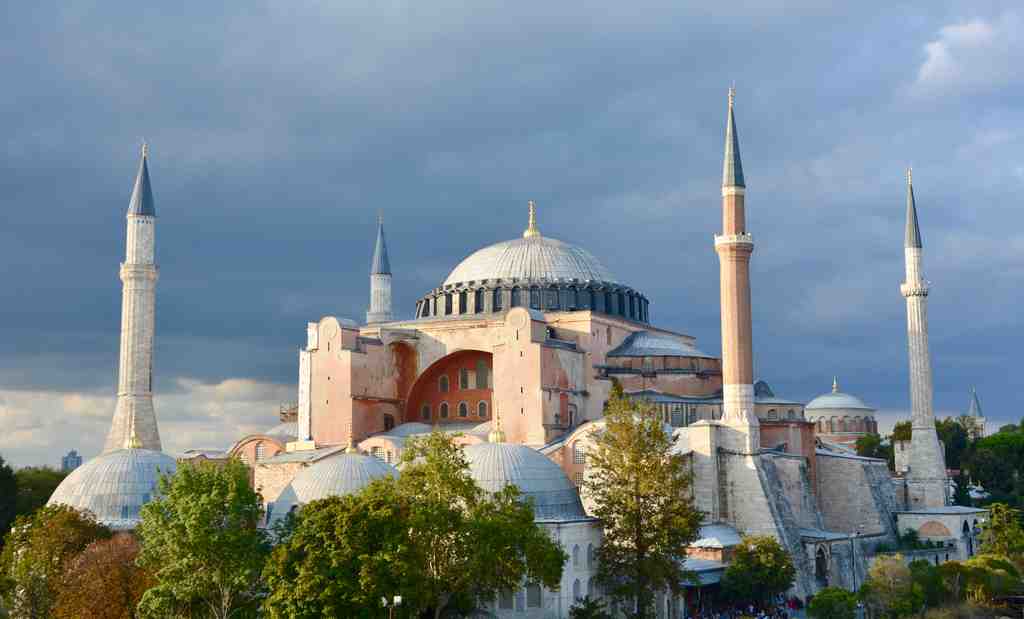
Hagia Sophia, also known as the Holy Wisdom in Greek and Ayasofya in Turkish, is a significant cultural and historical site located in Istanbul, Turkey. Originally built during the Byzantine Empire, it is the last of three church buildings constructed on the same site. Completed in 537 AD, Hagia Sophia served as an Orthodox church until the Ottoman conquest of Constantinople in 1453. Following that, it was converted into a mosque until 1935, when it became a museum. However, in 2020, it was once again turned into a mosque.
The current structure of Hagia Sophia was commissioned by the Byzantine emperor Justinian I and designed by the Greek geometers Isidore of Miletus and Anthemius of Tralles. It was initially known as the Church of the Holy Wisdom and is acclaimed for its architectural achievements. Notably, it was the world's largest interior space at the time of its completion and was among the first structures to employ a fully pendentive dome. Its construction marked a pivotal moment in architectural history.
Hagia Sophia holds great importance in Byzantine architecture and is credited with revolutionizing the field. It is said to have made a lasting impact and "changed the history of architecture." This current building represents the third church with the same name on the site, as the previous one was destroyed during the Nika riots. As the seat of the ecumenical patriarch of Constantinople, it held the title of the world's largest cathedral for nearly a thousand years, until the completion of Seville Cathedral in 1520.
The architectural style and layout of Hagia Sophia became a model for subsequent Byzantine structures, while its influence extended even further. Ottoman mosques, built a thousand years later, drew inspiration from its design. This unique position in both the Christian world and architectural history has cemented Hagia Sophia as an iconic symbol of Byzantine and Eastern Orthodox civilization.


