
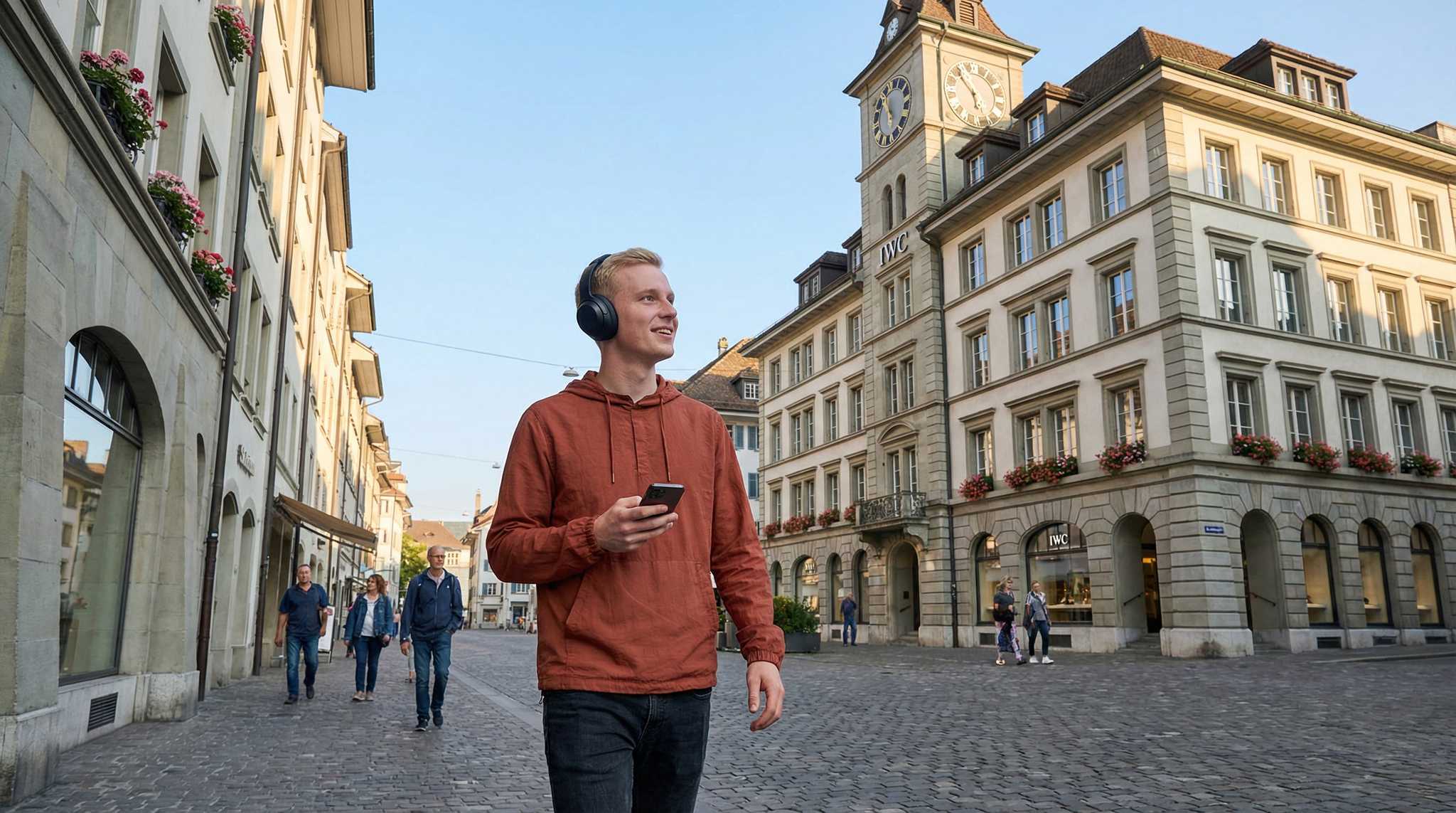
Schaffhausen Audio Tour: Echoes and Enigmas of the Altstadt Maze
A city where medieval clocks once decided fates and monastic stone walls whisper secrets no guidebook reveals. Schaffhausen is more than painted facades and cobbled lanes—it hides rivalries, inventions, unlikely heroes, and shadows that changed its course. With this self-guided audio tour, unlock hidden stories beneath Altstadt’s spires and squares. Each stop peels back layers of intrigue that most visitors rush past. Why did a brutal football match at FC Schaffhausen erupt into a citywide scandal? What haunting secret echo still lingers inside the Monastery of All Saints? Who vanished after designing the world’s rarest watch at the International Watch Company? Trace footsteps through silent cloisters and bustling terraces. Feel the thunder of ancient uprisings, ticker the pulse of lost craftsmanship, and witness how one city shaped destinies in whispers and uproar. Are you ready to let Schaffhausen reveal its hidden face? Begin your journey now.
Tour preview
About this tour
- scheduleDuration 40–60 minsGo at your own pace
- straighten2.6 km walking routeFollow the guided path
- location_onLocationSchaffhausen, Switzerland
- wifi_offWorks offlineDownload once, use anywhere
- all_inclusiveLifetime accessReplay anytime, forever
- location_onStarts at Schaffhauser Kantonalbank
Stops on this tour
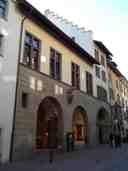
Look for the pale stone facade with its broad rectangular front, orderly rows of tall windows, and the bank’s name fixed above the entrance. At first glance, this building seems…Read moreShow less
Open dedicated page →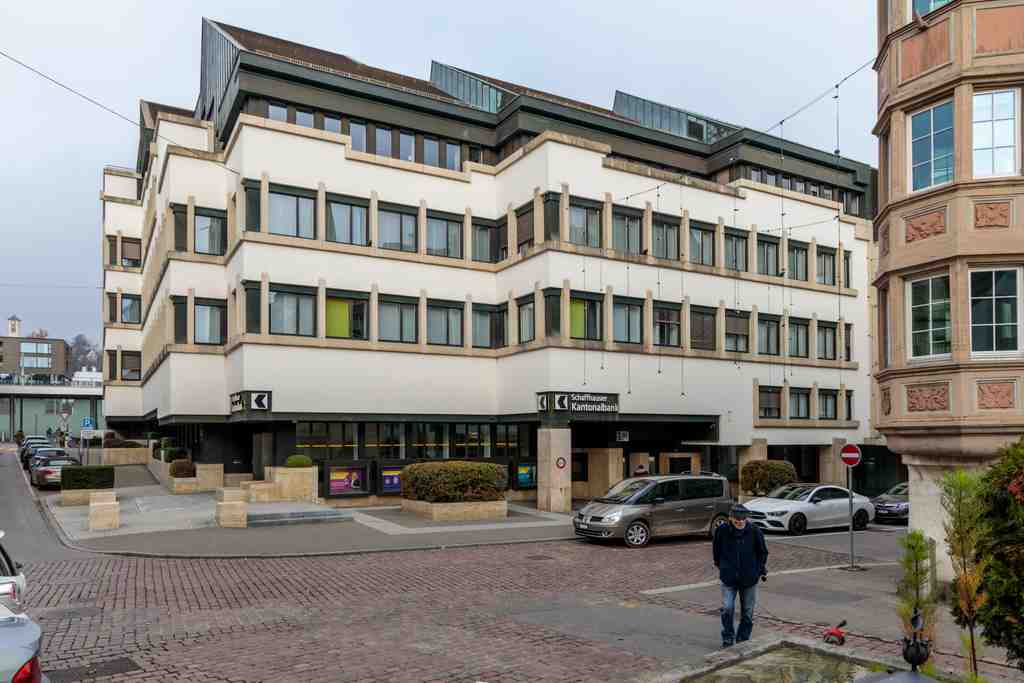
Schaffhauser KantonalbankPhoto: -wuppertaler, Wikimedia Commons, CC BY 4.0. Cropped & resized. Look for the pale stone facade with its broad rectangular front, orderly rows of tall windows, and the bank’s name fixed above the entrance.
At first glance, this building seems to promise the oldest civic virtue of all: solidity. Old towns like to dress authority in towers, gates, and church walls... but power changes outfits. Here in Schaffhausen, it also wears a banker’s suit. Instead of relics or banners, it deals in confidence, risk, and the polite suggestion that your money will still be here tomorrow.
The Schaffhauser Kantonalbank began in eighteen eighty-three as the cantonal bank of Schaffhausen. It still belongs entirely to the canton, which means this is not just a business but a public institution. It even carries a state guarantee, meaning the canton stands behind its liabilities if the bank’s own funds ever fall short. Reassuring, in the way a safety net is reassuring... especially when you remember it usually appears because somebody might fall.
Over time, this bank became one of the region’s engines. For its one hundred twenty-fifth anniversary in two thousand eight, it created a jubilee fund that still supports non-commercial projects tied closely to Schaffhausen: social work, culture, sport, business, and sustainability. A birthday present to itself turned into a permanent funding tool for the canton. In two thousand twelve, Swiss Radio and Television, S-R-F, described the bank as growing strongly: more than two hundred new business clients, one thousand new private clients, and a core capital ratio of almost twenty-four percent, one of the strongest in the sector. That success flowed outward too; the canton received more than twenty-five million Swiss francs. A few years later, in two thousand sixteen and two thousand seventeen, the bank recorded the second-highest profit in its history, pushed its balance sheet past seven billion Swiss francs, and paid out twenty-six point nine million to the canton.
If you glance at the image in the app, you can see the headquarters as a familiar old-town address and also a work in progress, because the main seat itself is being renewed rather than merely preserved. That feels fitting. Institutions like this survive by looking permanent while constantly rewriting themselves.
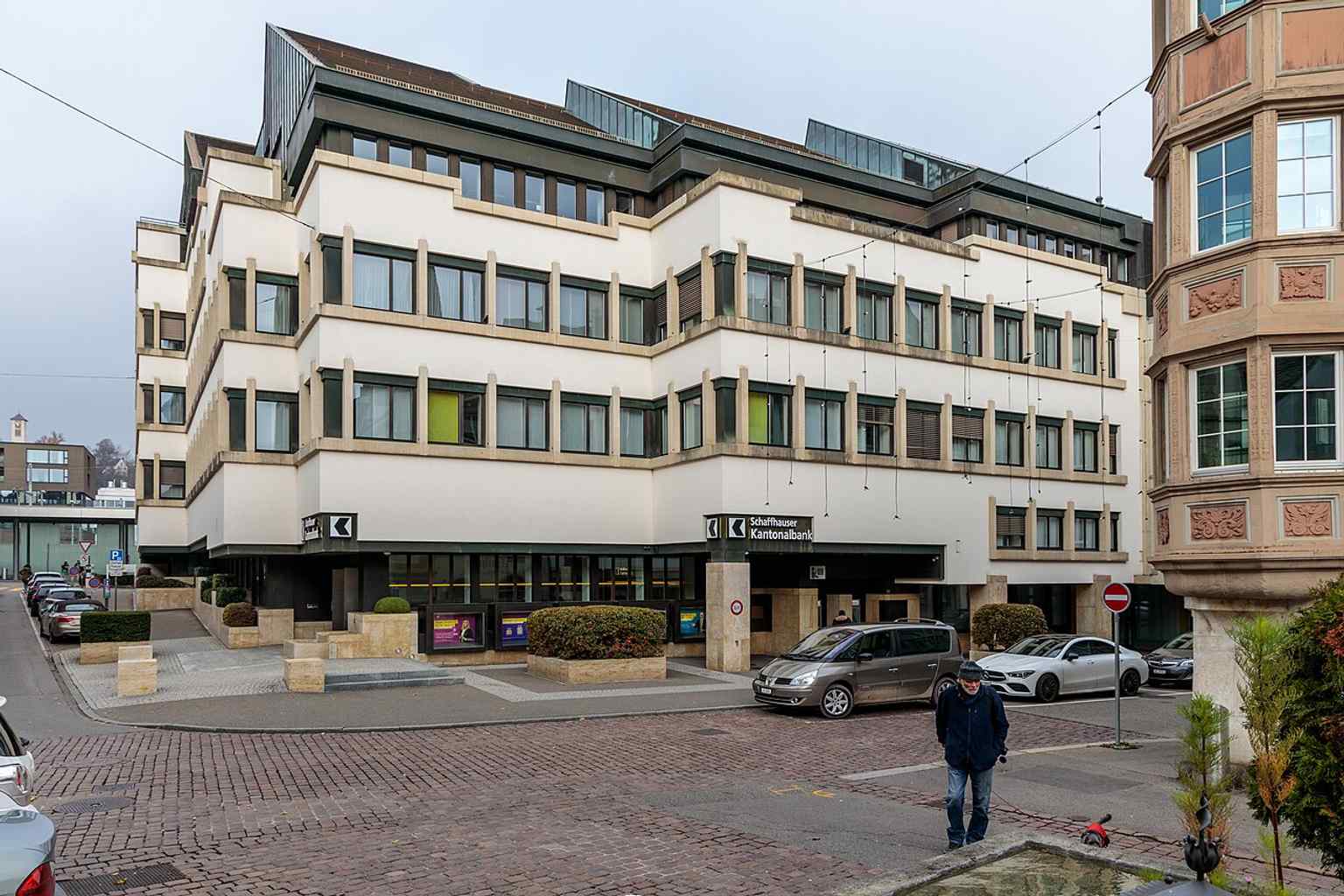
The main headquarters at Vordergasse 53 in Schaffhausen, the bank’s historic base in the old town and the focus of its ongoing building renewal.Photo: JoachimKohler-HB, Wikimedia Commons, CC BY-SA 4.0. Cropped & resized. And yet permanence attracts scrutiny. In two thousand fifteen, the bank settled with the U-S Justice Department during the Swiss Bank Program, after getting pulled into the hunt for undeclared U-S accounts. In two thousand eighteen, a local investigation accused the bank of not systematically preserving its own board and management records, and raised the unresolved question of how wartime decisions involving assets of Jewish Holocaust victims had been handled. Even a regional bank can discover that local respectability does not stop at the border.
So when an institution calls itself stable, what are you really trusting: the stone facade, the balance sheet, or the story it tells about itself?
Schaffhausen asked that question long before banks existed here. Before balance sheets, legitimacy came through religious houses, vows, and sacred endowments... and our next stop, about four minutes away, is the Monastery of Saint Agnesen. If you return for banking rather than philosophy, the counters keep weekday hours, stay open a bit later on Thursday, and close on weekends.
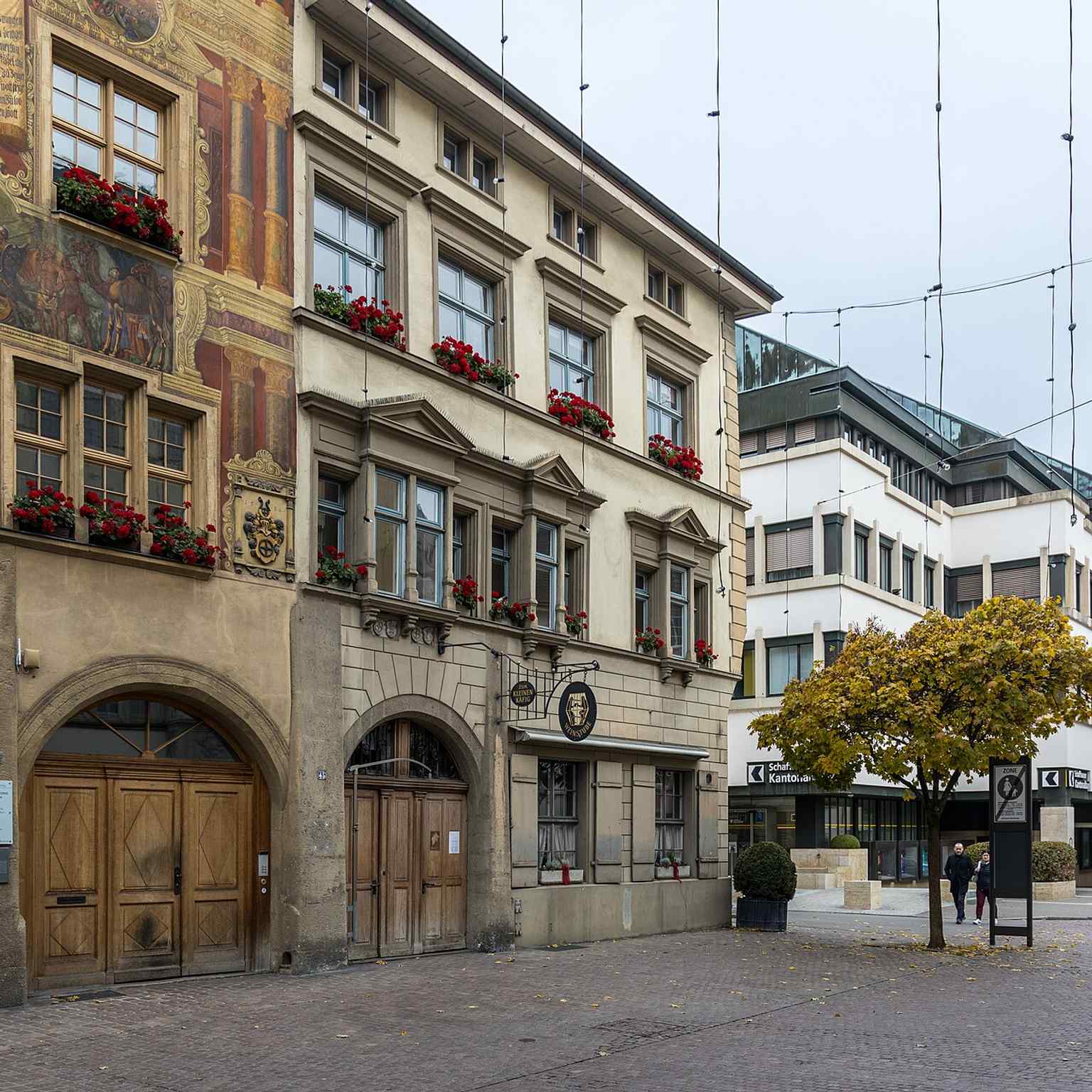
A view from Vorstadt showing the Kantonalbank behind the neighboring building, matching the bank’s prominent location on the northern edge of Schaffhausen’s old town.Photo: JoachimKohler-HB, Wikimedia Commons, CC BY-SA 4.0. Cropped & resized. On your left, look for a pale plaster-and-stone complex with steep tiled roofs, rows of rectangular windows, and the broad bulk of the former church folded into the facade. This…Read moreShow less
Open dedicated page →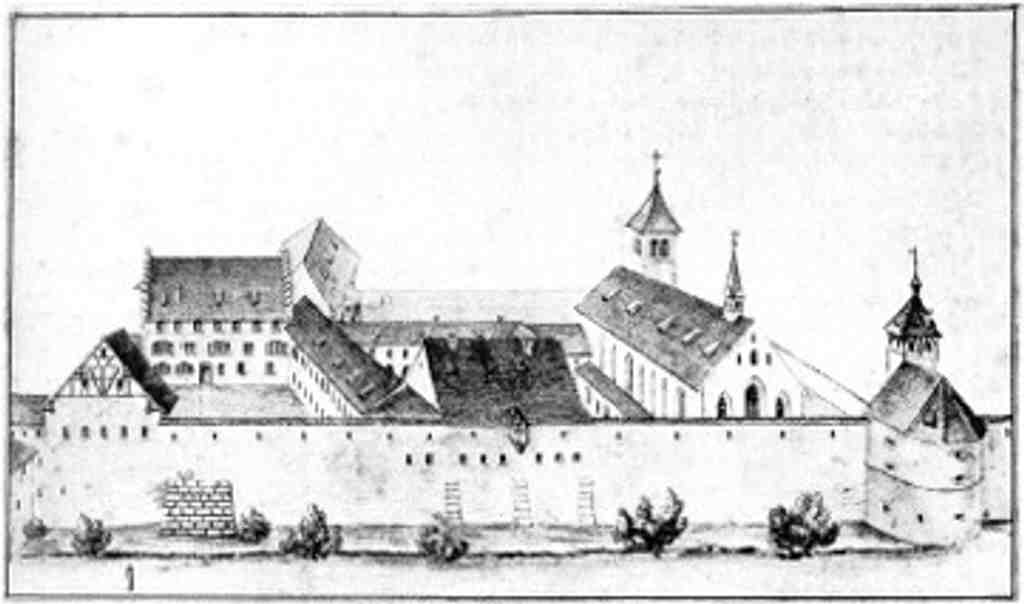
Monastery of St. AgnesenPhoto: Hans Wilhelm Harder, Wikimedia Commons, Public domain. Cropped & resized. On your left, look for a pale plaster-and-stone complex with steep tiled roofs, rows of rectangular windows, and the broad bulk of the former church folded into the facade.
This place asks you to imagine an older kind of vigilance. Schaffhausen was not only guarded by walls and gates; it was also watched over by enclosed communities like this one, where prayer, routine, and remembrance formed a kind of spiritual lookout. The women here kept watch over souls, over family memory, and over the city’s sense of moral order... not flashy work, but cities lean on it more than they admit.
St. Agnesen began around ten eighty, when Burkhard von Nellenburg founded a Benedictine convent here for his mother, Countess Ita. That family mattered. Burkhard’s father, Count Eberhard the Sixth of Nellenburg, had received the right to mint coins for Schaffhausen from King Henry the Third in ten forty-five, so the Nellenburgs helped give the young city both money and institutions. At the bank, power wore ledgers; here, it arrived as endowed prayer, family devotion, and property carefully tied to salvation.
A mistress led the convent, but it did not float free in some serene female world. In ten ninety-two, the abbot of All Saints took authority over it, and noble networks stayed close. In fourteen oh eight, for example, Ulrich von Küssenberg appears in the records as convent lord and provost, a reminder that this was a women’s house embedded in a larger system run by city elites and regional aristocrats.
The convent grew popular. By the early fourteenth century, the number of sisters had to be capped at sixty. Many came from Schaffhausen’s own citizen families, others from noble houses in the nearby Hegau. Entry fees and donations gave St. Agnesen solid wealth, including land around the city and even the hamlet of Gennersbrunn. Some of the nuns used those resources to help the poor and the sick, so this place shaped the city’s moral map even when its gates stayed closed.
Most visitors miss one telling detail. Locals who know the records will tell you St. Agnesen never became a major pilgrimage magnet. Even though people honored Eberhard von Nellenburg’s grave in the church, Schaffhausen never developed the broad spiritual glow that drew crowds from far away. Useful for humility, I suppose. But it does mean this convent mattered less as a miracle factory and more as a well-funded urban house that quietly held society together.
Two fires in the fourteenth century badly damaged the original buildings, and the nuns rebuilt the complex in Gothic style by the century’s end. The grounds once stretched to the eastern town wall and ran from today’s Repfergasse down toward Pfarrhofgasse. After the Reformation, the city dissolved the convent and moved its hospital here in fifteen forty-two. From then on, these buildings served as an almshouse, orphanage, prison, and asylum. The arrangement could be bleak: the official who supervised prisoners and corporal punishment also taught the orphans... which is one hiring decision best left in the past.
By nineteen thirty-six, the city had turned the old hospital into a retirement home, and later additions changed the complex again. That is why the place now barely looks like a medieval convent at all. Still, the old authority lingers here, just under the plaster.
Keep that in mind as you head to St. Johann, about a two-minute walk away, where religious power in Schaffhausen becomes more public, more forceful, and definitely less quiet. If you return later, public access is generally Tuesday through Sunday from ten to six, with Mondays closed.
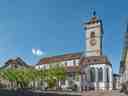
In front of you stands a broad pale-stone Gothic church, its long rectangular body stretching toward a polygonal choir, beside a rough-stone tower capped with a steep pyramid roof…Read moreShow less
Open dedicated page →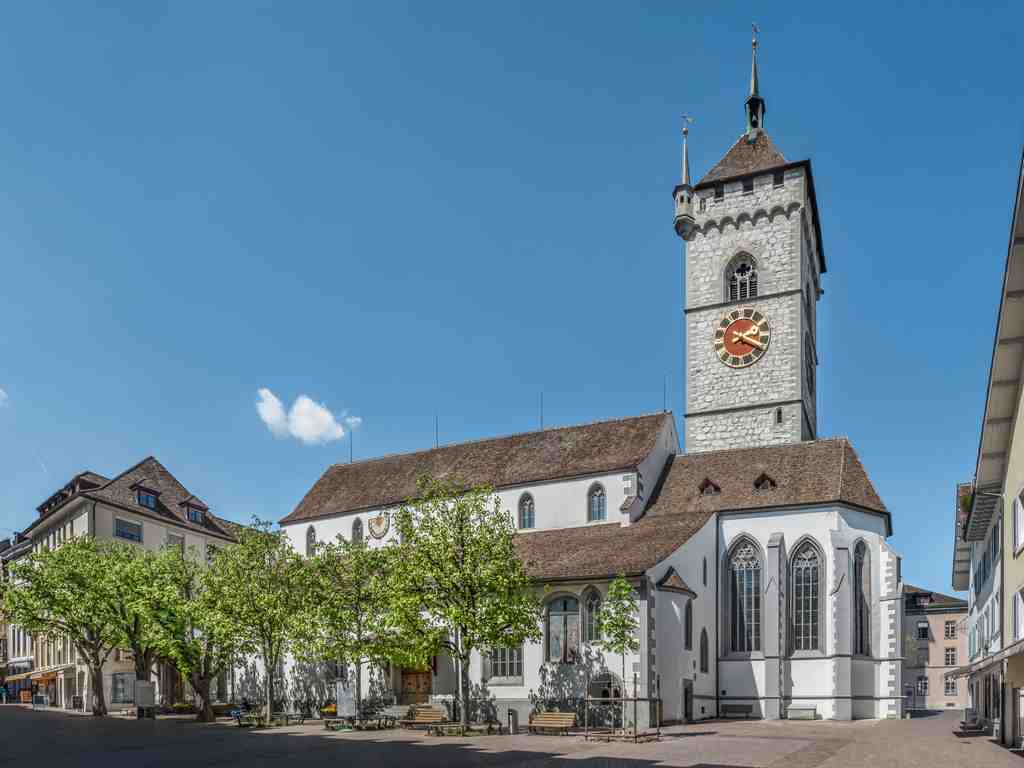
Church of St. JohannPhoto: Hauserphoton, Wikimedia Commons, CC BY-SA 4.0. Cropped & resized. In front of you stands a broad pale-stone Gothic church, its long rectangular body stretching toward a polygonal choir, beside a rough-stone tower capped with a steep pyramid roof and a tiny lantern.
St. Johann looks steady, almost stubborn... and that is exactly why it matters. This church shows how Schaffhausen handles damage: not by pretending nothing happened, but by turning scars into a new system. Sacred space here kept getting broken, repurposed, and put back to work... first for religion, then for politics, then for music.
In fifteen twenty-four, the last abbot, Michael Eggenstorfer, helped tilt power away from the monastery and toward the city council. Church property now funded a theological school and twelve preaching posts. So this was no longer just a place to pray; it became one of the rooms where Schaffhausen rearranged who ruled, who preached, and who paid.
Then came the hard break. On the thirtieth of September, fifteen twenty-nine, right after the Reformation arrived, people did not merely change opinions. They smashed images and altars, walled up the Madonna niche in the tower, and wrecked the organ. By fifteen thirty-two, the interior had been stripped bare. Sound, ritual, and decoration were all put on trial at once.
And here is the detail locals love because it is so bluntly Schaffhausen: in fifteen ninety-seven, people tried to make the organ playable again. The clergy objected, the decision got reversed, and the organ pipes were melted down into wine jugs. Theology, apparently, could be poured by the cup.
The ground around this church changed too. In fifteen forty-one, the cemetery moved to what is now the Mosergarten, and the market shifted here in front of the church. So devotion gave way to trade at the doorstep. If you glance at the app’s interior photo, you’ll see the scale of the main hall, the great central space of the church, later adapted again and again for worship and concerts.
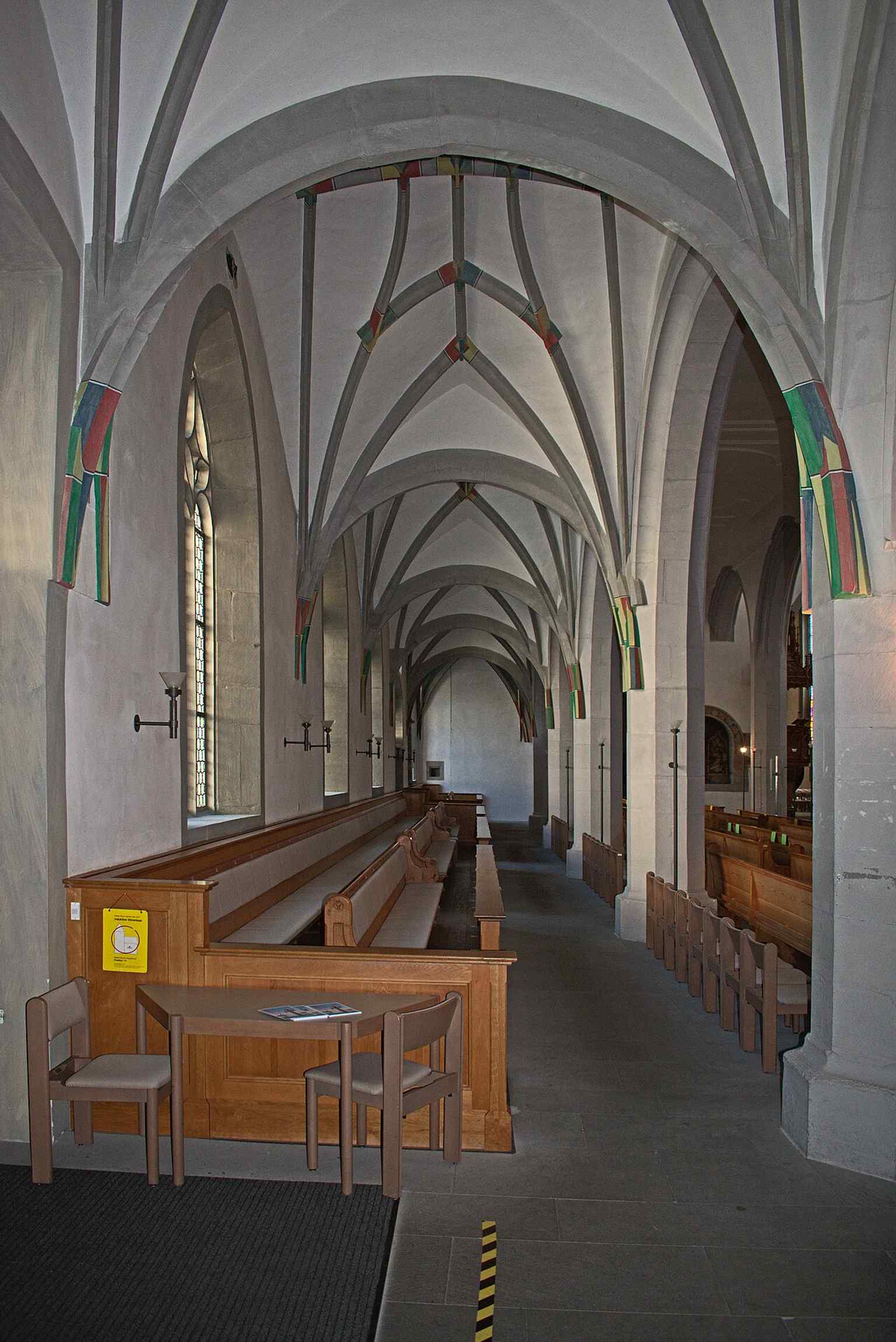
The side nave interior highlights the church’s spacious Gothic hall, later adapted for worship and concerts.Photo: Ymblanter, Wikimedia Commons, CC BY-SA 4.0. Cropped & resized. St. Johann also became a place of discipline. In sixteen twelve, the council ordered a stone shame bench at the lower church steps for what they called “idle and disorderly people.” That tells you something about this city: after the old religious order cracked, public morality got a lot more visible.
Later centuries kept revising the room rather than freezing it. Baroque stucco ceilings arrived in seventeen thirty-three and seventeen thirty-four. In the nineteenth century, people removed market stalls by the choir and even partitioned off a heated worship area. Then music returned in force. If you check the organ image on your screen, that is the great Kuhn organ, rebuilt and refined, the one Albert Schweitzer praised in nineteen twenty-eight for its “soft and delicate tone.” Since nineteen forty-six, the Bach festivals have made this church sing again... after a very rough argument about whether it should sing at all.
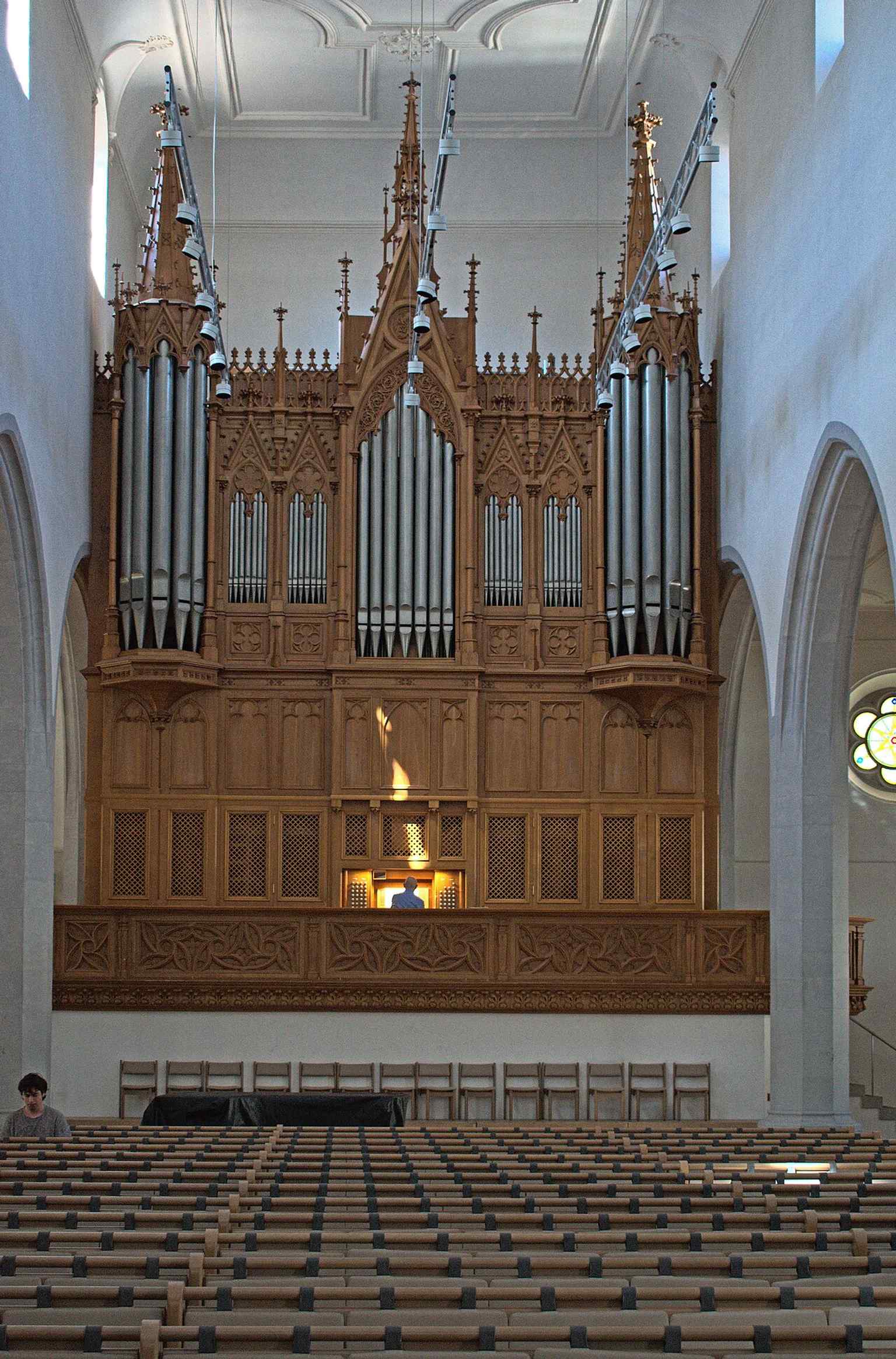
The west organ of St. Johann, a key part of the church’s concert life and the famous Kuhn organ tradition.Photo: Ymblanter, Wikimedia Commons, CC BY-SA 4.0. Cropped & resized. Once sacred authority breaks open, the city starts speaking louder in its place. Fittingly, our next stop is Schaffhauser Nachrichten, about a one-minute walk from here.
If you want to step inside later, the church is generally open daily from nine A-M to six P-M.
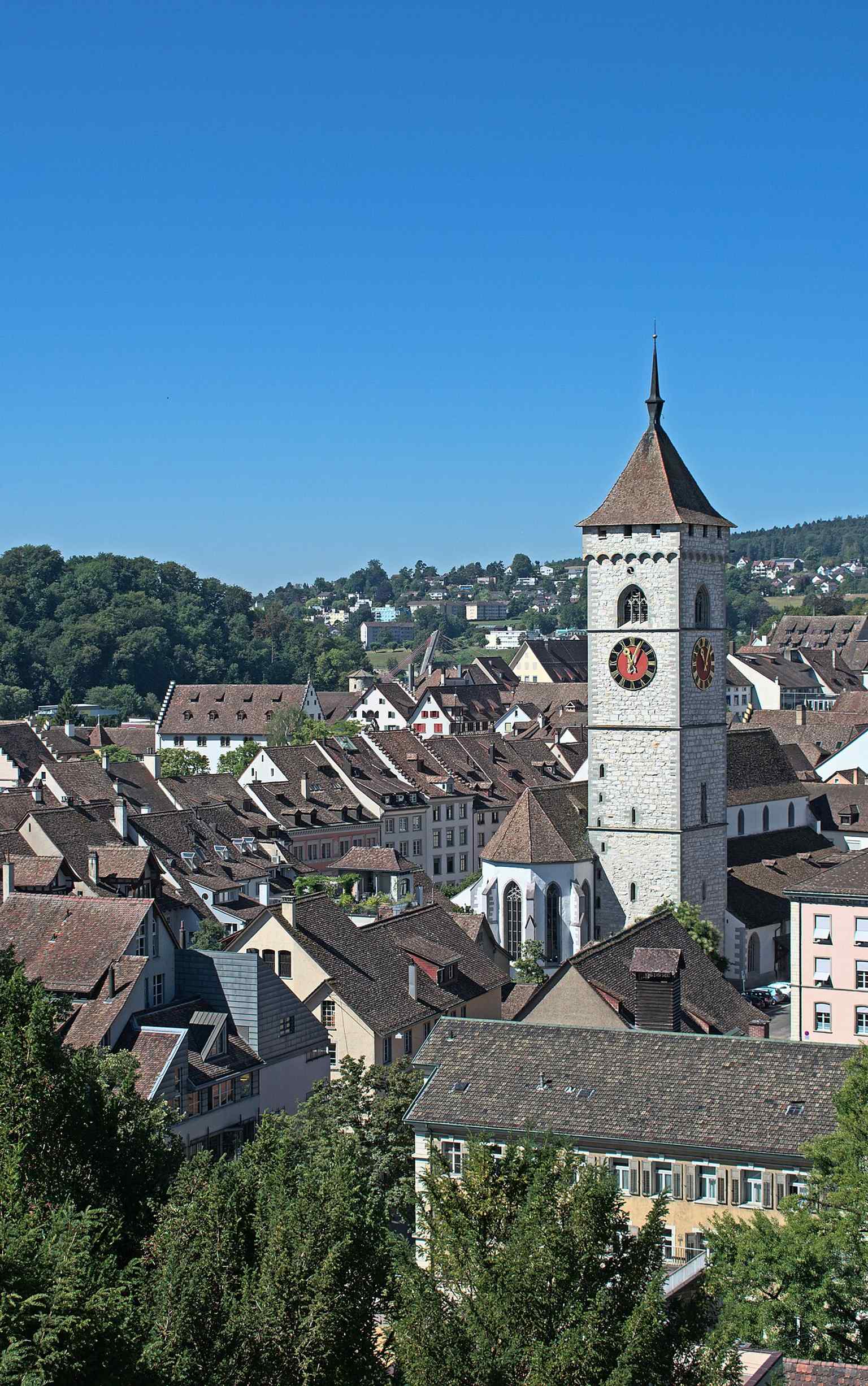
A high, sweeping view with St. Johann at the center, showing the church's urban setting in Schaffhausen.Photo: Ymblanter, Wikimedia Commons, CC BY-SA 4.0. Cropped & resized. 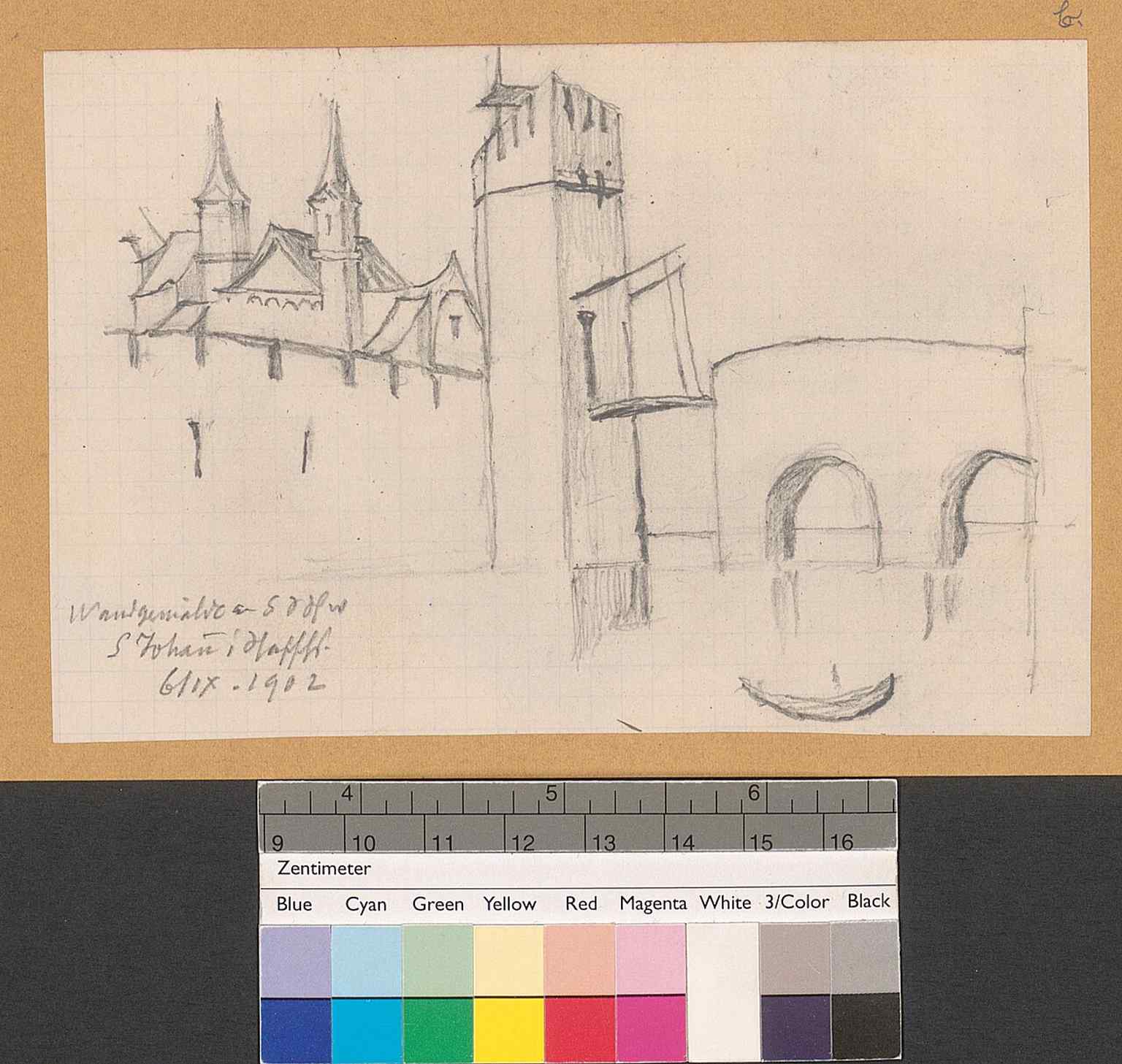
A close view of the exterior wall painting on St. Johann’s south side, one of the church’s decorative historical details.Photo: Johann Rudolf Rahn, Wikimedia Commons, Public domain. Cropped & resized.
Show 11 more stopsShow fewer stopsexpand_moreexpand_less
On your right, look for a pale, symmetrical stucco façade with neat rows of rectangular windows and the permanent Schaffhauser Nachrichten name marking the ground floor. This is…Read moreShow less
Open dedicated page →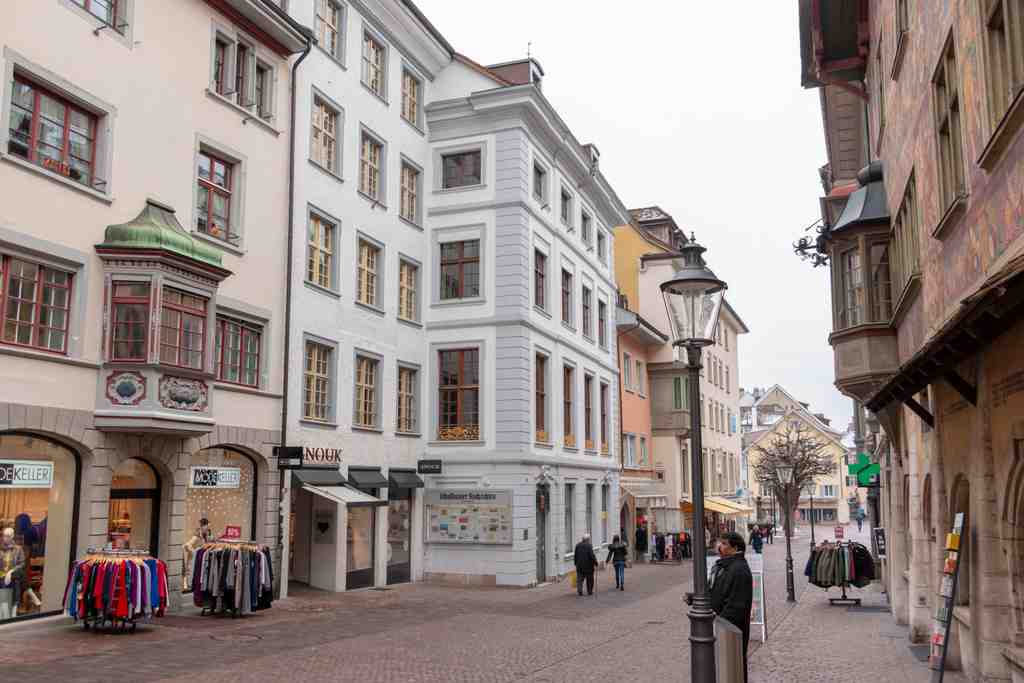
Schaffhauser NachrichtenPhoto: Verlag SN, Wikimedia Commons, CC BY-SA 4.0. Cropped & resized. On your right, look for a pale, symmetrical stucco façade with neat rows of rectangular windows and the permanent Schaffhauser Nachrichten name marking the ground floor.
This is the headquarters of the Schaffhauser Nachrichten, the paper locals usually call simply S-N. In a town that has long watched itself through pulpits, guild halls, and council chambers, this became the public voice of print: the daily place where Schaffhausen decides what deserves attention, argument, or a raised eyebrow.
The newspaper first appeared in December of eighteen sixty-one as the Schaffhauser Intelligenzblatt. That old title sounds a bit grand, as if intelligence might be distributed by subscription. But the paper mattered quickly. By eighteen sixty-four, after several mergers, it had established itself as an alternative to the liberal-conservative Tagblatt. In nineteen oh four it served the liberal political camp, then in nineteen forty it took the name Schaffhauser Nachrichten. Since nineteen fifty-two, it has presented itself as politically independent, though still clearly civic and liberal in outlook. It publishes six days a week and remains the most-read daily paper in the canton.
And this house had a long career before it became a newsroom. The merchants’ guild owned the property here from the late Middle Ages. A Romanesque tower once stood on this site until people decided, quite sensibly, that a tower in danger of collapsing added too much excitement to daily life. They demolished it in seventeen eighty, then built this early classical replacement between seventeen eighty and seventeen eighty-four. Inside, the guild hall took on a rococo style - that means ornamental, elegant, and a little fond of flourish - and after restoration in two thousand and one it regained much of that original splendor. Before journalists debated headlines here, the city parliament even met in this building.
In nineteen oh eight, Meier plus Cie bought the property and turned the interior into a book-printing works by nineteen ten. So authority changed outfits again: from guild to parliament to press. No bells, no sermon... yet plenty of power. Editors choose what becomes public, urgent, official, or forgettable. Since eighteen seventy-six, the paper has also served several local communities as an official publication organ, which is a formal way of saying: if the town needs something published for the record, this paper helps make it real.
The presses themselves eventually left town. After the in-house print operation closed in two thousand and thirteen, printing moved first to the N-Z-Z plant and later, from July two thousand and fifteen, to Winkeln. But the local voice stayed here, under editors including Norbert Neininger and, after his death in two thousand and fifteen, Robin Blanck.
So once the paper names the issue... who actually acts on it? For that, we head to the Town Hall, about one minute away. If you ever want to test this public voice yourself, the office keeps weekday hours, closes on weekends, and on Fridays readers can drop in without an appointment for S-N-direkt.
On your left, spot the pale sandstone-and-plaster façade with its row of broad arches at street level and the small ram figure set high on the north face. This is Schaffhausen’s…Read moreShow less
Open dedicated page →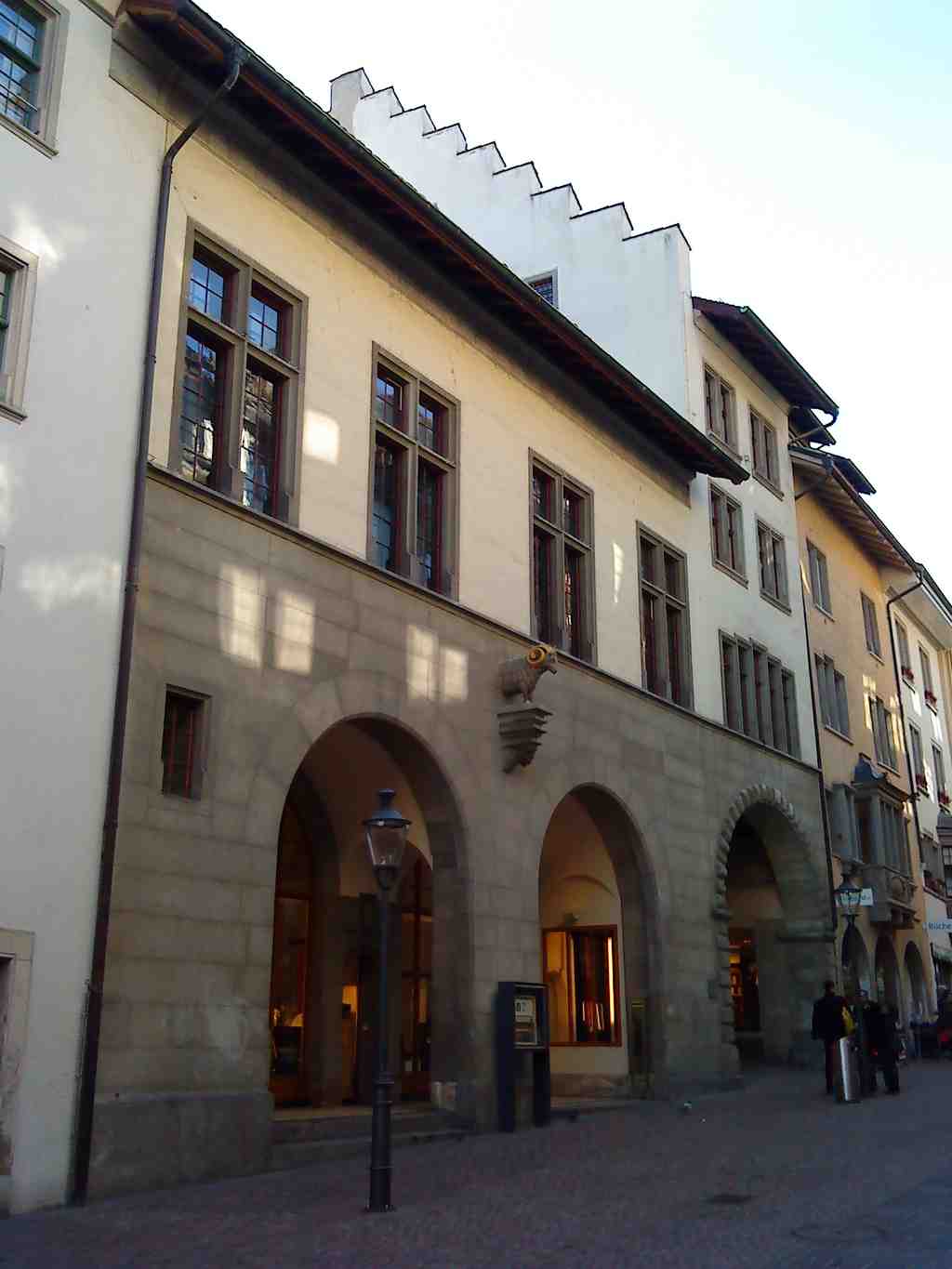
Town HallPhoto: Wandervogel, Wikimedia Commons, CC BY-SA 3.0. Cropped & resized. On your left, spot the pale sandstone-and-plaster façade with its row of broad arches at street level and the small ram figure set high on the north face.
This is Schaffhausen’s Town Hall, finished in fourteen twelve, and it has been doing the same job ever since... which is more than most governments can claim. It is still the political center of both the city and the canton, and that matters because this building never treated power as something hidden away in back rooms. Here, civic rule stepped onto a public stage.
The key space is the Rathauslaube, a grand civic hall, and beside it the council chamber, or Ratssaal. Together they turned government into something the city could witness: debates, judgments, announcements, formal gatherings, all given a proper setting with arches, thresholds, and ceremony. Not quite theater... though government does enjoy a good entrance.
This complex has three parts. Along Vordergasse, the ground floor now serves commercial use, but it began as a corn hall, one tall room carried by four massive Gothic oak columns. The council spaces are reached through the lane called Rathausbogen, which links this street to Herrenacker, the city’s largest square. Above that passage, the old city-state once held meetings in a small late Gothic council room, and the Great Council gathered here to choose the mayor each year. So yes, authority changed its outfit over time, moving from sacred settings into civic chambers, but it kept the same taste for ritual.
Take a moment and study the arches, the passage, the way one façade leads you toward another space... architecture here is quietly telling you that public life should look serious before anyone says a word.
Inside, the Town Hall grew more splendid as the city did. In fifteen eighty-six, builders gave the Rathauslaube a Renaissance coffered ceiling, a ceiling divided into neat sunken panels, and lined it with warm wood. Twelve oil portraits and three large history paintings later joined the room. In sixteen twenty-four, craftsmen added a magnificent wooden portal to mark the entrance to the council chamber, and the painter Hans Caspar Lang the Elder covered that chamber with Bible quotations and allegories, meaning painted ideas about justice and good rule. Even the ram on the façade has a story: the one outside is a copy, while the original, carved in fifteen fifteen by Augustin Henel, now lives safely in the Museum zu Allerheiligen.
The building kept adapting. The nineteenth century added a public gallery and a fashionable plaster ceiling, then architect Johann Christoph Bahnmaier partly reversed that and restored a late Renaissance look. In the early nineteen forties, workers cut in a recessed shopfront, creating the short arcade below. More recently, the rooms gained modern technology, and in twenty twenty the tourism center moved in... because apparently even a medieval town hall can learn front-desk manners.
From here, walk on to Fronwagplatz, where civic pride becomes more public still: square, fountain, clock, and the daily business of being seen. If you need the building for practical reasons, its public offices generally open on weekdays from nine to noon and from one thirty to five, and stay closed on weekends.
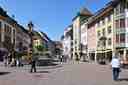
Look for the broad stone-paved square narrowing toward the pale Fronwagturm, a tall rectangular tower with a small roof lantern and a striking clock set high in its gable. This…Read moreShow less
Open dedicated page →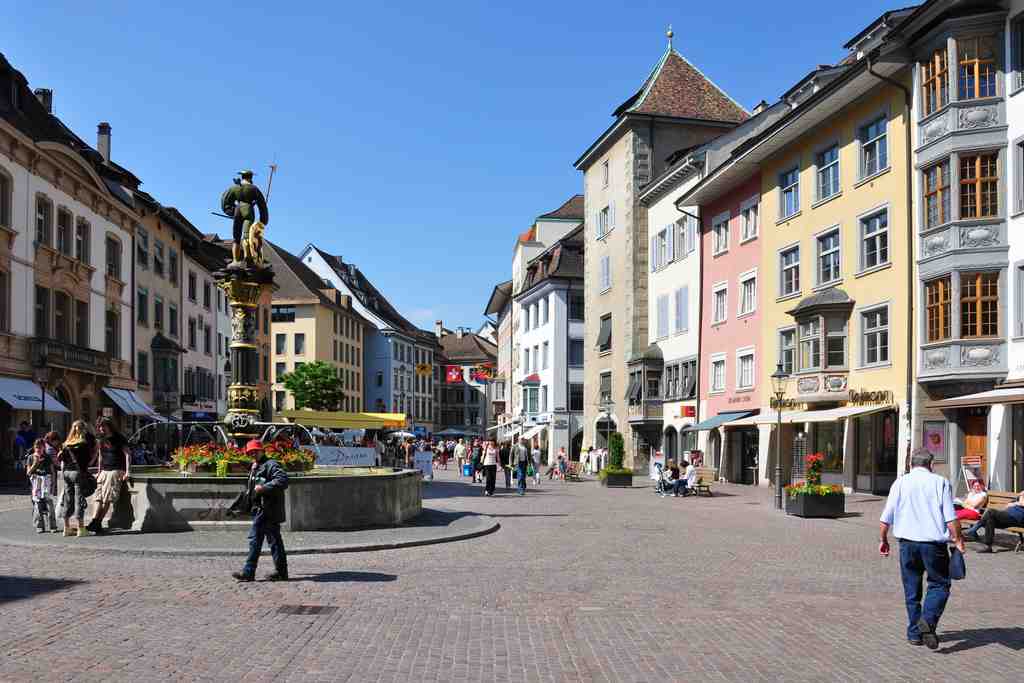
FronwagplatzPhoto: Roland zh, Wikimedia Commons, CC BY-SA 3.0. Cropped & resized. Look for the broad stone-paved square narrowing toward the pale Fronwagturm, a tall rectangular tower with a small roof lantern and a striking clock set high in its gable.
This is Fronwagplatz, the old town boiled down to one public room. Trade crossed here, authority showed its face here, and the city learned to measure itself here... sometimes quite literally. In the Middle Ages people simply called it Am Markt, the market. That was the practical truth of the place. Because boats could not pass the Rhine Falls, merchants had to unload goods in Schaffhausen, haul them overland, and load them again farther along the river. That traffic came through this square, and here the goods met the Fronwaage, the great public scale.
So the tower ahead was never just picturesque. Long before visitors admired the clock, the Fronwagturm served as a very public tool of control. The city enforced its weighing rights here, checked what goods really weighed, and made punishment visible too. The council could debate rules at the Town Hall, but this square turned rules into something everybody could see. Politics, in other words, stepped outside and put on its work clothes.
Then Schaffhausen decided even control should look impressive. In fifteen sixty-one, the council hired Joachim Habrecht to build what became Habrecht’s astronomical clock. This was not merely a timekeeper. It was an engineered boast, a machine with ten different astronomical functions, designed to delight locals and impress strangers. Precision became decoration; civic pride learned to tick. If you look at the image on your screen, you can see that south side clearly, with the Fronwagturm standing beside the Zunfthaus Herrenstube.
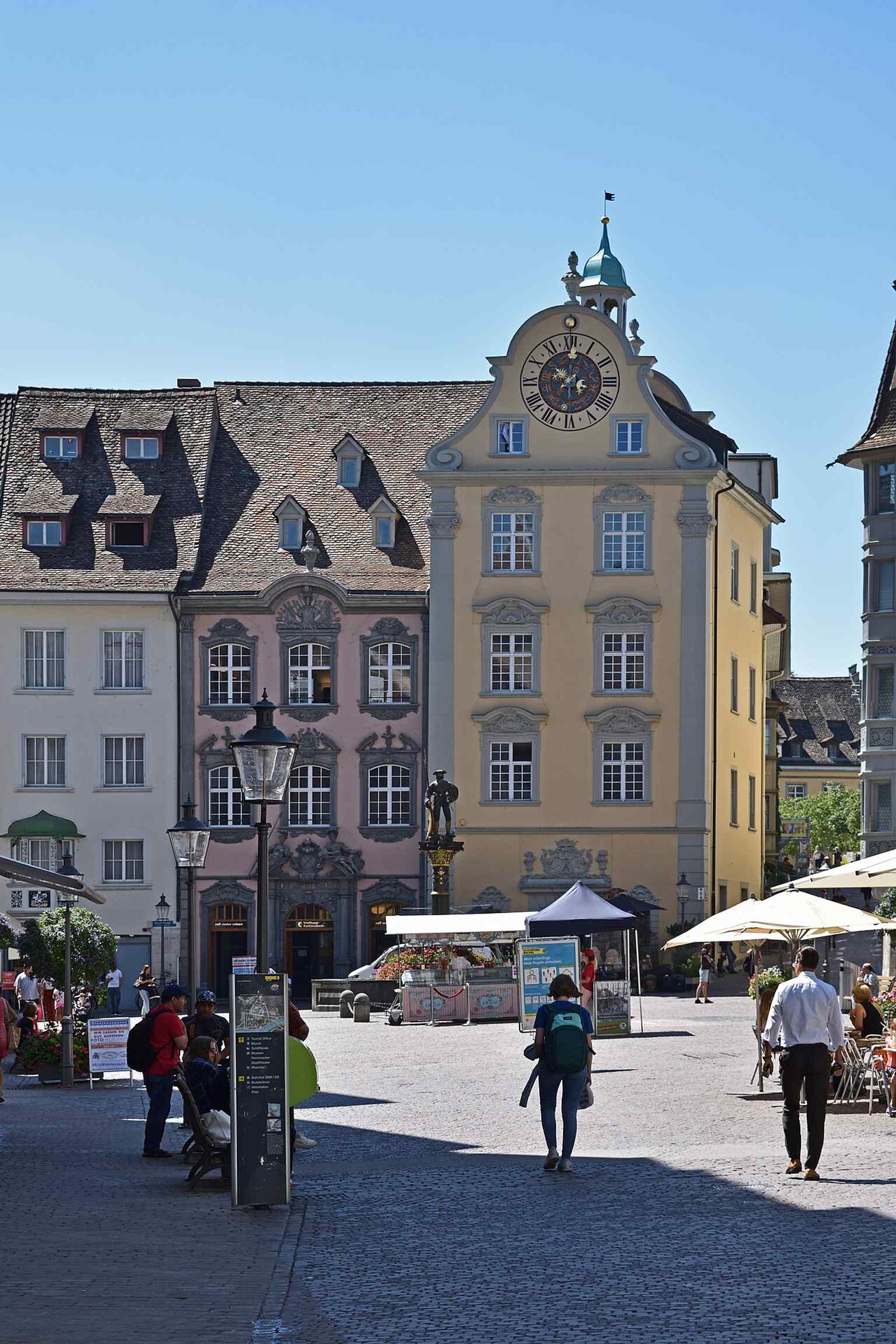
A classic view of the square’s south side: Zunfthaus Herrenstube beside the Fronwagturm, the landmark tower with its historic astronomical clock.Photo: Ymblanter, Wikimedia Commons, CC BY-SA 4.0. Cropped & resized. The original tower did not survive intact. On the first of June, seventeen forty-six, it collapsed. Two years later the city raised the present tower, and, with admirable stubbornness, reused the surviving bell from the chapel of Balm Castle and Habrecht’s clock in the new structure. Schaffhausen does not throw away a good symbol.
Most people never notice that the square under your feet hides an older city still. Archaeologists found the tower’s medieval foundations reaching about two meters below today’s surface. So this elegant open space stands on buried layers of weighing, watching, arguing, and rebuilding. Even the two sixteenth-century fountains, the Landsknechtbrunnen near the tower and the Mohrenbrunnen at the north end, remind you that utility and display have always shared the same address here.
From this civic stage, the story shifts to another kind of performance... where culture steps forward and money helps keep the curtain rising. Head on to the Stadttheater Schaffhausen, about two minutes away.
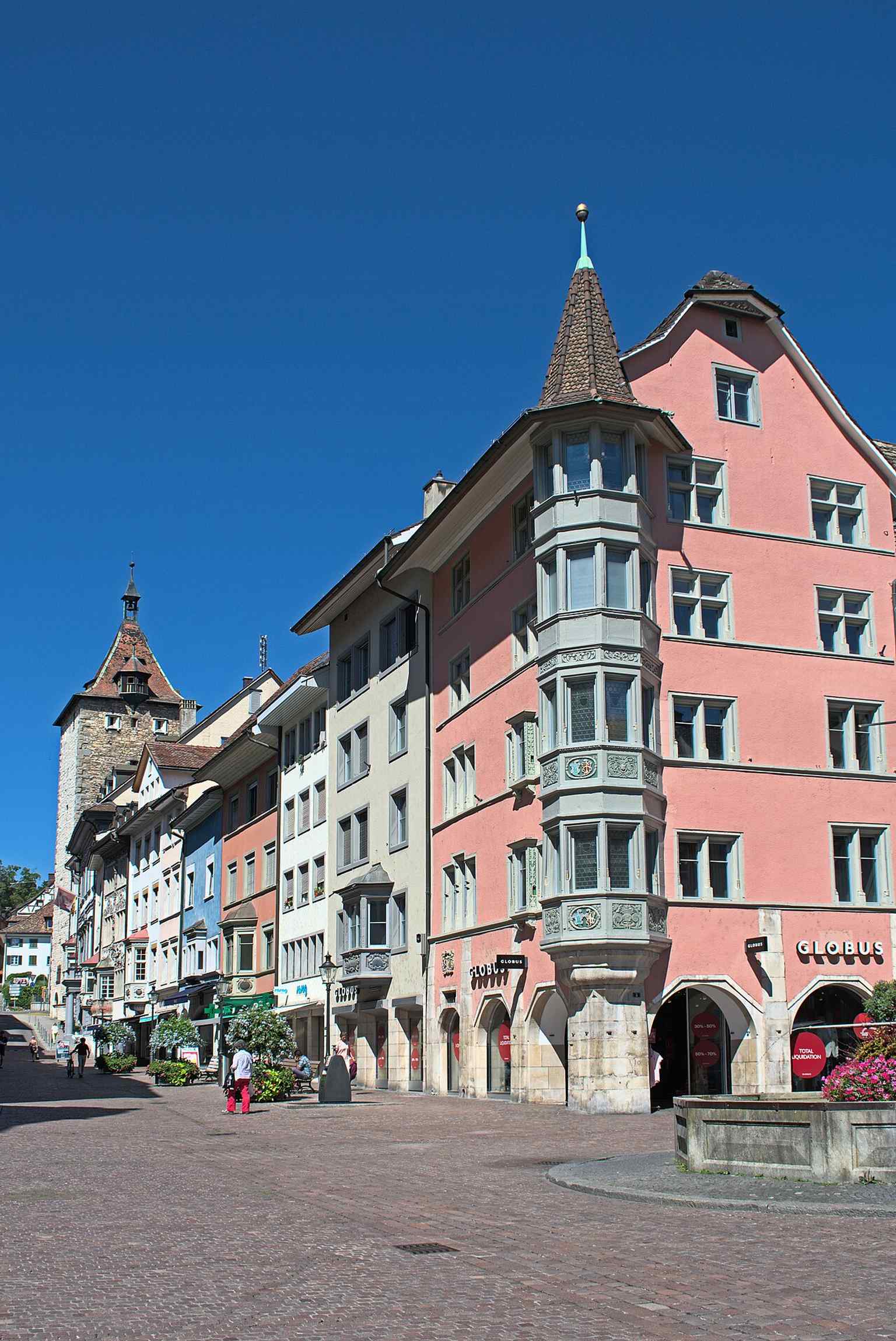
Looking along Fronwagplatz toward the Upper Town, with the Obertorturm visible at the end of the street — one of the two main axes leading out of the square.Photo: Ymblanter, Wikimedia Commons, CC BY-SA 4.0. Cropped & resized. 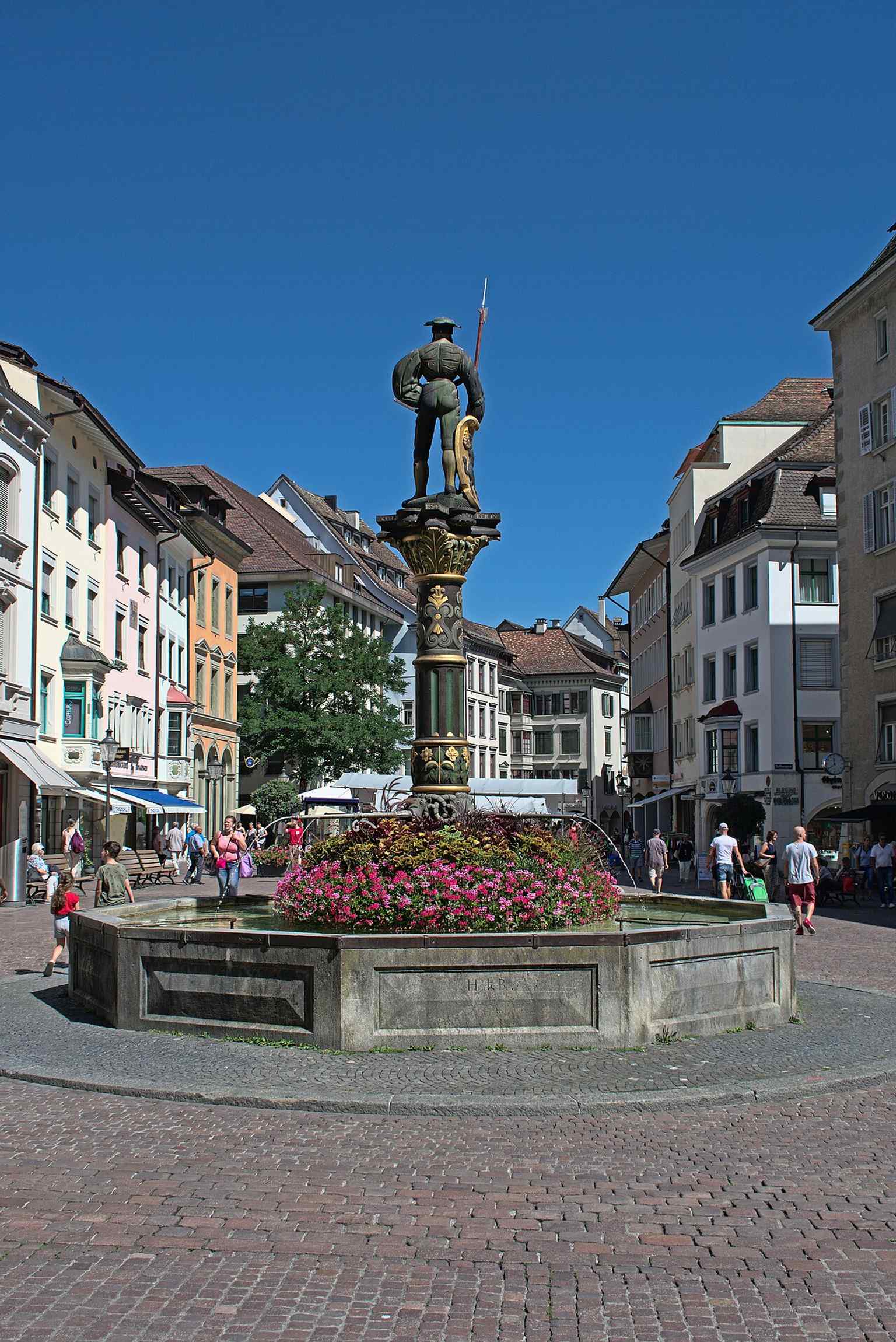
The Landsknechtbrunnen on Fronwagplatz, one of the square’s 16th-century decorative fountains mentioned in the tour text.Photo: Ymblanter, Wikimedia Commons, CC BY-SA 4.0. Cropped & resized. 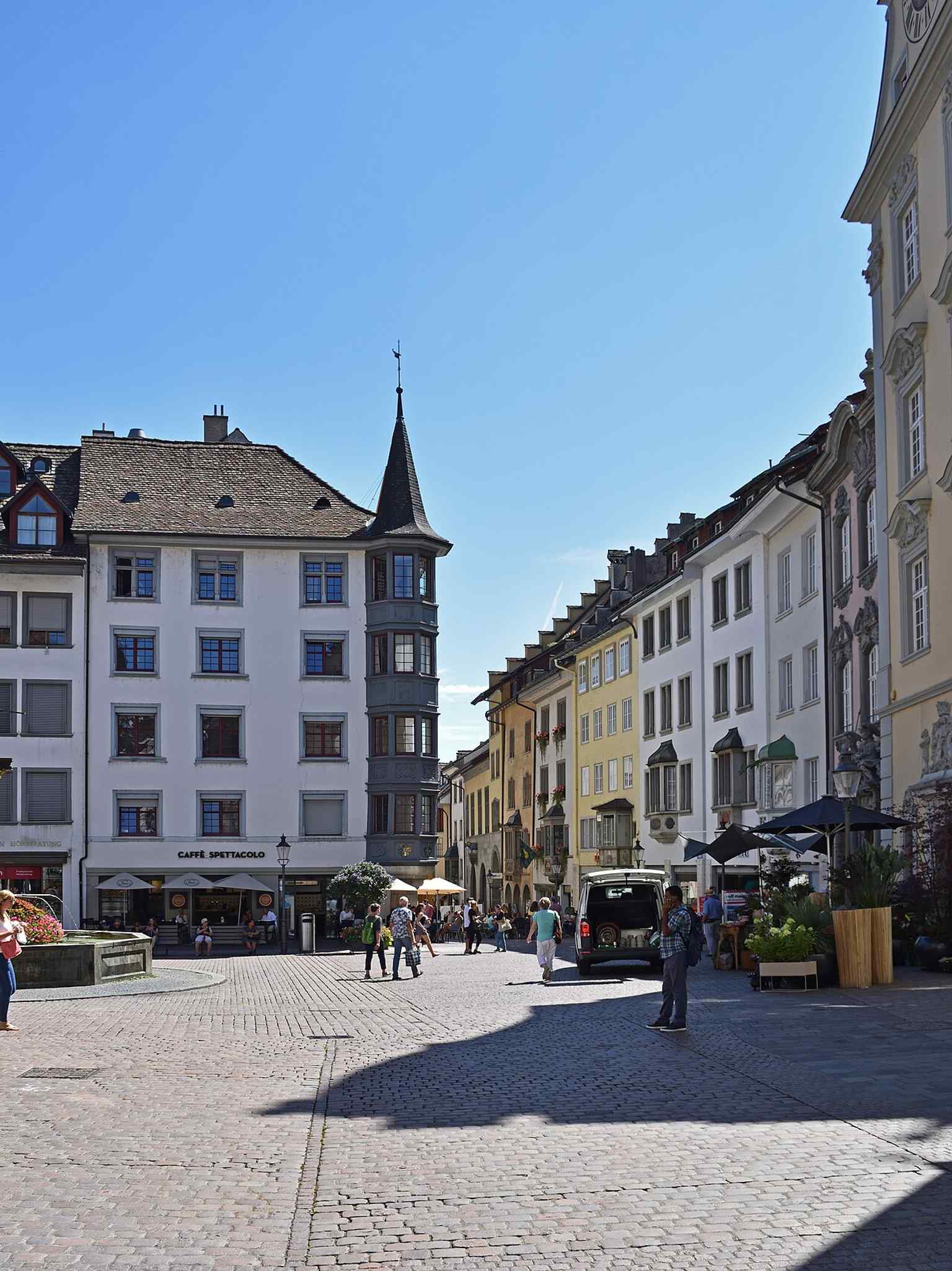
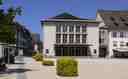
Fronwagplatz meeting Vordergasse, showing the square’s role as the central junction linking the old town toward the Rhine and the river landing.Photo: Ymblanter, Wikimedia Commons, CC BY-SA 4.0. Cropped & resized. Look for a broad, pale facade with a clean rectangular front, a shallow entrance canopy, and the unmistakably civic, mid-century calm of a building meant to gather a crowd. This…Read moreShow less
Open dedicated page →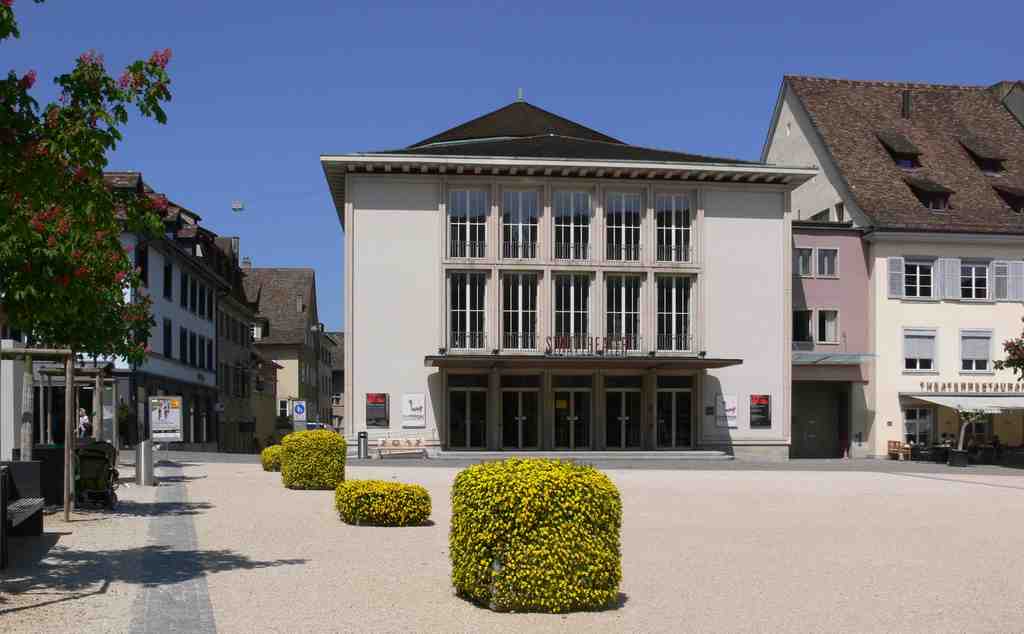
Stadttheater SchaffhausenPhoto: Photo: Andreas Praefcke, Wikimedia Commons, CC BY 3.0. Cropped & resized. Look for a broad, pale facade with a clean rectangular front, a shallow entrance canopy, and the unmistakably civic, mid-century calm of a building meant to gather a crowd.
This is the Stadttheater Schaffhausen, and it stands on ground that once held the city slaughterhouse... which tells you a lot about Schaffhausen. A trading town looked at a practical, bloody bit of urban real estate and thought: no, let’s put music here.
That instinct has a name: Johann Conrad Im Thurn’s legacy. Im Thurn was a Schaffhausen merchant who made serious money through his London trading house, and in eighteen sixty-four he gave his hometown ten thousand pounds sterling... in today’s money, well over a million pounds. He said he wanted to leave a lasting proof of his affection for the city, and he aimed that money at music, art, and education under one roof. Not a bad use of commercial success, really.
The first theater here, the Imthurneum, opened in eighteen sixty-seven. It carried a concert and theater hall, a music school, and a distinctly ambitious program. In its very first season, audiences got Shakespeare, Goethe, Schiller, and lighter entertainments with singing and dancing. So from the start, this place wasn’t just a stage. It was Schaffhausen trying on a larger cultural identity.
The old hall also had one hundred and seventeen doors, which earned it the nickname Zuglufttheater - the “draft theater.” Fine acoustics, apparently... and a fair chance of catching a breeze. Still, people loved it. In ten weeks, the first director, Ferdinand Stolte, managed forty-four performances.
Over time, the theater kept changing costume. It ran with visiting companies, then with its own ensemble, then in partnerships with other cities like Solothurn, Winterthur, and Konstanz. Cornelia Donhoff even led the house from nineteen oh seven, a notable break with expectations in her day. But money remained the stubborn backstage critic. A fully independent ensemble proved too expensive, so Schaffhausen returned to guest performances.
Then came a more literal collapse. In nineteen fifty-two, workers closed the old building after pieces of stucco fell into the empty auditorium during a rehearsal. That is generally considered a poor review. Voters approved a new theater in nineteen fifty-three, and this replacement opened in nineteen fifty-six, with Schauspielhaus Zürich bringing Aeschylus’ Orestie.
Today, the theater still works mainly as a guest-performance house, presenting drama, music theater, dance, cabaret, and family shows from September to June, with room for up to six hundred eighty-seven people. So the old city keeps doing its favorite trick: turning trade into culture, and culture into a way of recognizing itself.
In a moment, we’ll head toward F-C Schaffhausen, where collective feeling gets a little less scripted and a lot louder. If you need practical details, the box office usually opens in the late afternoon on weekdays, on Saturday morning, and stays closed on Sunday.
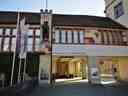
Look for a pale stucco streetfront with rectangular windows and the F-C Schaffhausen name marking the entrance. This is one of those places where a city puts on a different…Read moreShow less
Open dedicated page →
FC SchaffhausenPhoto: FC Schaffhausen, Wikimedia Commons, Public domain. Cropped & resized. Look for a pale stucco streetfront with rectangular windows and the F-C Schaffhausen name marking the entrance.
This is one of those places where a city puts on a different costume. Once, belonging gathered in guilds, churches, and council rooms. Here, it gathers around a badge, a scoreline, and the stubborn idea that your town should matter on a larger map. Football is very good at carrying civic pride... and equally good at testing its blood pressure.
In twenty nineteen, Roland Klein took over F-C Schaffhausen and got an early hint of hope: his young team drew two-two with promotion favorite Lausanne in his first match. At the same time, he hunted for investors, with Francesco Ciringione briefly mentioned as a possible backer, and he pushed a bigger stadium rethink. Swiss public broadcaster S-R-F reported plans for more than football there, with multi-year large events and a much lower stadium rent, so more money could go to the squad and youth development.
Then came the rescue that did not stay a rescue. In July twenty twenty-three, Berformance became main sponsor in a six-figure annual deal, and the stadium took the name Berformance Arena. By autumn, Schaffhauser A-Z described a V-I-P lounge full of return promises, crypto talk, and some very strange self-advertising. If you glance at the chart on your screen, you can see how the club’s form kept lurching up and down like a nervous heartbeat.
In December twenty twenty-three, Klein stepped back from management but stayed sole shareholder. Jimmy Berisha took over as board president and chief executive, Admir Mehmedi became sporting director, and Kubilay Türkyilmaz chief scout. They inherited a club with almost no money and last place in the Challenge League, Switzerland’s second tier. Short-term transfers kept Schaffhausen up. Then, in June twenty twenty-four, Berformance chief Christian Lux was arrested; prosecutors said his company may have cheated investors out of one hundred and nine million Swiss francs. By April thirtieth, twenty twenty-five, Klein had handed the club to Lotus One Swiss A-G, a finance group from Singapore.
That’s modern local identity in a nutshell: fragile, loud, hopeful, and public. In about four minutes, the All Saints’ Museum shows you what a city preserves when the chants die down. If you need the club office, it generally keeps weekday morning hours, with limited afternoon opening on most weekdays, and closes on weekends.
On your left stands a pale stone monastery complex with long rectangular wings, a steep tiled roof, and the attached church tower marking the old abbey of Allerheiligen. This is…Read moreShow less
Open dedicated page →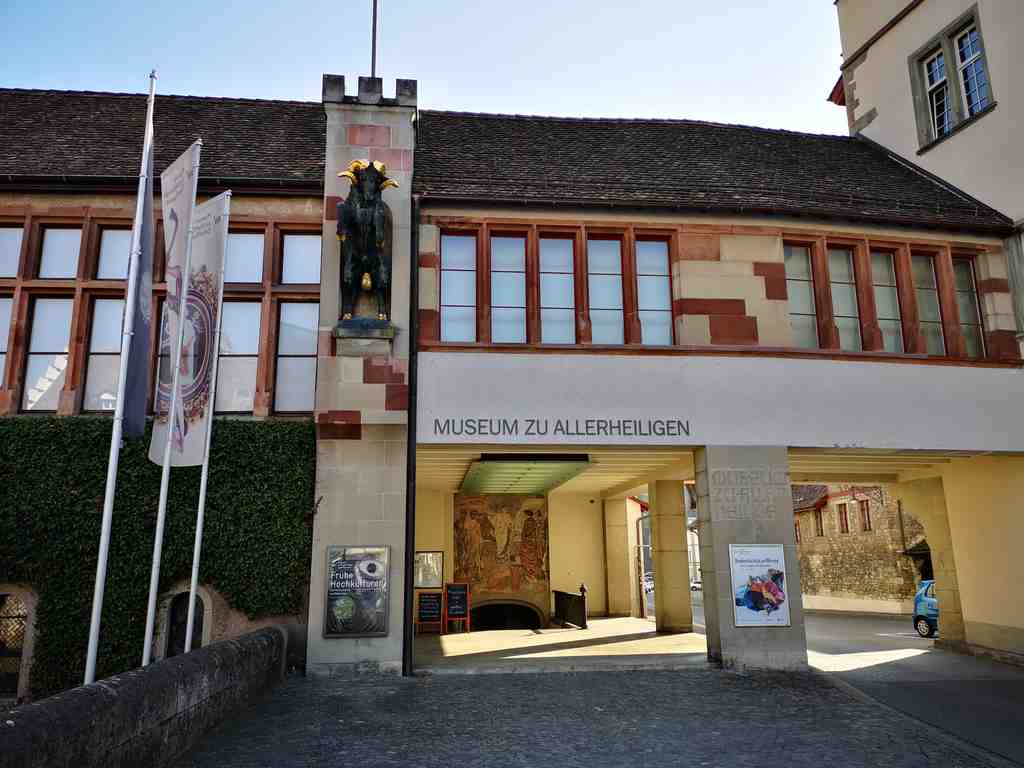
All Saints' MuseumPhoto: Medea7, Wikimedia Commons, CC BY-SA 3.0. Cropped & resized. On your left stands a pale stone monastery complex with long rectangular wings, a steep tiled roof, and the attached church tower marking the old abbey of Allerheiligen.
This is the All Saints' Museum, Schaffhausen’s great storehouse of itself... part Benedictine monastery, part archive, part cabinet of wonders. Inside, archaeology, local history, art, and natural science live under one roof, which makes this not only the region’s most important museum, but among the largest in Switzerland by floor area. The name matters too: by keeping the old monastery name, Allerheiligen, the museum borrowed the medieval idea that one place can hold many kinds of knowledge. A neat trick, really... prayer became preservation.
In the nineteenth century, Schaffhausen wanted a museum of its own. A brand-new building never happened, so in nineteen nineteen the city hired the architects Schäfer and Martin Risch to transform these monastery buildings instead. That decision did two jobs at once: it created a universal museum and rescued the old abbey from decay. After seven years of work, the museum opened in nineteen twenty-eight with forty-two exhibition rooms, then expanded again in the nineteen thirties.
If you glance at the image on your phone, the Erhardskapelle shows the character of the place perfectly: a medieval chapel folded into a modern museum, with the old sacred space still doing its quiet work.
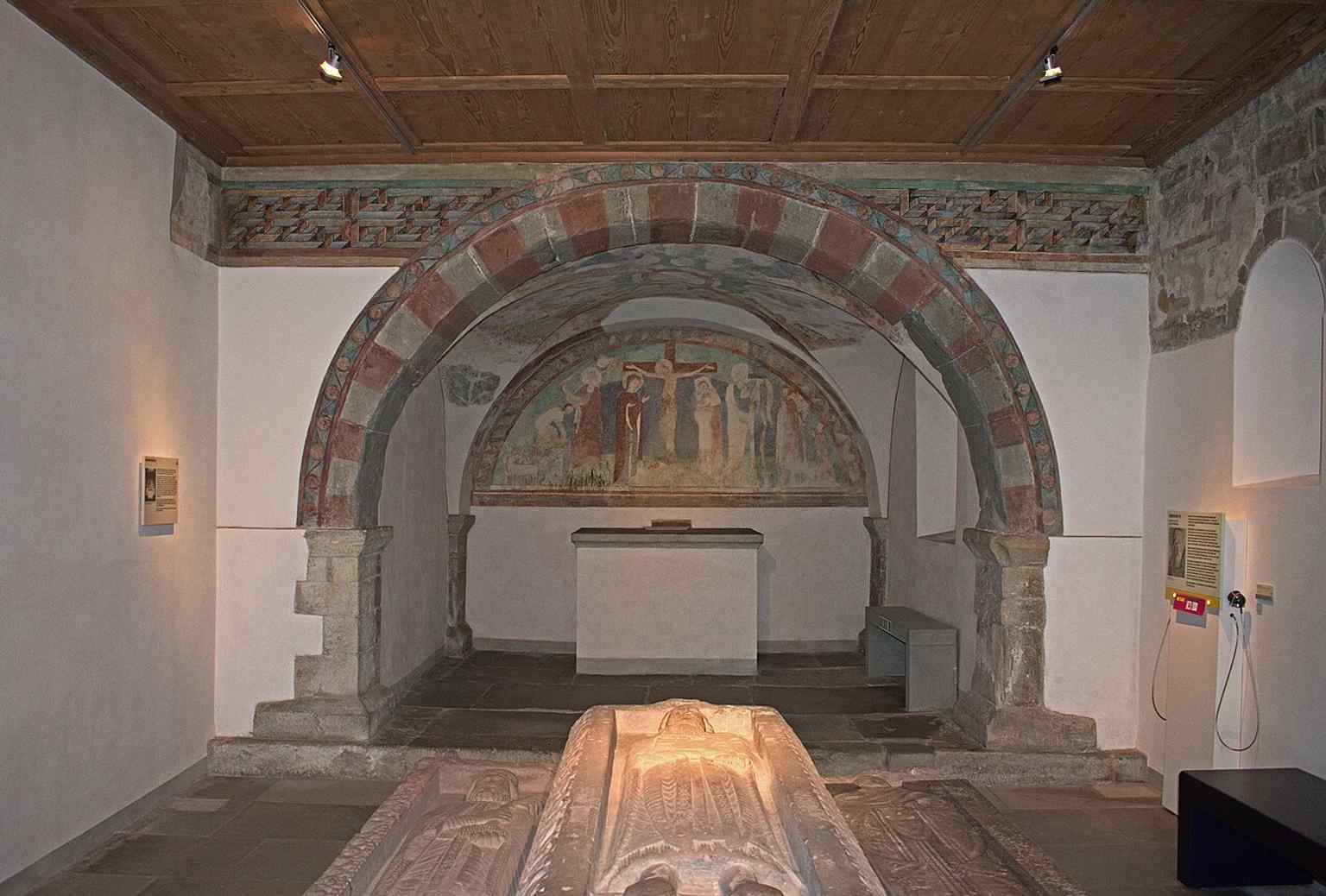
The Erhardskapelle inside All Saints’ Museum — one of the medieval monastery spaces that helped turn the old abbey into a universal museum.Photo: Ymblanter, Wikimedia Commons, CC BY-SA 4.0. Cropped & resized. Then came the rupture. On the first of April, nineteen forty-four, U-S bombers missed their intended target and struck Schaffhausen by mistake. The museum’s west wing took a direct hit; ceilings collapsed, rooms burned, and more than seventy old master paintings vanished, including nine works by Schaffhausen’s own Tobias Stimmer. One portrait, of Conrad Gessner, survived by absurd luck: the blast threw it out of a window into the street, where people found it damaged, but alive.
And that leaves a stubborn question... if the objects that anchor a city’s story disappear, what keeps the story standing: the buildings, the habits, the names, or only what people can still remember?
Schaffhausen answered with rebuilding, and with help. Donors from across Switzerland sent paintings, objects, and support, and by nineteen forty-six the museum reopened. But it did more than recover. It changed course and became, unexpectedly, an international exhibition venue. In the years after the war, while many museums in neighboring countries still lay in ruins, Schaffhausen hosted major shows such as Meisterwerke altdeutscher Malerei in nineteen forty-seven and Rembrandt und seine Zeit in nineteen forty-nine. Damage, in other words, forced reinvention.
The curators here became a new kind of guardian, inheritors of the old monastic watch. They care for everything from Stone Age finds and Roman objects to medieval reliefs, city history, birds, fossils, and the Ebnöther collection of antiquities, a gift of around six thousand objects that also raises difficult questions about looting and restitution. Memory, this museum admits, is precious... and sometimes compromised.
You can see that breadth in the image of Thomas Spleiss’s planetarium on your screen, a beautiful reminder that this place collects not just beauty, but systems for understanding the world.
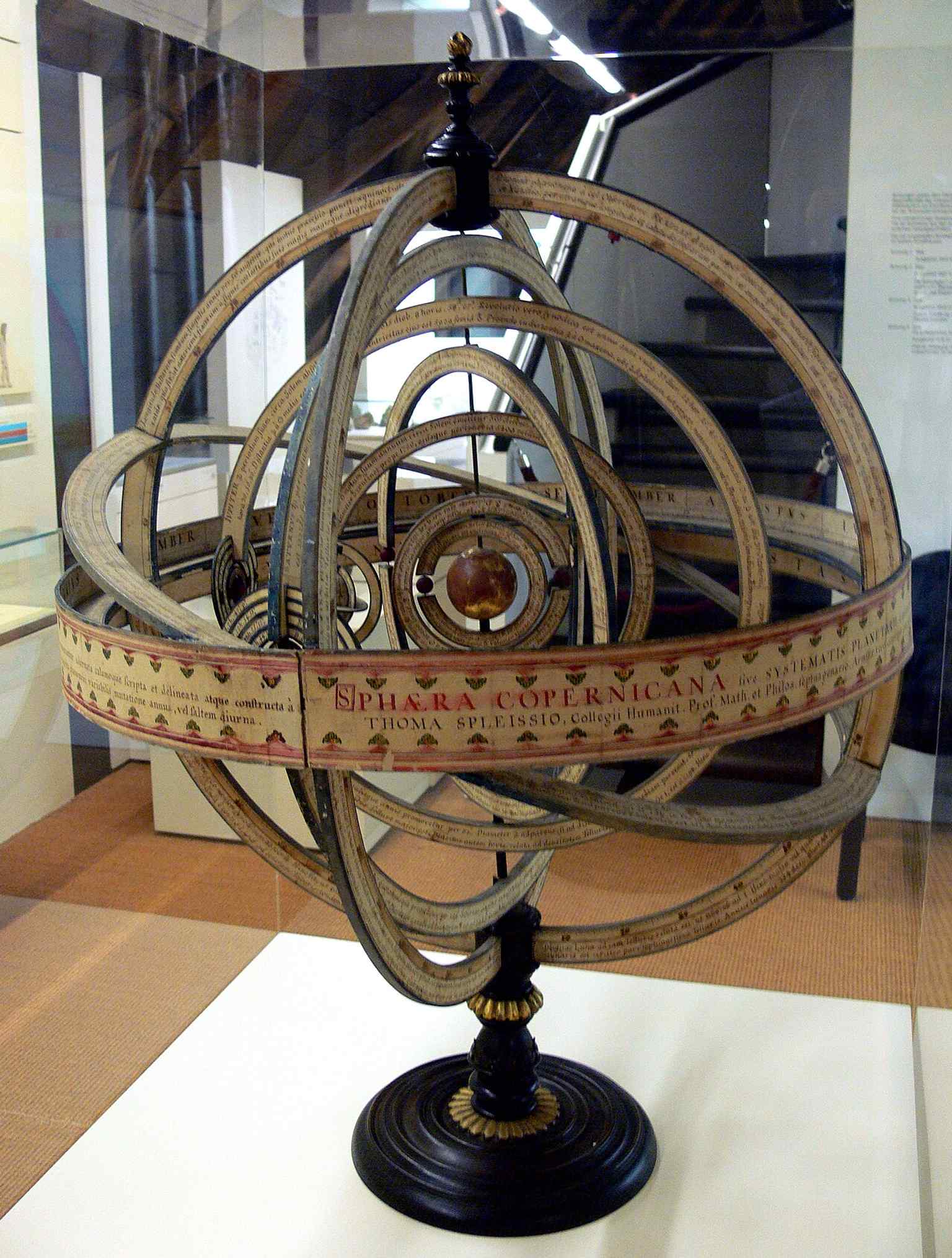
Thomas Spleiss’s planetarium in the museum collection, showing how the museum brings together science as well as art, history, and nature.Photo: User:Helvetiker, Wikimedia Commons, Public domain. Cropped & resized. From here, we leave stored memory for measured time. In about two minutes, we’ll reach the International Watch Company, where Schaffhausen turned precision into a language the world could read.
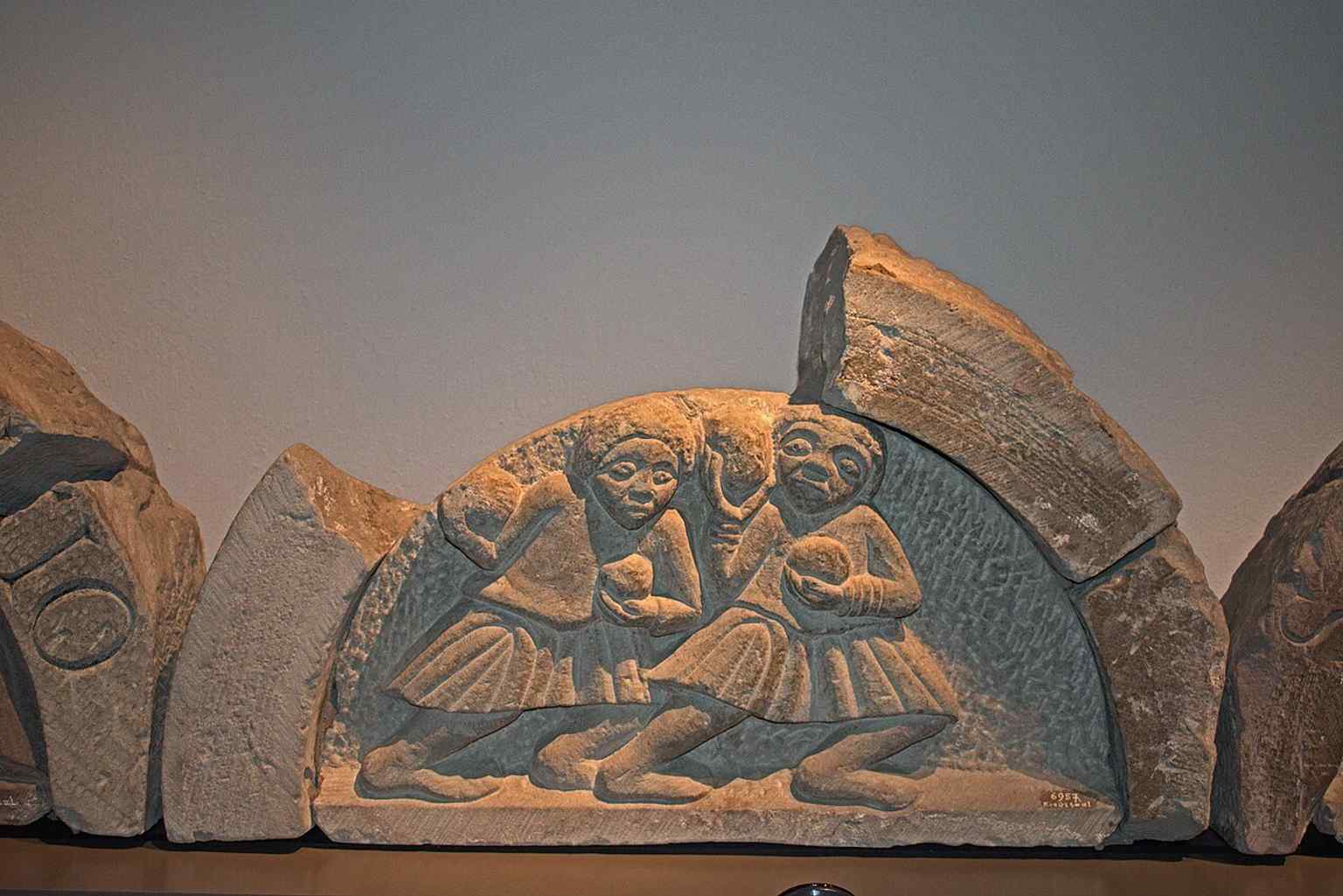
A 12th-century sandstone relief of Saint Stephen, part of the museum’s medieval holdings from the former monastery complex.Photo: Ymblanter, Wikimedia Commons, CC BY-SA 4.0. Cropped & resized. 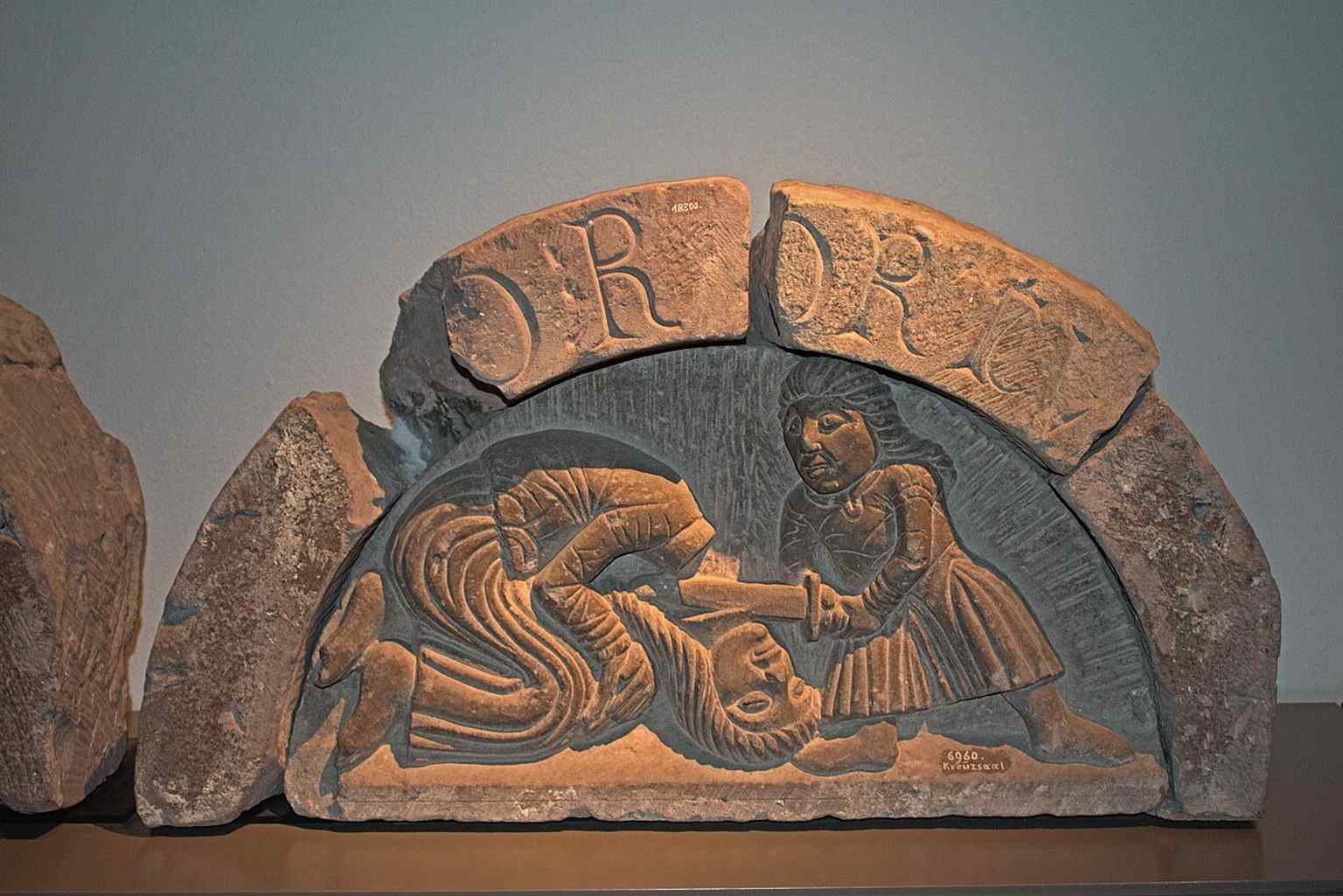
The Beheading of Saint John the Baptist — a Romanesque stone relief that fits the museum’s strong medieval art and archaeology collections.Photo: Ymblanter, Wikimedia Commons, CC BY-SA 4.0. Cropped & resized. 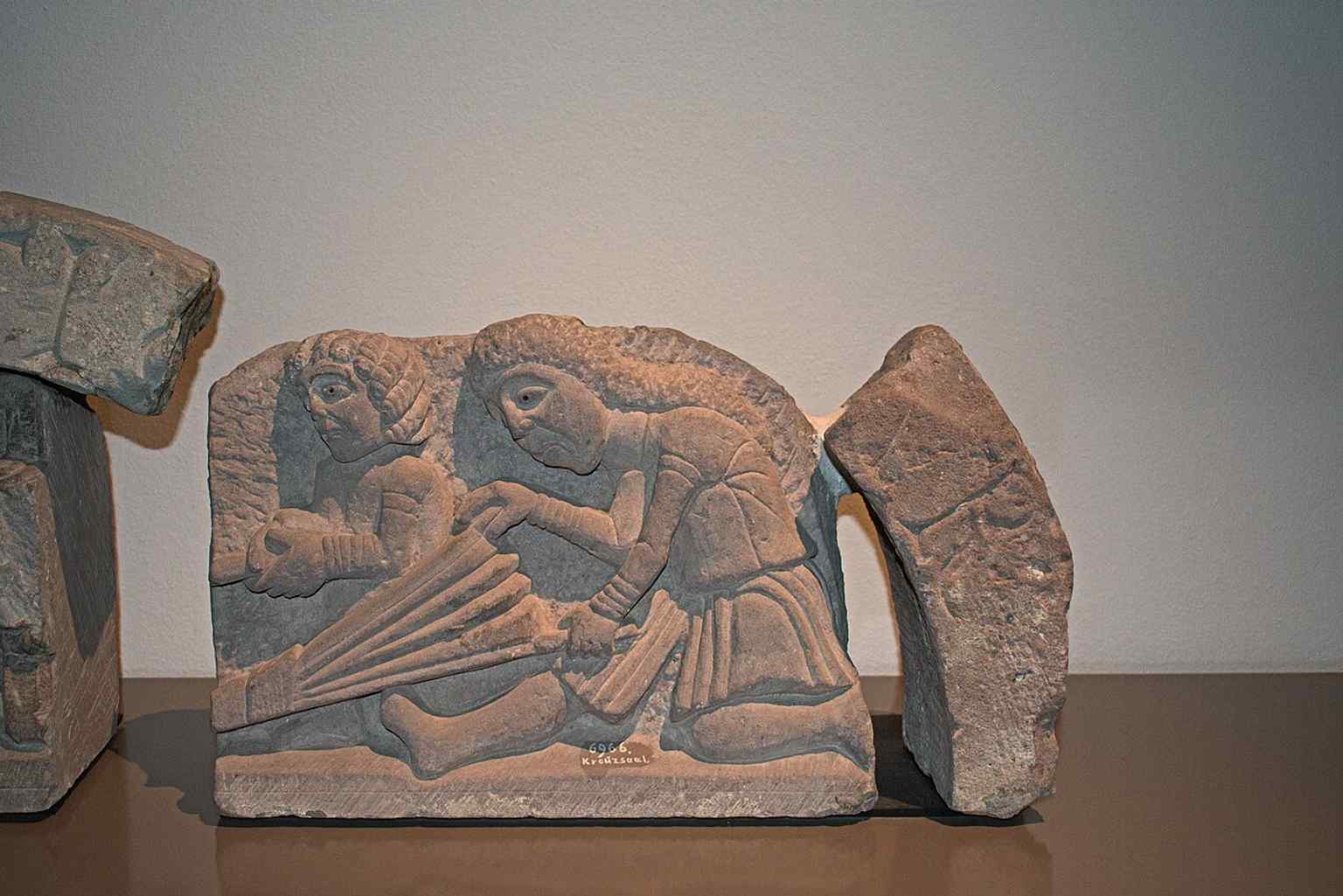
The Martyrdom of Saint Lawrence, one of the museum’s 12th-century sandstone reliefs preserved in the former Allerheiligen monastery.Photo: Ymblanter, Wikimedia Commons, CC BY-SA 4.0. Cropped & resized. 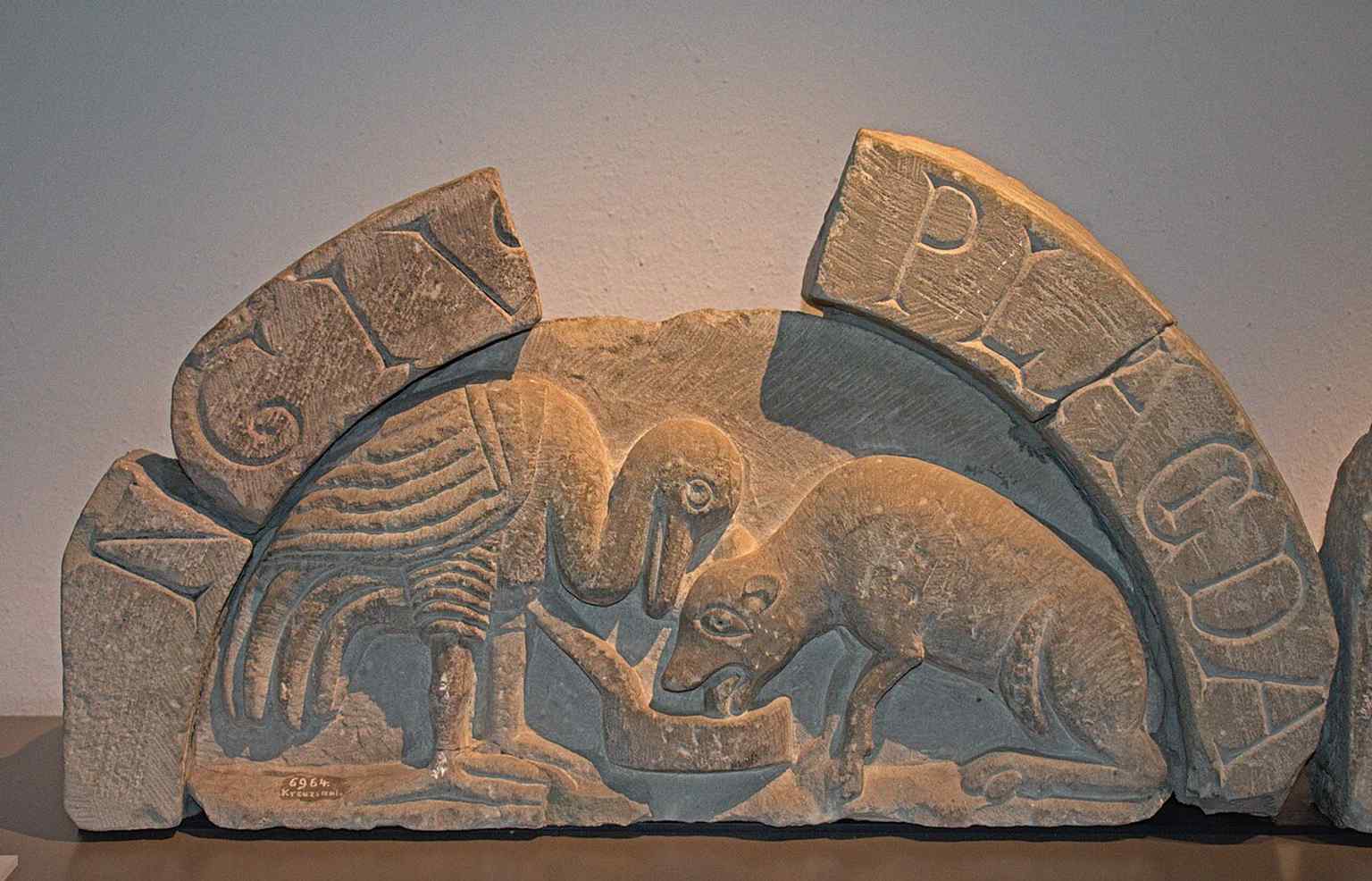
A playful medieval fable of the fox and the stork, a reminder that the museum’s stone carvings also include secular storytelling.Photo: Ymblanter, Wikimedia Commons, CC BY-SA 4.0. Cropped & resized. Look for a stately factory-style building with a pale masonry facade, long rows of rectangular windows, and the I-W-C name marking the place plainly. This is the International…Read moreShow less
Open dedicated page →
International Watch CompanyPhoto: Unknown author, Wikimedia Commons, Public domain. Cropped & resized. Look for a stately factory-style building with a pale masonry facade, long rows of rectangular windows, and the I-W-C name marking the place plainly.
This is the International Watch Company, I-W-C, and it tells a very Schaffhausen story: a local city with the nerve to think internationally. In eighteen sixty-eight, an American watchmaker and engineer named Florentine Ariosto Jones came here with a bold idea. He wanted Swiss craftsmanship, American industrial methods, and customers across the Atlantic... which is either visionary strategy or a splendid way to make accountants nervous.
Jones mattered because he saw what locals sometimes overlook in their own town. Schaffhausen had skilled hands, industrial discipline, and room to build. He founded the company here with another American, Charles Kidder, even though watchmakers in western Switzerland greeted the plan with a fair amount of skepticism. Reasonable, really. Outsiders often arrive announcing the future.
And here’s the detail locals enjoy slipping into the story: Jones was not just a businessman. He had served in the thirteenth Massachusetts Infantry during the U-S Civil War and listed his trade simply as “watchmaker.” So this quiet Swiss address connects, improbably, to one of the nineteenth century’s bloodiest conflicts. History does love an odd thread.
By eighteen seventy-five, I-W-C already employed one hundred ninety-six people. But machines, expansion, and a new production building cost more than Jones planned. He stepped down and returned to the United States. After more trouble, Schaffhausen industrialist Johannes Rauschenbach bought the firm in eighteen seventy-nine and finally pushed it toward lasting success. Later, the ownership web even touched Carl Gustav Jung, who became a shareholder through marriage. In Schaffhausen, even psychology can end up inside a watch company.
What came out of here kept shrinking precision without shrinking ambition. Earlier in town, precision lived in public spectacle, in things like Habrecht’s astronomical clock. Here, it moved onto the wrist. In nineteen fifteen, I-W-C began making movements specifically for wristwatches. In nineteen thirty-nine came the Portugieser, built around large, highly accurate pocket-watch mechanics. In the postwar years, technical director Albert Pellaton created a clever self-winding system that turned the wearer’s movement into energy through a rotor, a weighted semicircle that swings as your arm moves.
If you glance at your screen, the Aquatimer dial shows how far that ambition traveled: from old-town workshops to professional dive watches designed in nineteen sixty-seven for serious underwater use.
I-W-C still belongs to Schaffhausen, but it has always looked outward. Since two thousand it has been part of Richemont, and in twenty twenty-four its Portugieser Eternal Calendar won Geneva’s top watch prize. Not bad for a company started by an American veteran betting on Swiss precision.
When you’re ready, head back toward the older monastic core at the Monastery of All Saints, where some of this city’s earliest ambitions first took institutional shape. If you want to return later, this site is generally open Monday through Saturday, and closed on Sunday.
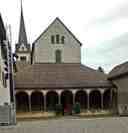
On your left, look for the pale stone church with its broad rectangular west porch and square tower rising into a steep spire. This is Allerheiligen, All Saints, and this is…Read moreShow less
Open dedicated page →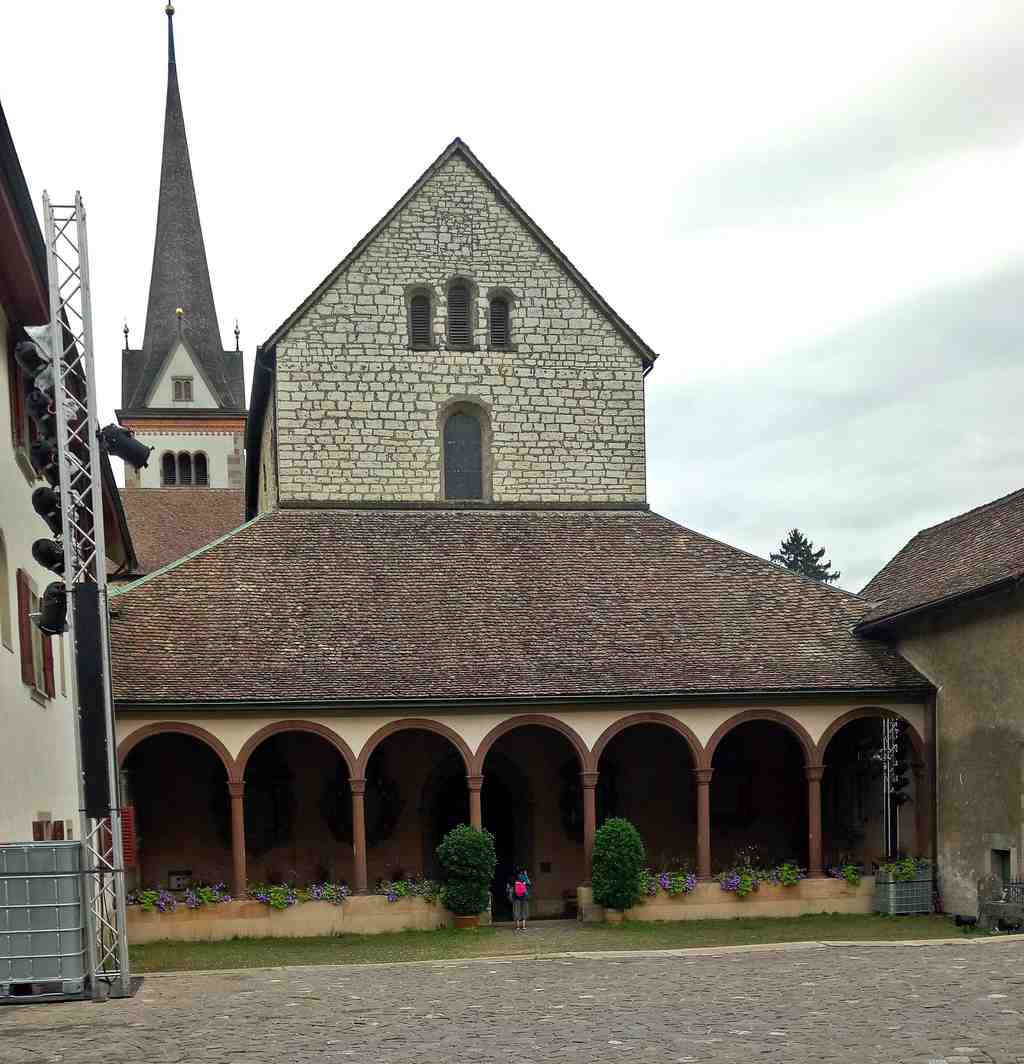
Monastery of All SaintsPhoto: Altera levatur, Wikimedia Commons, CC BY-SA 4.0. Cropped & resized. On your left, look for the pale stone church with its broad rectangular west porch and square tower rising into a steep spire.
This is Allerheiligen, All Saints, and this is where Schaffhausen stopped being just a settlement by the Rhine and started behaving like a place the wider world had to notice.
The story begins with Count Eberhard of Nellenburg. In the year ten forty-five, Emperor Henry the Third gave him minting rights in Schaffhausen. A few years later, around ten fifty, Eberhard founded a Benedictine abbey here in the wooded ground between the town and the river. He did not think small. On the twenty-second of November, ten forty-nine, Pope Leo the Ninth - a relative of Eberhard’s - consecrated an altar on this site. By ten fifty, building had already begun. According to the founders’ chronicle, Eberhard and his son Burkhard later traveled to Rome again, where Eberhard negotiated privileges with Pope Alexander. So from the start, this monastery looked not only to the town, but straight to Rome.
By ten sixty-four, Eberhard, his wife Ita, and their master builder Luitpald had completed the first abbey. They dedicated it to Christ the Savior, the Holy Cross, Mary, and all saints. Papal protection followed. That mattered enormously. It meant this was not just a family chapel with good connections. It became a serious institution with legal weight, spiritual prestige, and a direct line into the church reform movement of the age.
Then the Nellenburg family turned devotion into dynasty. After Eberhard won wider rights from the pope, he made Allerheiligen the family burial place. They added a burial crypt, a west tower, a cloister, and guest spaces. Eberhard himself retired here after ten seventy-five and was buried here. Ita, who also founded Saint Agnes, belongs to the same family script written across this part of town.
The really decisive move came from Burkhard. In ten eighty, he gave up the family’s private control over the monastery and handed Allerheiligen astonishing powers: the family lands, free election of the abbot, and the market and mint rights of Schaffhausen. In plain English... the abbot became the city’s lord. Before councils, newspapers, and industrial brands took their turn, power here wore a monk’s habit.
The church you see now mostly comes from the rebuilding that began around ten ninety. The monks planned an enormous five-aisled church - ambitious, glorious, and a little too ambitious. Internal conflict stopped that grand version at the foundations, so they finished the present three-aisled basilica instead, and added the great porch around eleven oh five. If you want a closer look at that porch, there’s a good image in the app.
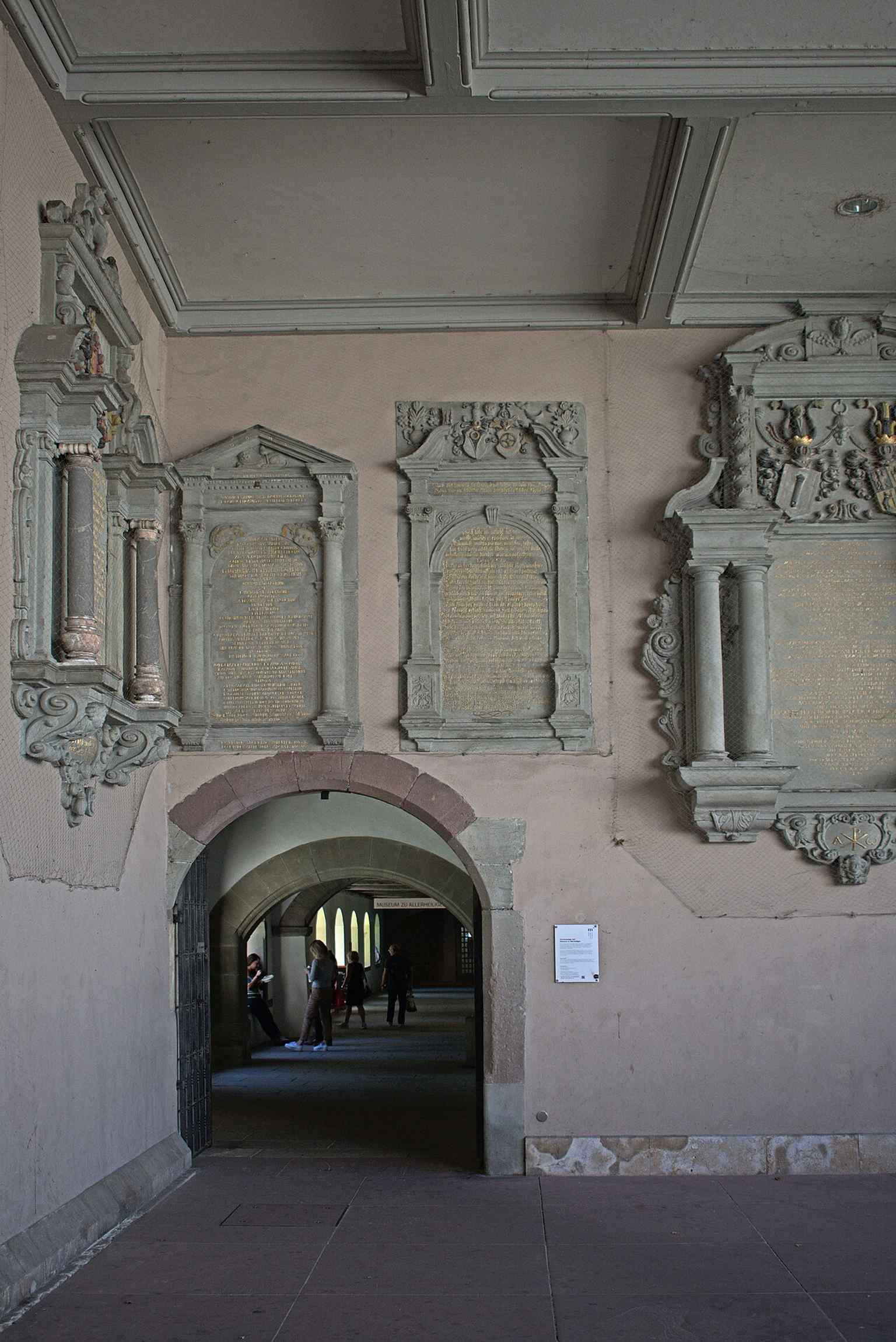
The Münster porch on the west side, linked to the 12th-century rebuilding after the original five-aisled plan was abandoned.Photo: Ymblanter, Wikimedia Commons, CC BY-SA 4.0. Cropped & resized. This monastery later lost political muscle, and in fifteen twenty-nine the Reformation dissolved it. But the break was not total ruin. The church became Evangelical-Reformed, and the rich monastery library passed into the city library. If you’re curious, take a peek at the before-and-after image in the app; it shows how this complex changed from a barer nineteenth-century survivor into the carefully conserved ensemble beside you.
Even after U-S bombers damaged parts of the complex in nineteen forty-four, Schaffhausen rebuilt it. Fairly stubborn, this place.
So pause here a moment. These stones mark the city’s first great conversion of faith into influence. From here, the story climbs uphill to Munot, where authority stops chanting and starts keeping watch.
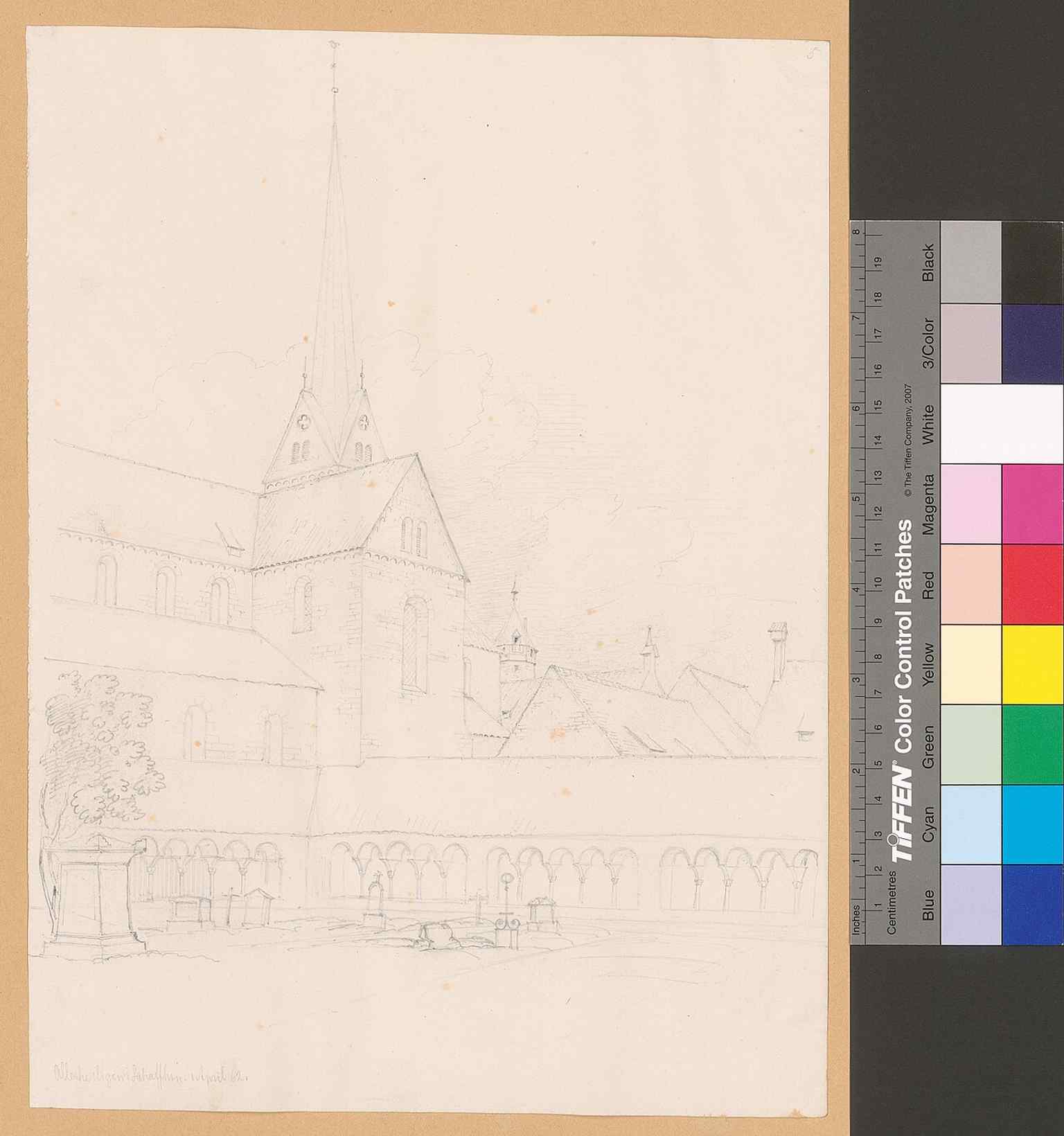
A 19th-century view of the church and cloister, showing the medieval complex before modern restoration campaigns.Photo: Johann Rudolf Rahn, Wikimedia Commons, Public domain. Cropped & resized. 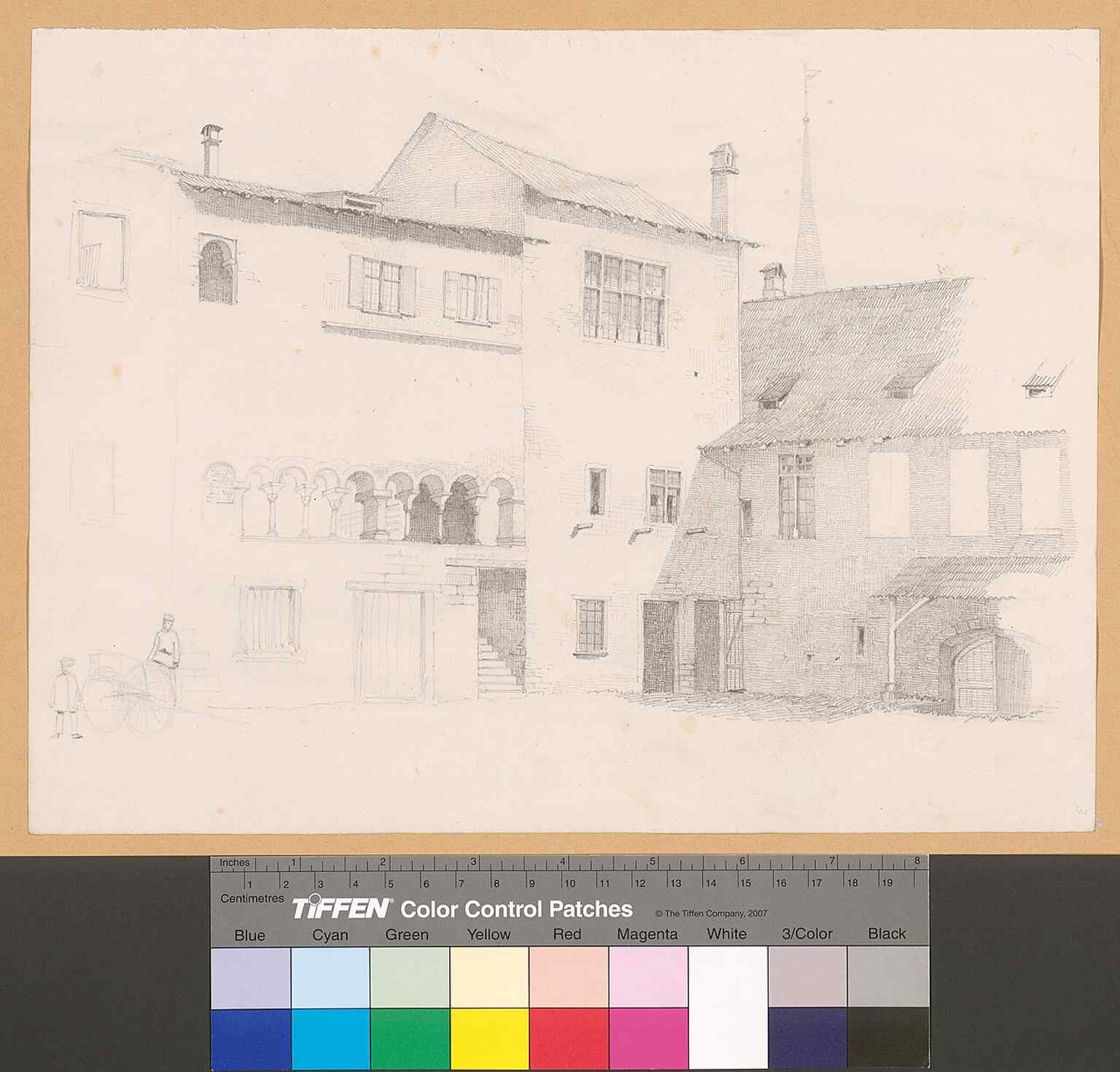
The monastery courtyard in 1862, a rare early image of the claustral heart of Allerheiligen.Photo: Johann Rudolf Rahn, Wikimedia Commons, Public domain. Cropped & resized. 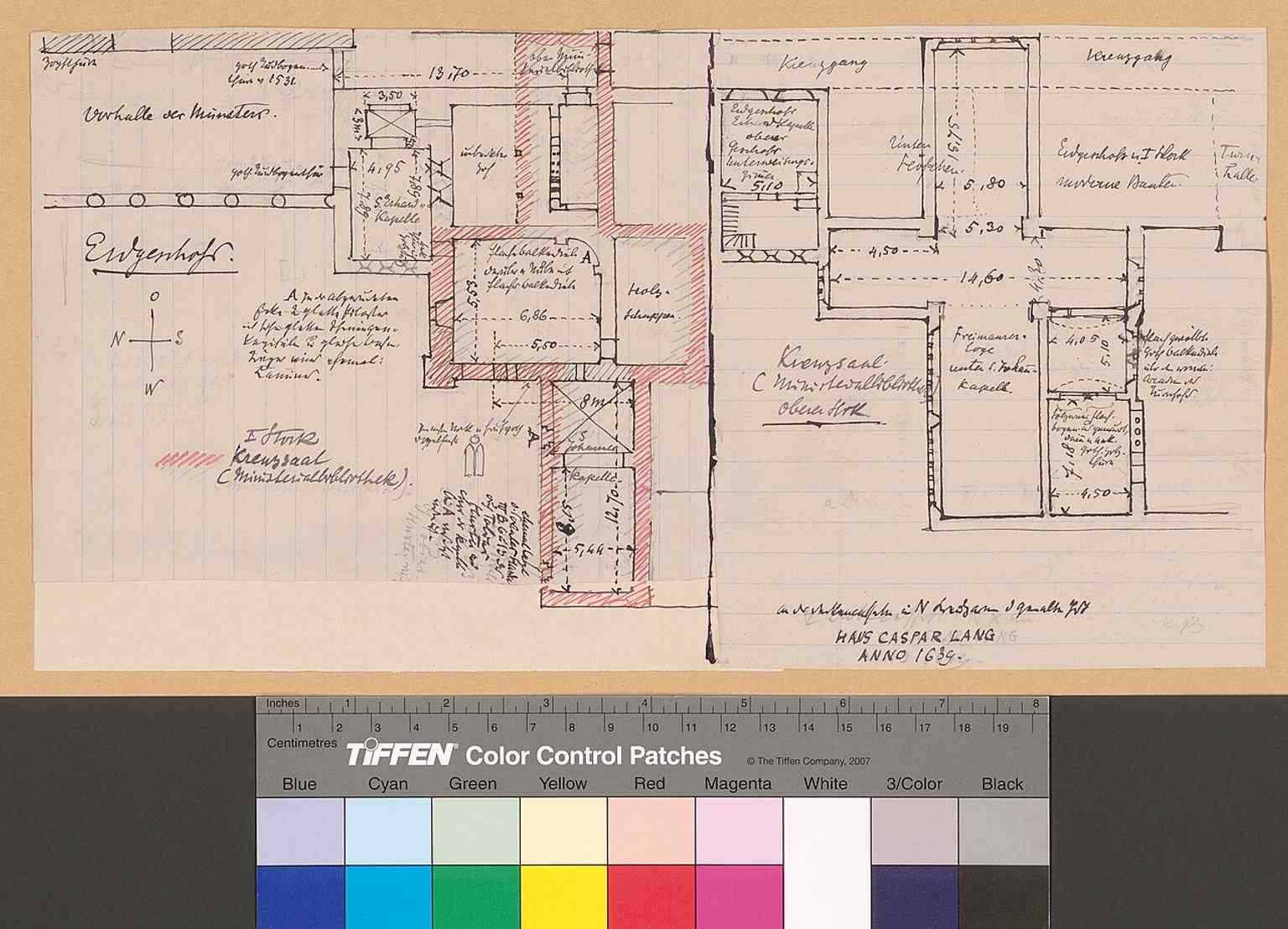
A floor plan of the monastery’s ground and upper levels, useful for understanding the cloister, hall, and library layout.Photo: Johann Rudolf Rahn, Wikimedia Commons, Public domain. Cropped & resized. 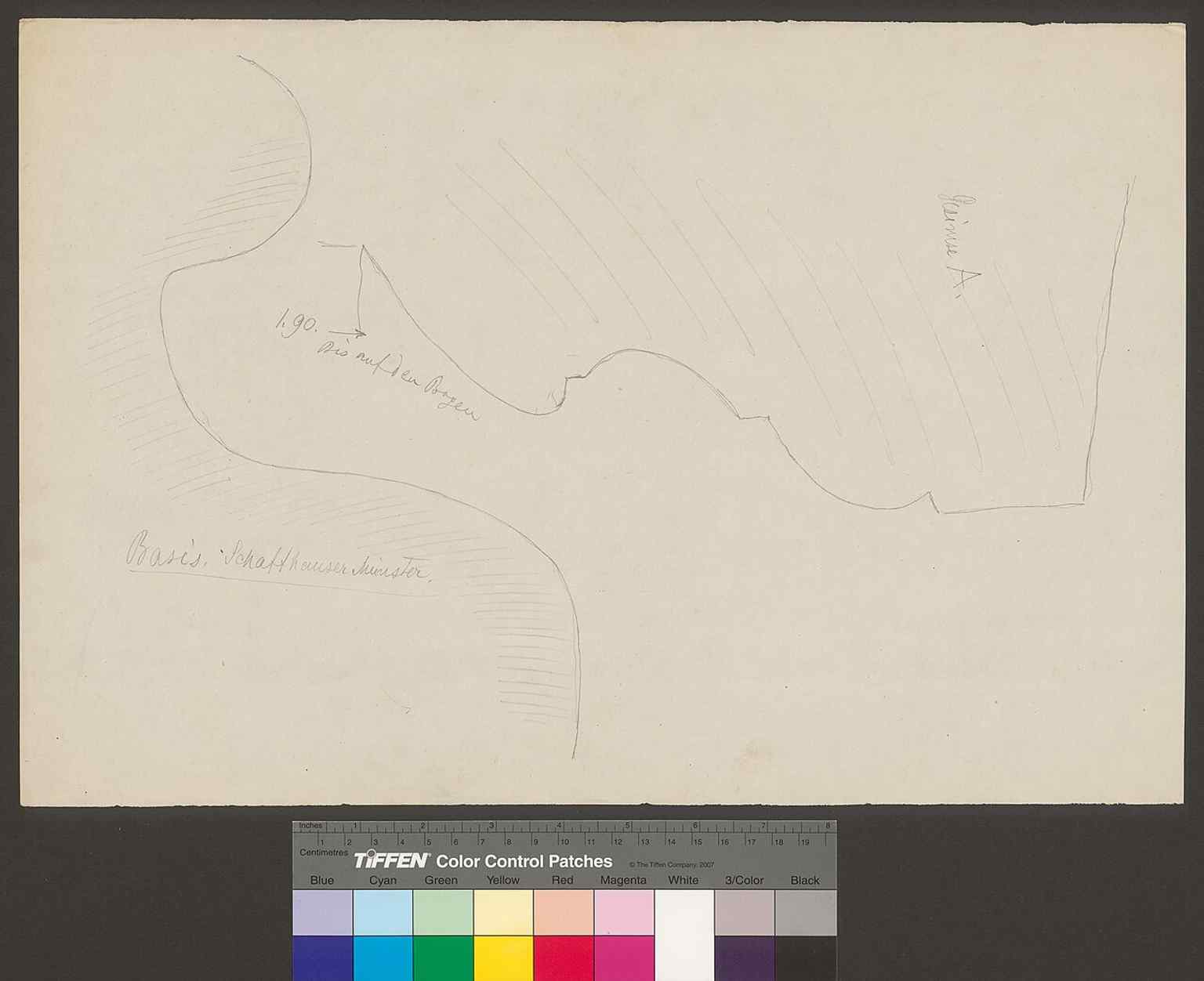
An early architectural study of Schaffhausen Münster, reflecting the Romanesque church built over the earlier foundations.Photo: Johann Rudolf Rahn, Wikimedia Commons, Public domain. Cropped & resized. 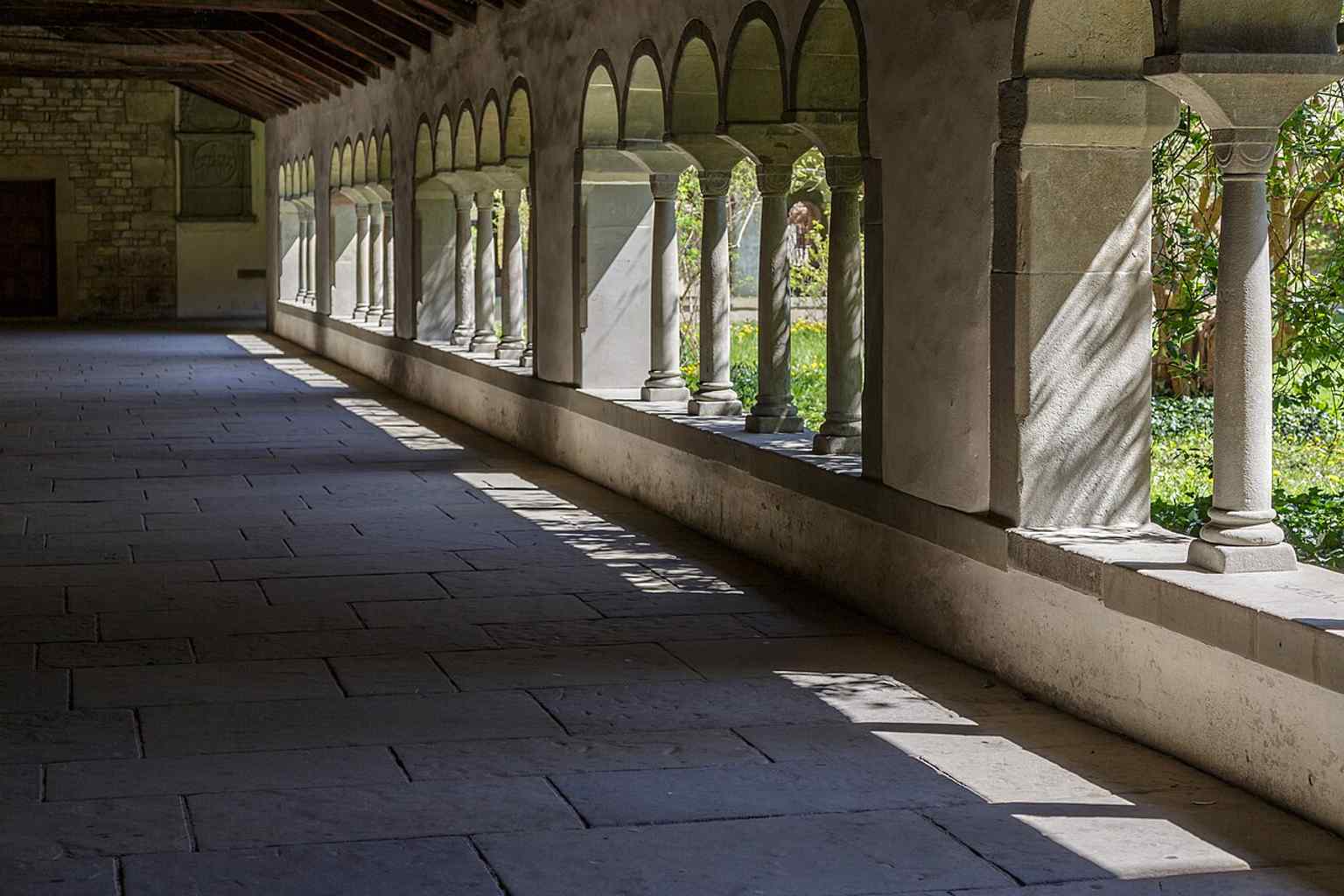
The cloister of Allerheiligen, where the monastery’s reform-era life and burial traditions were centered.Photo: JoachimKohler-HB, Wikimedia Commons, CC BY-SA 4.0. Cropped & resized. 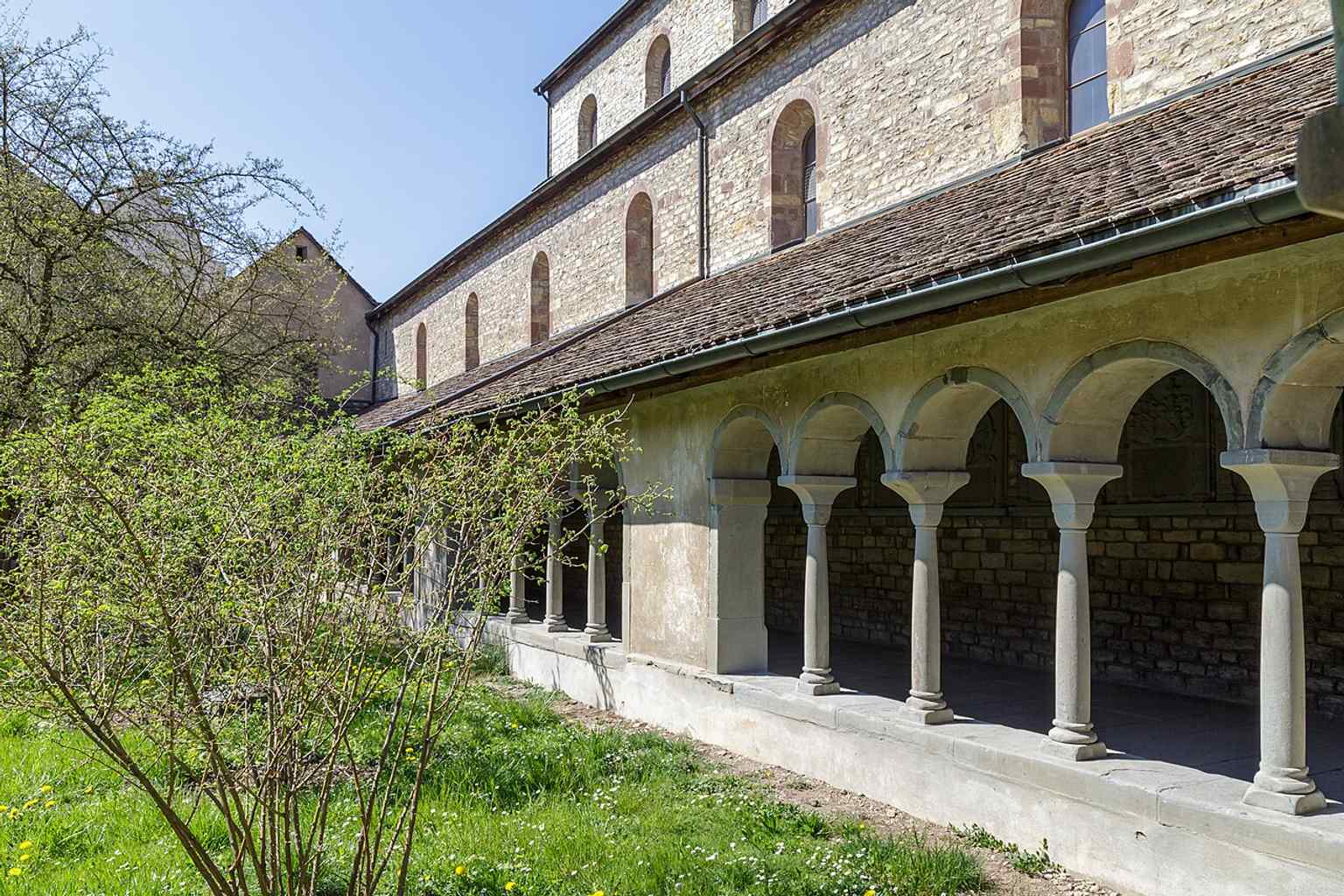
An exterior view of the cloister arcade, showing the monastic enclosure that shaped daily life at Allerheiligen.Photo: JoachimKohler-HB, Wikimedia Commons, CC BY-SA 4.0. Cropped & resized. 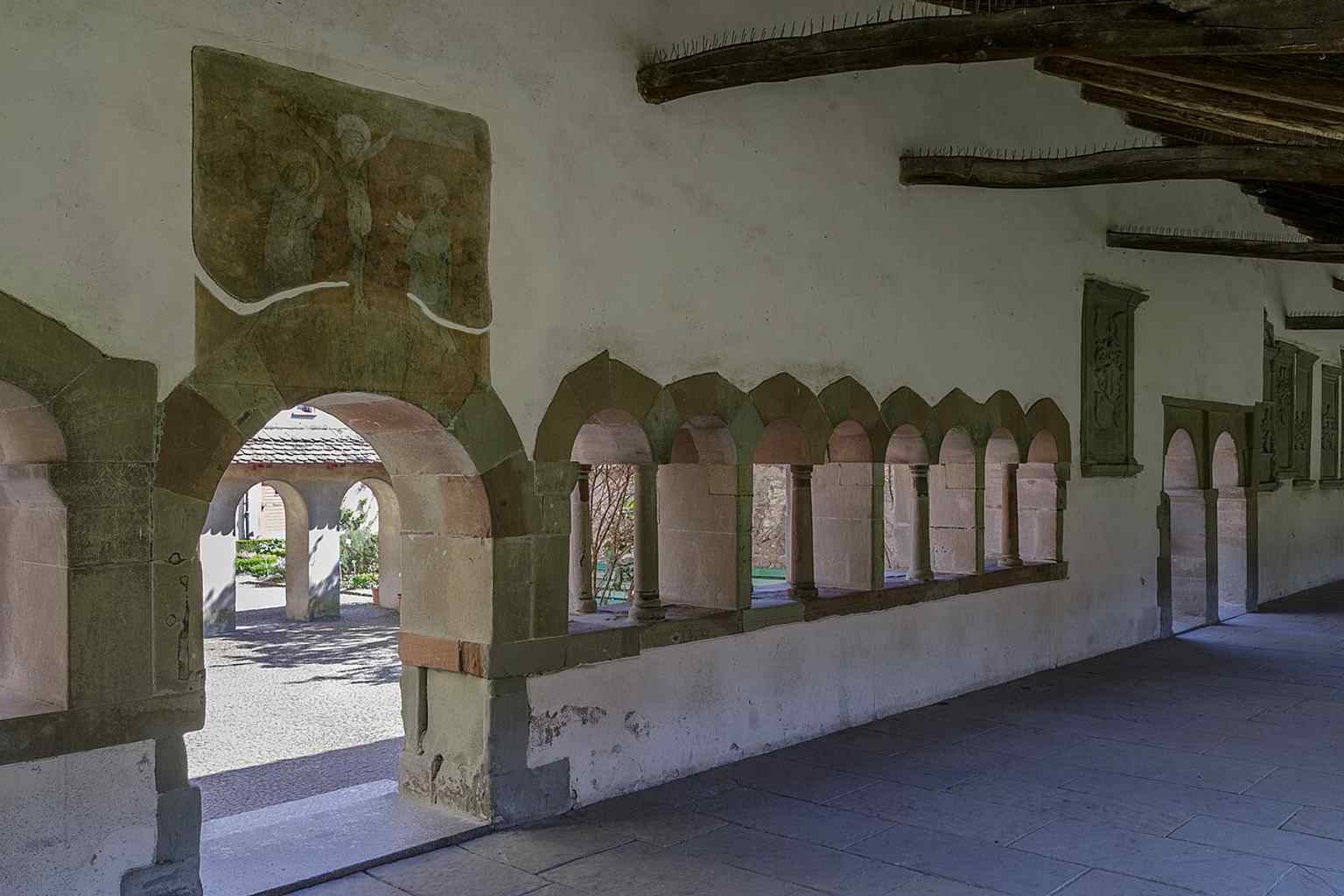
The cloister of the cathedral monastery, a quiet space that connects the church with the convent buildings.Photo: JoachimKohler-HB, Wikimedia Commons, CC BY-SA 4.0. Cropped & resized. 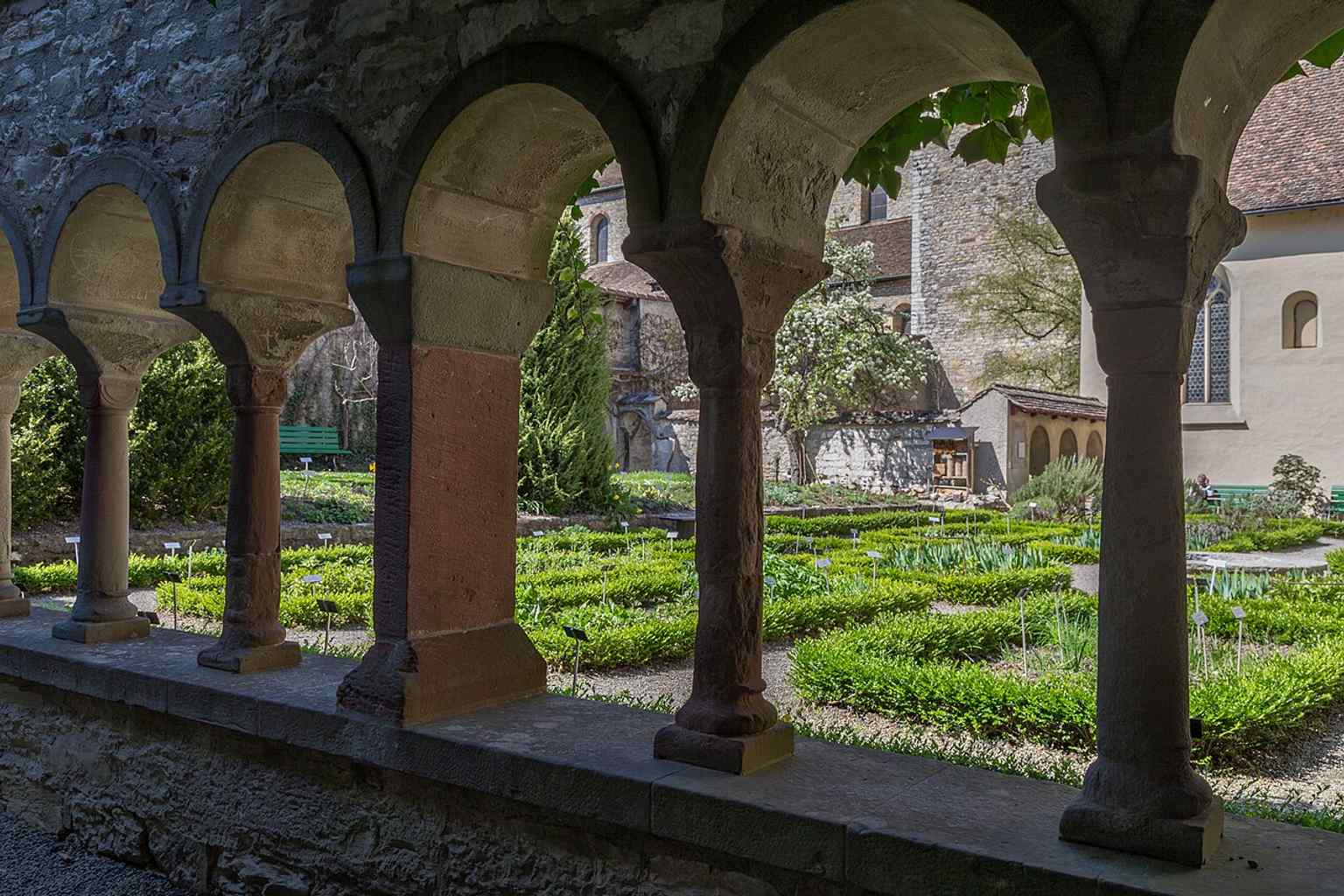
Looking from the cloister into the herb garden, echoing the monastery’s enclosed practical and devotional world.Photo: JoachimKohler-HB, Wikimedia Commons, CC BY-SA 4.0. Cropped & resized. 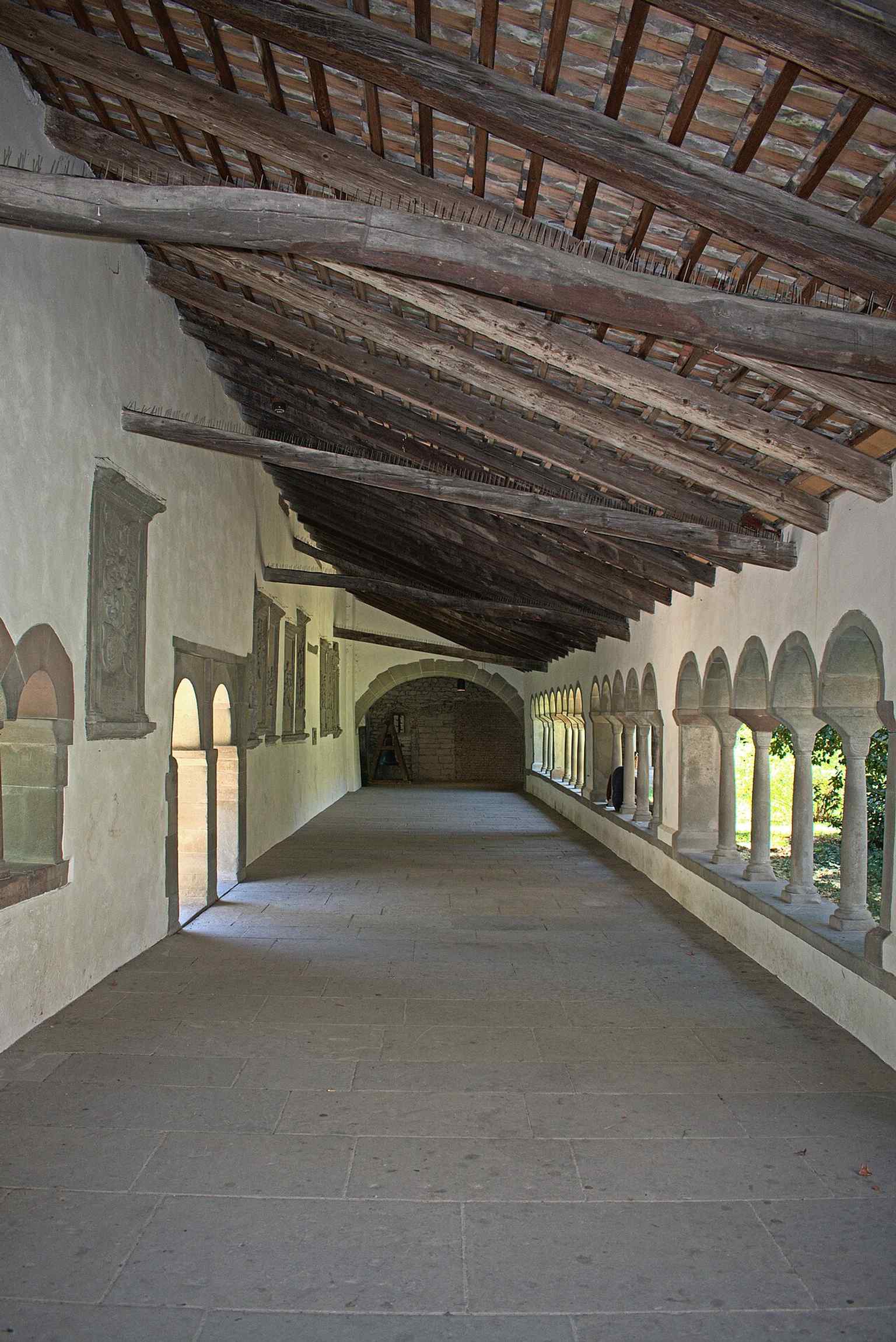
The eastern cloister arcade, one of the best surviving parts of the monastery’s medieval precinct.Photo: Ymblanter, Wikimedia Commons, CC BY-SA 4.0. Cropped & resized. 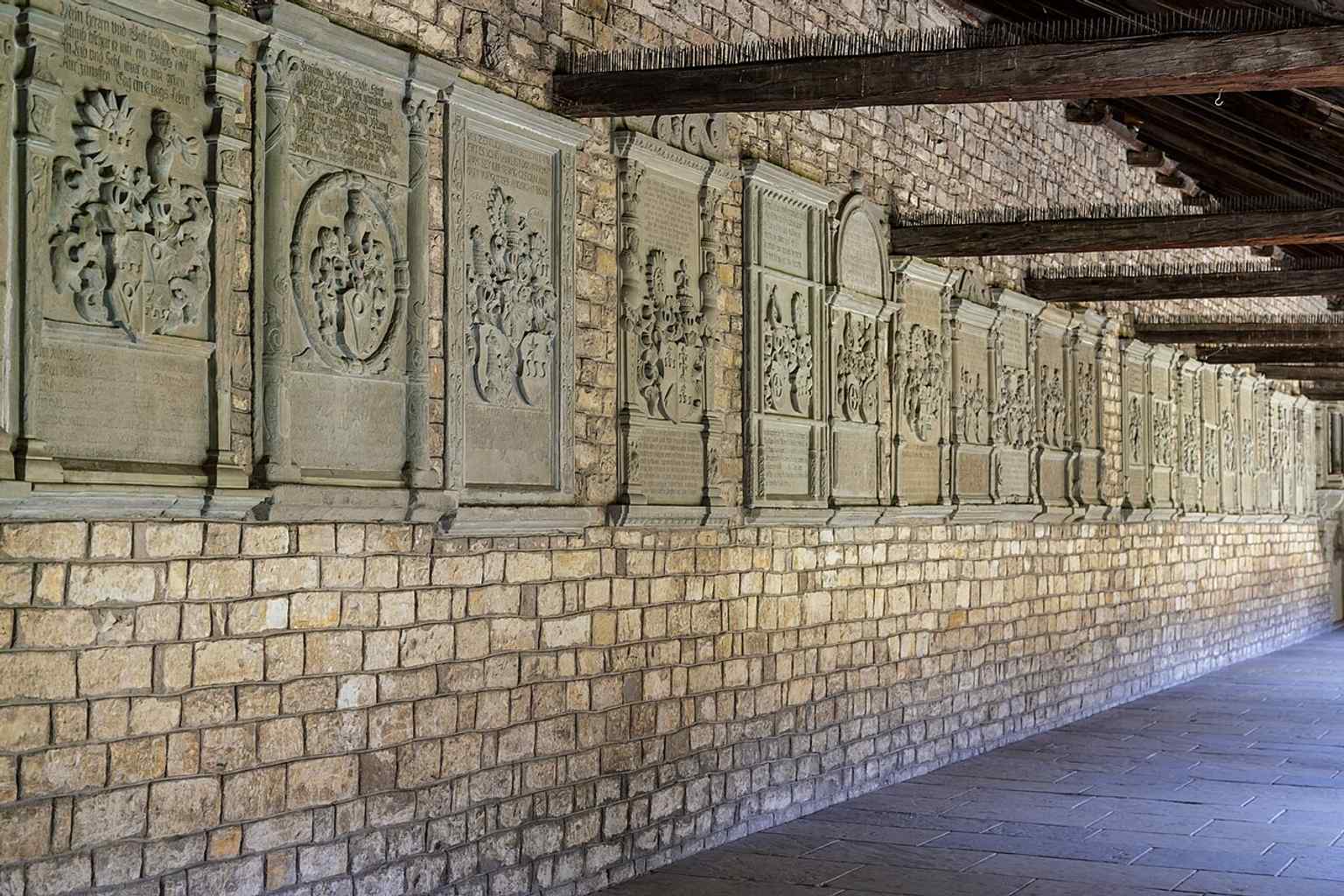
Cloister epitaphs in Allerheiligen, recalling the abbey’s role as the burial place of the Nellenburg founders and later abbots.Photo: JoachimKohler-HB, Wikimedia Commons, CC BY-SA 4.0. Cropped & resized. 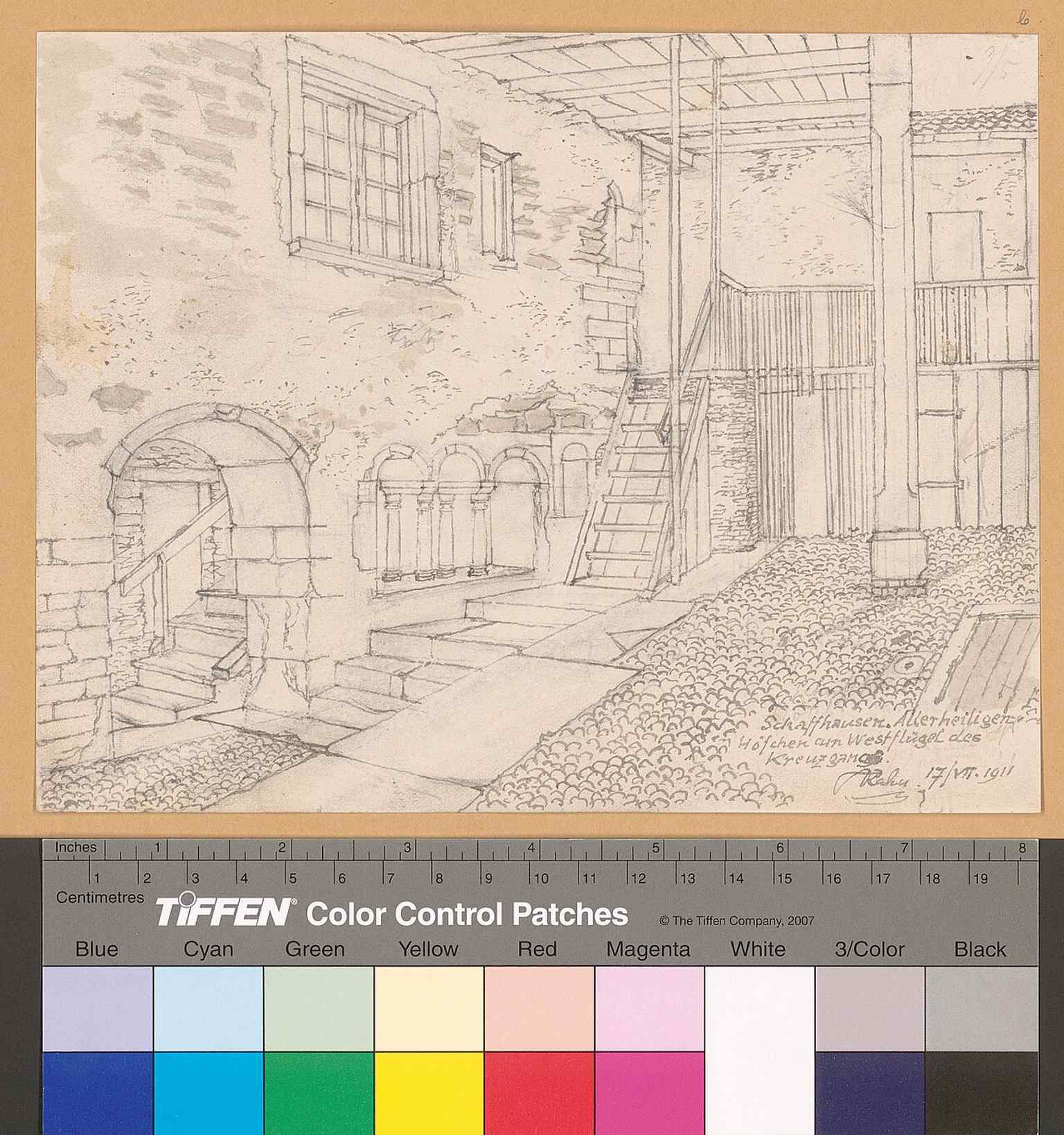
A 1911 view of the small courtyard on the west wing of the cloister, part of the old monastic circulation spaces.Photo: Johann Rudolf Rahn, Wikimedia Commons, Public domain. Cropped & resized. 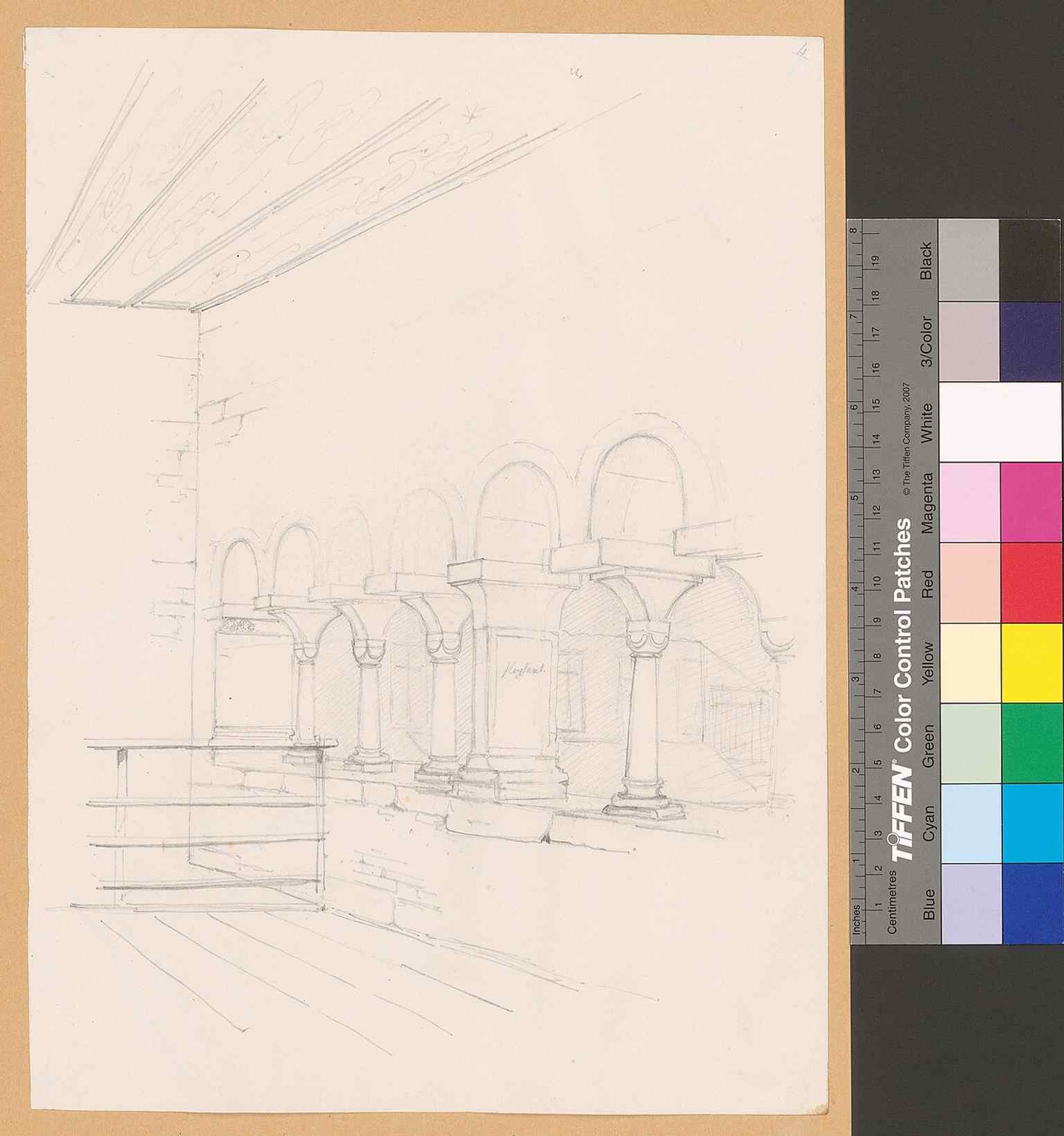
The great loggia of Allerheiligen in an 1862 print, a reminder of the monastery’s later architectural additions.Photo: Johann Rudolf Rahn, Wikimedia Commons, Public domain. Cropped & resized. 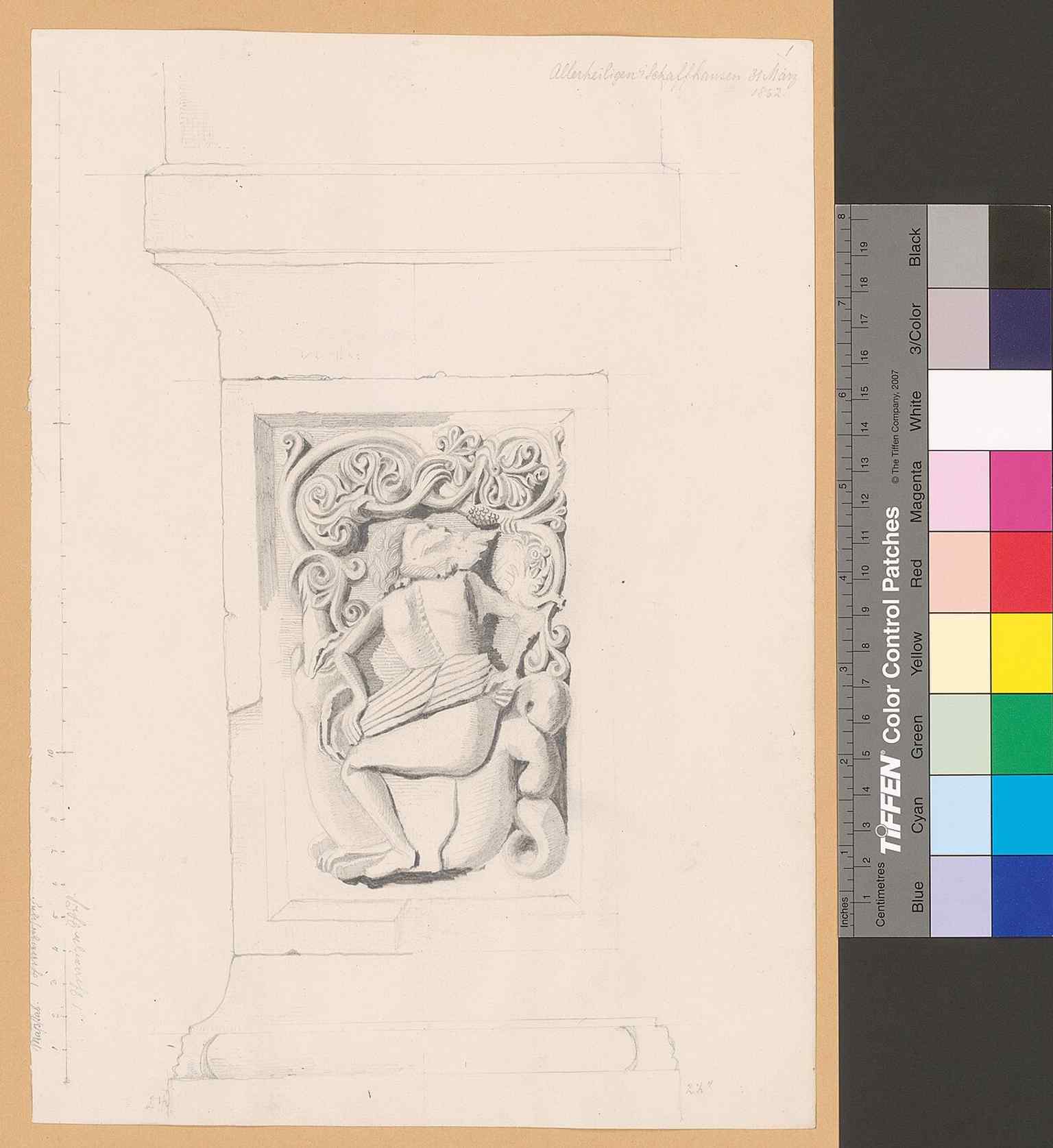
A carved apocalyptic rider relief from the great loggia, showing the rich Romanesque and Gothic ornament of the complex.Photo: Johann Rudolf Rahn, Wikimedia Commons, Public domain. Cropped & resized. Ahead of you stands a massive pale stone fortress: a broad circular wall rising from the hill, with a projecting tower on the city side that makes the whole thing look less like a…Read moreShow less
Open dedicated page →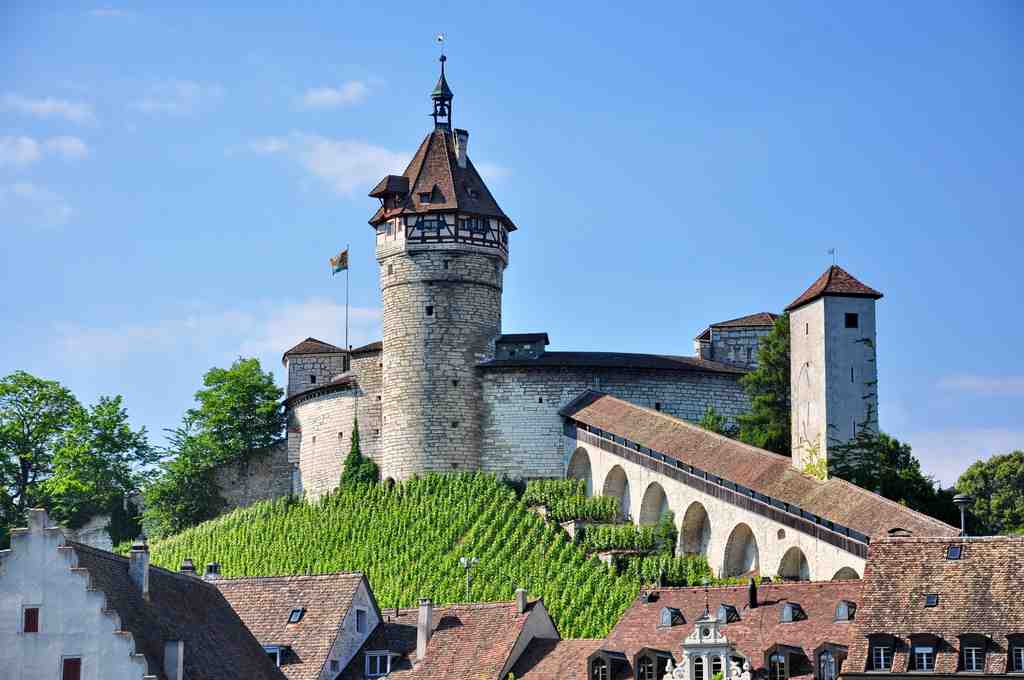
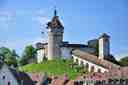
MunotPhoto: Roland zh, Wikimedia Commons, CC BY-SA 3.0. Cropped & resized. Ahead of you stands a massive pale stone fortress: a broad circular wall rising from the hill, with a projecting tower on the city side that makes the whole thing look less like a castle and more like a machine built to stare back.
This is the Munot, Schaffhausen’s emblem... though postcard charm is only half the story. Between the fifteen sixties and fifteen eighties, the city built it here on Emmersberg hill as part of its defenses, and it did so partly through compulsory labor, the old duty called Frondienst. So yes, this landmark arrived with muscle, pressure, and a strong municipal sense of urgency.
The design followed fortress ideas associated with Albrecht Dürer. Below, a hexagonal trench wrapped around the core, with caponiers - little defensive chambers that let soldiers fire along a ditch instead of only straight ahead. Above that came the circular casemates, the protected gun rooms, and the fighting platform. It was clever, severe, and expensive. People still started doubting it almost at once, because artillery improved so quickly that even new fortresses could feel old on arrival.
And then there was the Munot watchman, the human face of Schaffhausen’s long habit of keeping watch. He did not simply ring a bell and enjoy the view. He had to report fires, enemy movement, storms, and cargo boats arriving on the Rhine - basically an earlier, louder version of local breaking news. The city also regulated his life with almost comic determination: church only on Sundays, bathing every second Sunday, later a ban on taverns and social gatherings, and in fifteen fifty-four the council even warned him not to drink too much... and if he absolutely insisted, to do it with his wife up in the tower. Efficient, if not especially festive.
If you want a quick sense of how little the silhouette changed, glance at the before-and-after image in the app.
What nearly finished the Munot was not war but neglect. Once it lost military value, people treated it as a stone quarry. Then a schoolteacher, Johann Jakob Beck, campaigned to save it. Restoration began in eighteen twenty-six, and when the renewed monument opened in eighteen thirty-nine, Schaffhausen celebrated with speeches, music, singing, and a remarkable barrage of cannon shots. Nothing says “gentle preservation” quite like six hundred fifteen explosions.
Even the old moat changed roles. Since nineteen oh five, fallow deer have lived there, turning a defensive scar into an oddly civic habitat. If you want, check the deer photo in the app later.
Before you leave, take a moment and scan the city below. Which rooftops, towers, and offices now look like places made for watching, warning, or controlling the flow of things?
From here, head down toward the river and on to the Güterhof, where vigilance gives way to cargo, traffic, and exchange. If you plan to come back inside the Munot itself, it generally opens daily from nine in the morning to five in the afternoon.
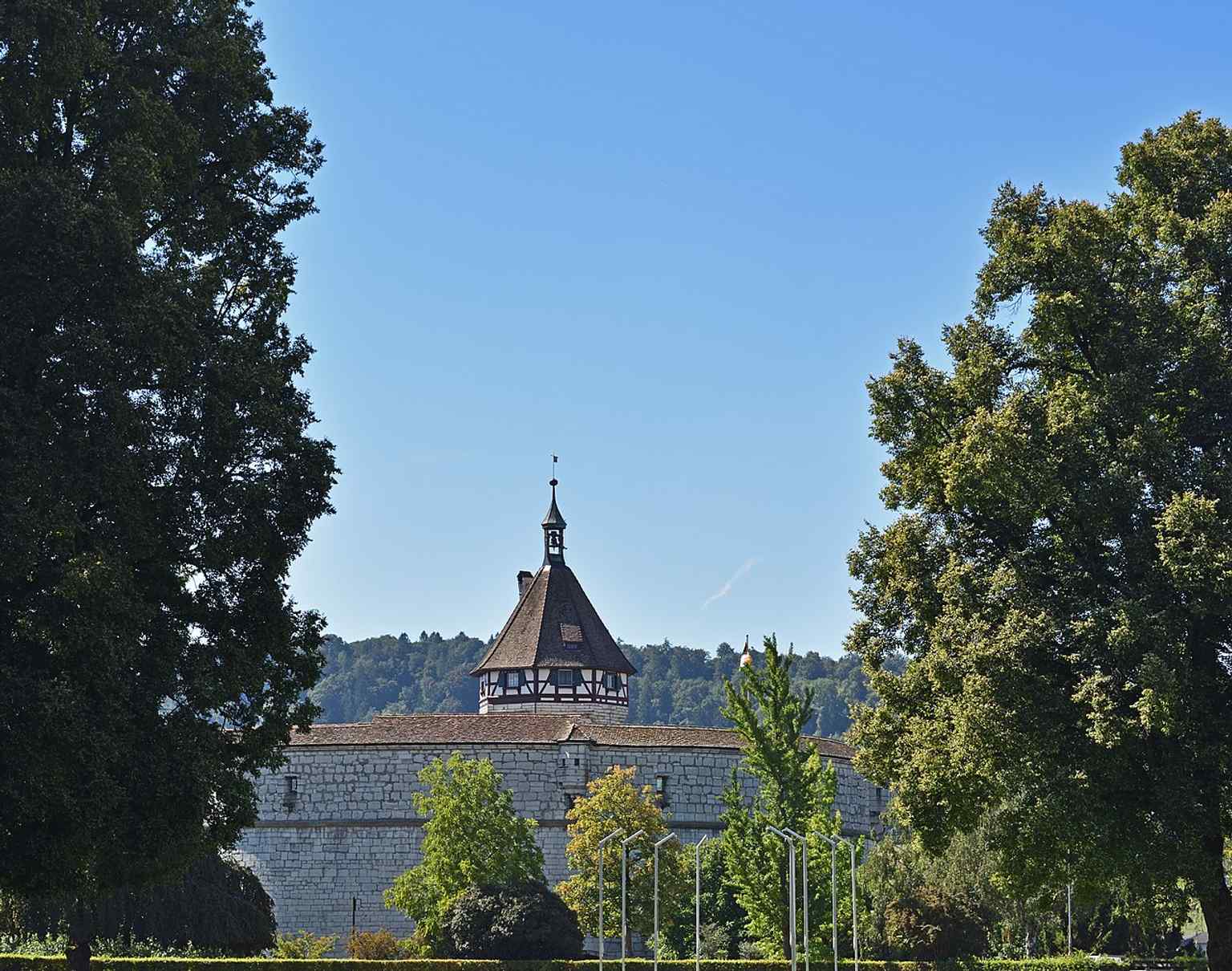
The Munot’s round fortress wall and tower, the city’s best-known symbol above Schaffhausen.Photo: Ymblanter, Wikimedia Commons, CC BY-SA 4.0. Cropped & resized. 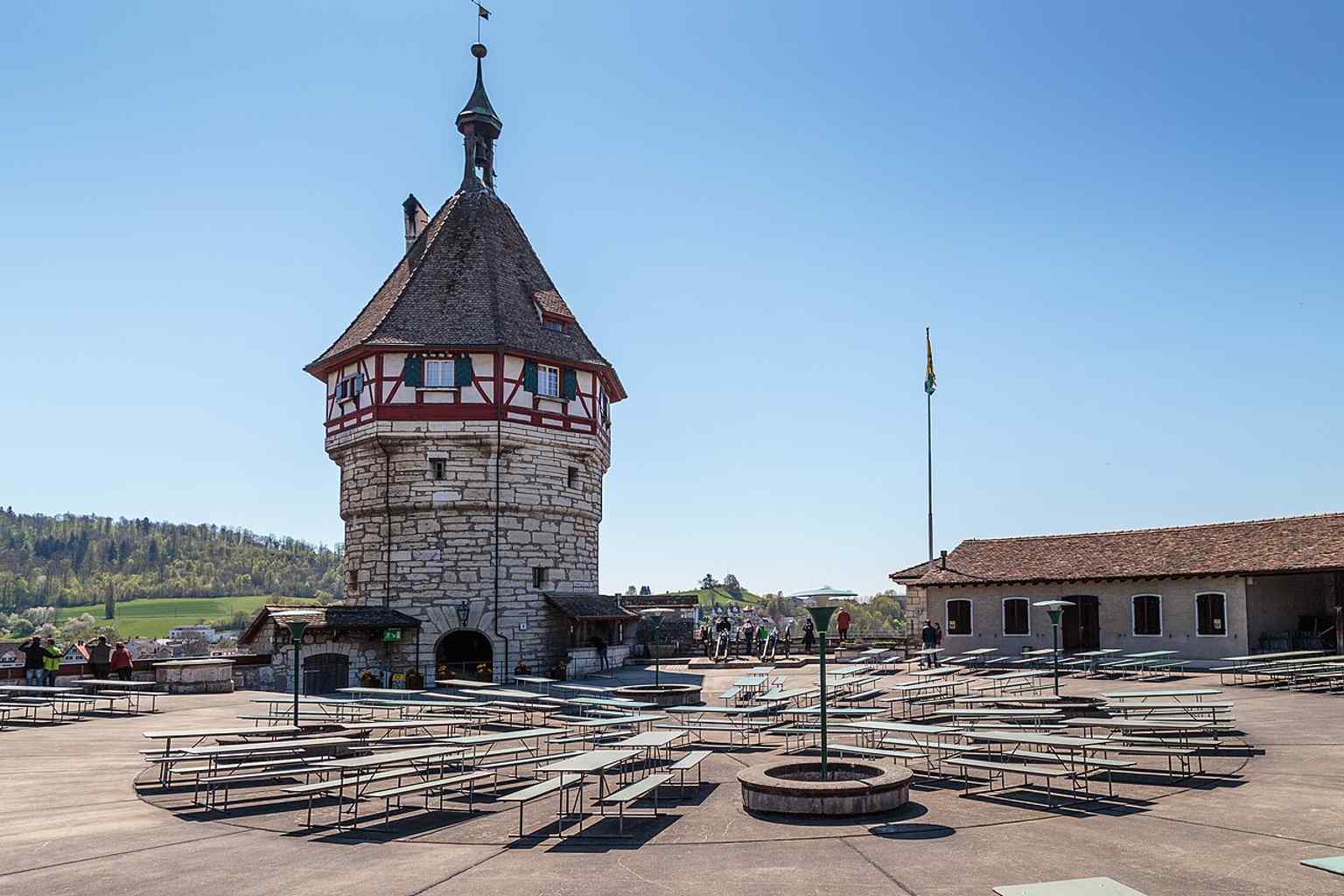
The upper platform and tower show the Munot’s circular defensive design and city-facing lookout position.Photo: JoachimKohler-HB, Wikimedia Commons, CC BY-SA 4.0. Cropped & resized. 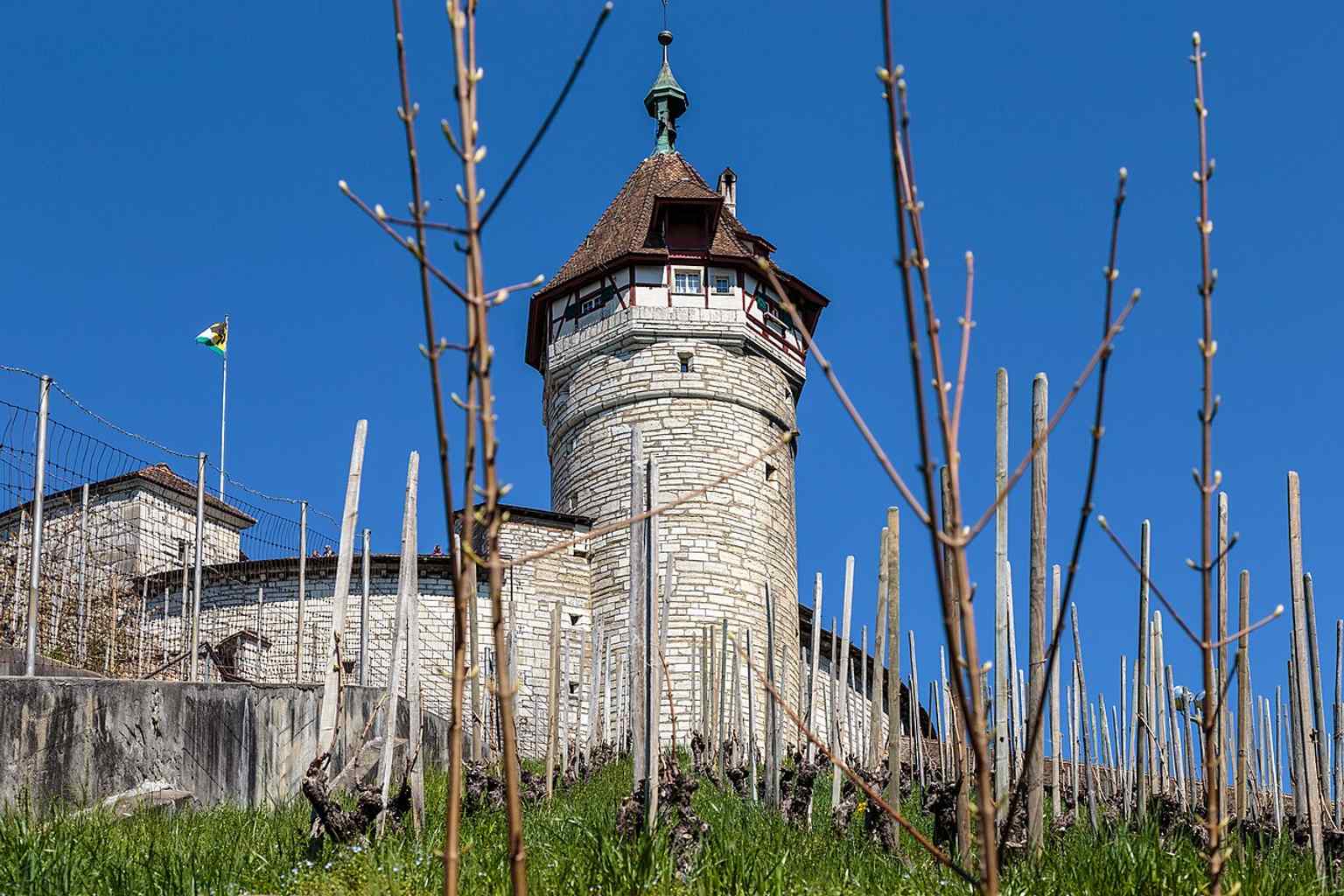
The tower rising above the vineyards reflects the Munot’s setting on Emmersberg hill, surrounded by wine-growing slopes.Photo: JoachimKohler-HB, Wikimedia Commons, CC BY-SA 4.0. Cropped & resized. 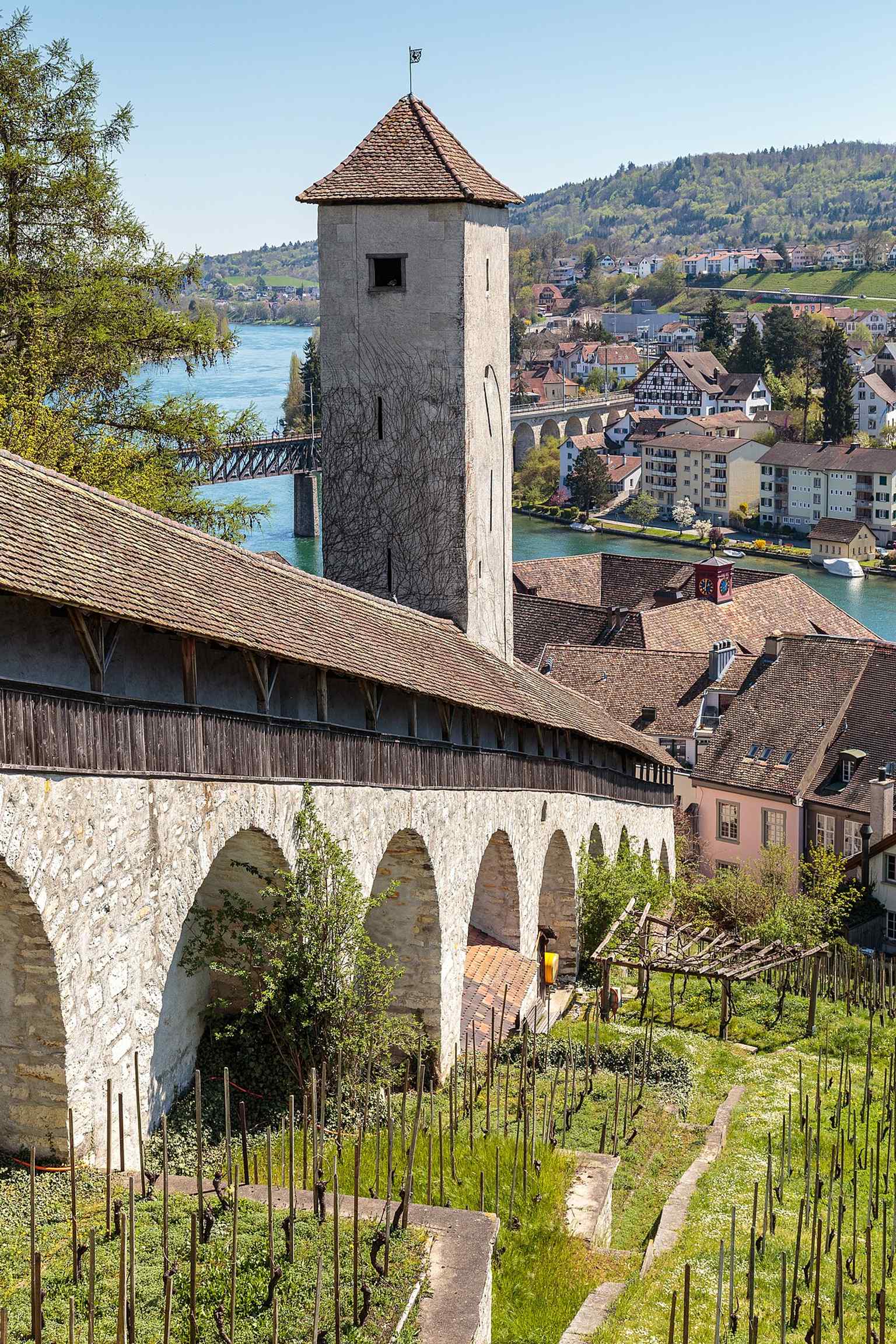
A sweeping view from the Munot over the Rhine and surrounding town, echoing its old role as a watchpoint for fires, storms, and river traffic.Photo: JoachimKohler-HB, Wikimedia Commons, CC BY-SA 4.0. Cropped & resized. 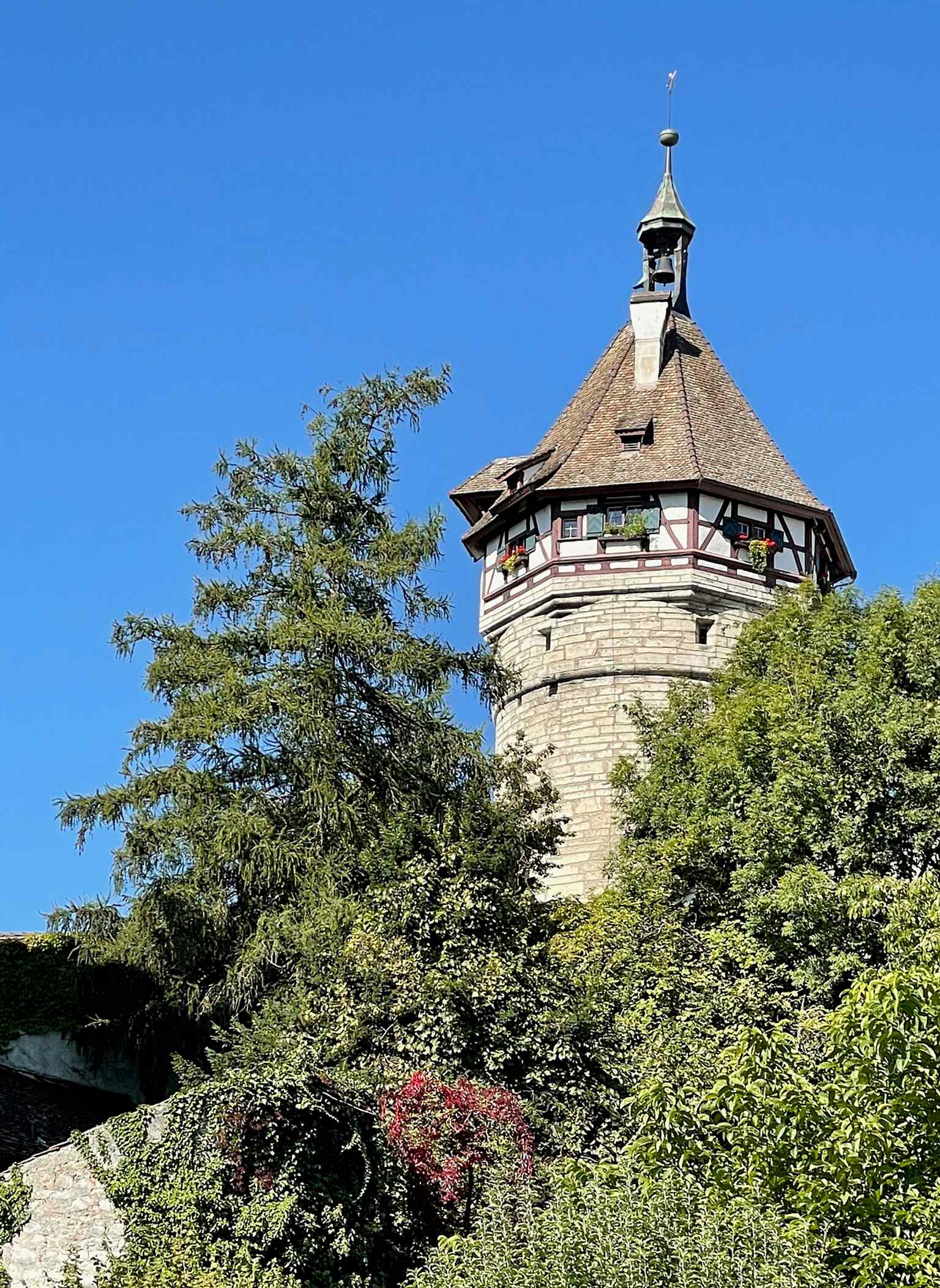
The Munot bell is still part of daily life here, and its 9 p.m. ringing remains the fortress’s signature ritual.Photo: HerBauhaus, Wikimedia Commons, CC BY-SA 4.0. Cropped & resized. 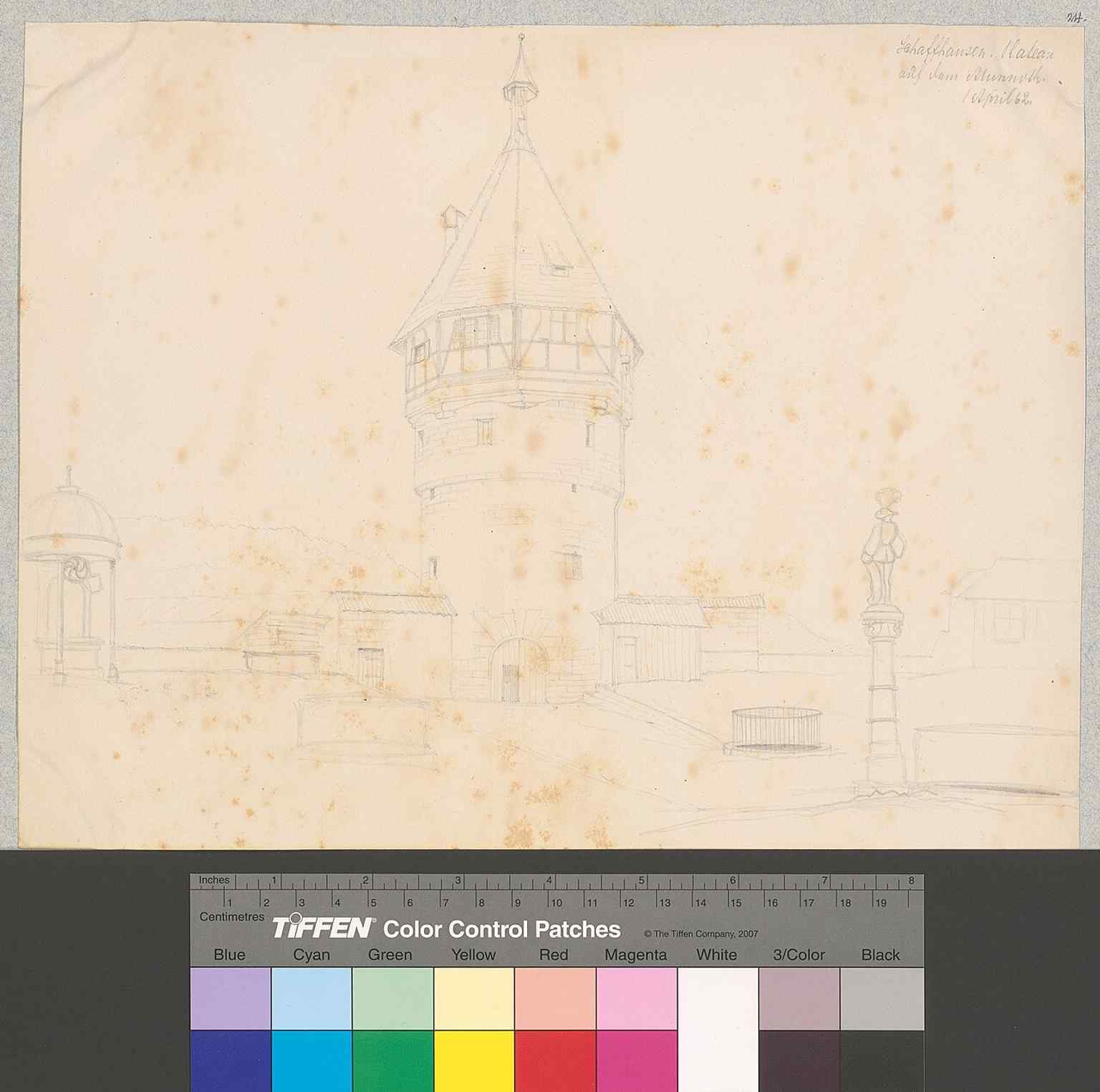
A 19th-century view of the Munot ramparts, useful for showing the monument before and after its rescue from quarrying.Photo: Johann Rudolf Rahn, Wikimedia Commons, Public domain. Cropped & resized. 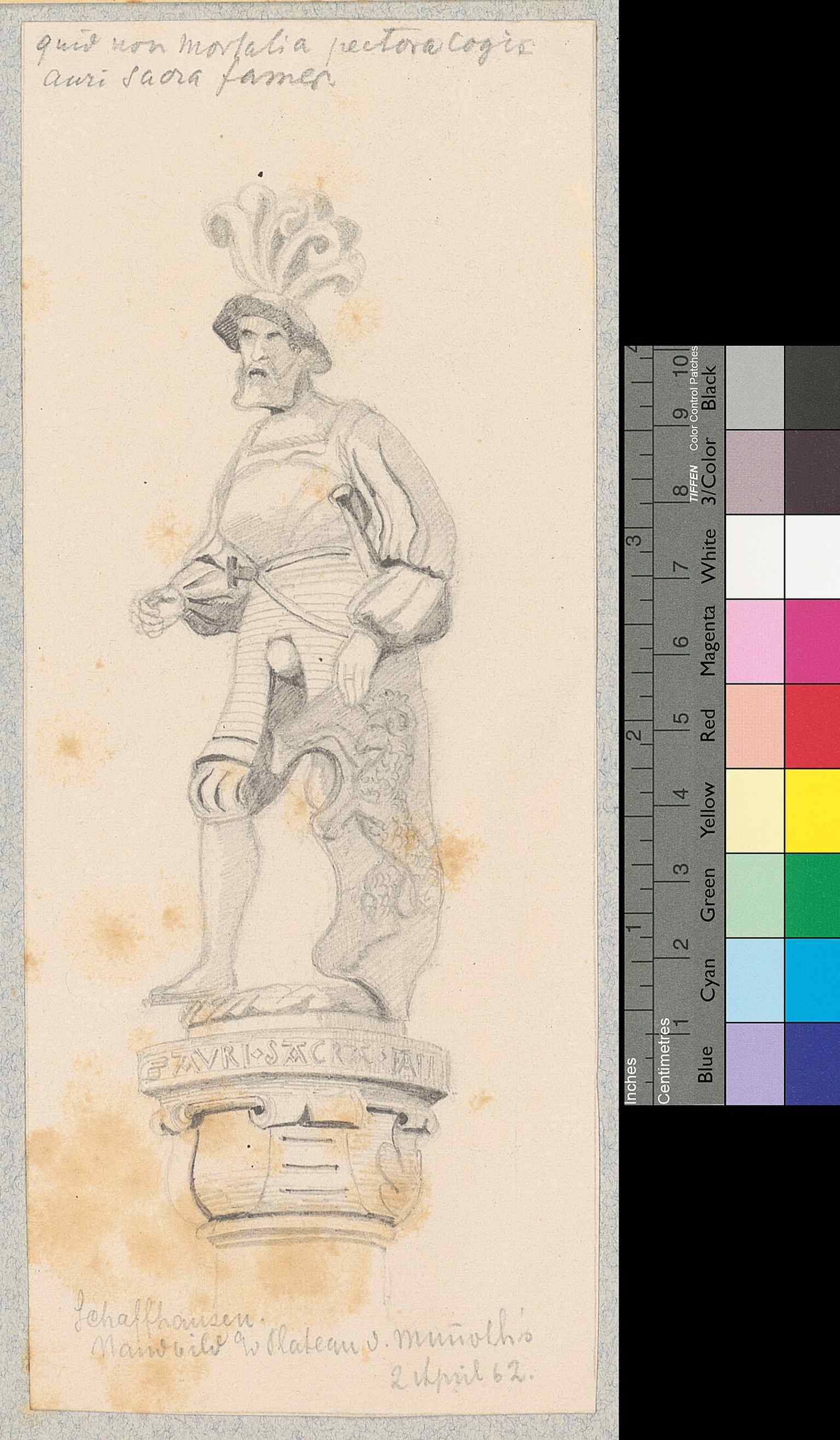
An old engraved view of the Munot plateau, linking the fortress to its long history of watchmen and city defense.Photo: Johann Rudolf Rahn, Wikimedia Commons, Public domain. Cropped & resized. On your left is a long, pale plastered warehouse with a low, broad roof, rows of evenly spaced windows, and a small clock turret perched on top like a supervisor who never quite…Read moreShow less
Open dedicated page →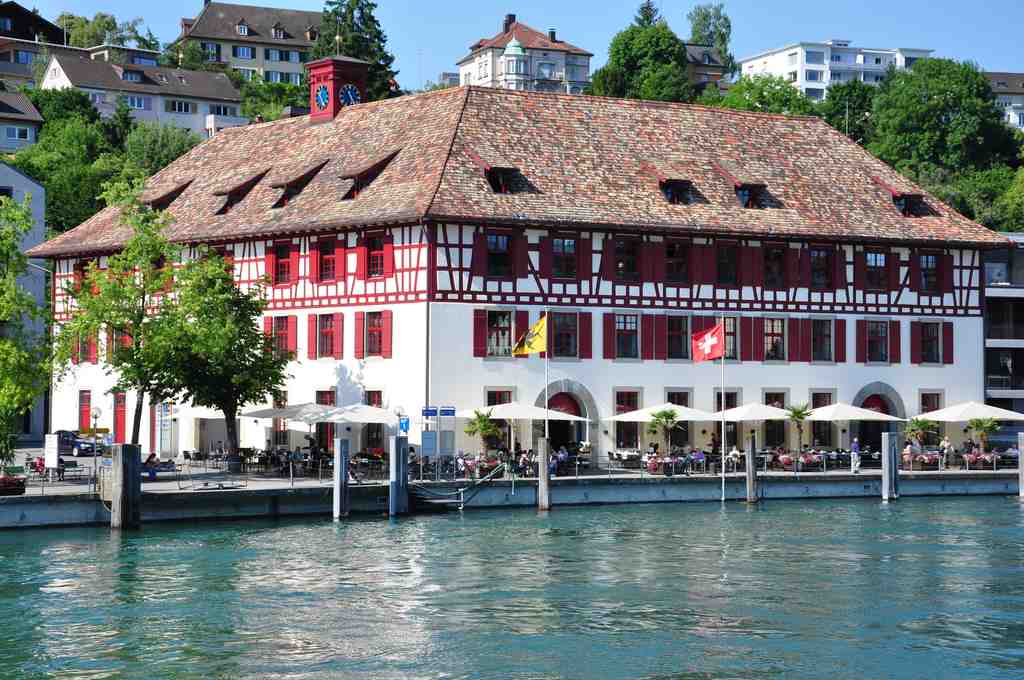
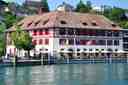
GüterhofPhoto: Roland zh, Wikimedia Commons, CC BY-SA 3.0. Cropped & resized. On your left is a long, pale plastered warehouse with a low, broad roof, rows of evenly spaced windows, and a small clock turret perched on top like a supervisor who never quite retired.
This is the Güterhof, and if you want the practical heart of Schaffhausen in one building... here it is. The Rhine crossing and trade corridor made this town prosperous for a very simple reason: boats could not just glide straight through. Between the rapids and the Rhine Falls, cargo heading from Lake Constance toward Basel, or back the other way, had to stop here and get shifted onto wagons. Geography handed Schaffhausen a business model, and the city accepted with very little false modesty.
A local would point out something most visitors miss: this house only exists because the city literally erased part of its own defenses. Right where you’re standing, there used to be a ditch and a stretch of wall running down from the old Schwarztor to a round riverside bastion called the Backofen. In seventeen eighty-seven, Schaffhausen filled the ditch, tore away what it no longer needed, and built the Güterhof over it. Nothing says changing priorities like replacing a fortification with a freight hub.
That decision mattered. It turned a military edge into a commercial front. Instead of guarding the riverbank, the city monetized it. On the south side, the Güterhof originally stood directly on the Rhine, so barges could load and unload straight into the ground floor. The riverside landing you see today came much later, in the nineteen sixties, during work tied to the power station and bridge construction.
The building itself quietly announces that break with the past. Its footprint is an unusual four-sided shape with a small inner courtyard, and its roof is flatter than the steep late medieval roofs around it. The generous window rows, set out in a strict rhythm, belong to the late Baroque age: orderly, confident, commercial. If you glance at the image on your screen, you’ll see why the Güterhof became a postcard regular, with the river in front and Munot behind it.
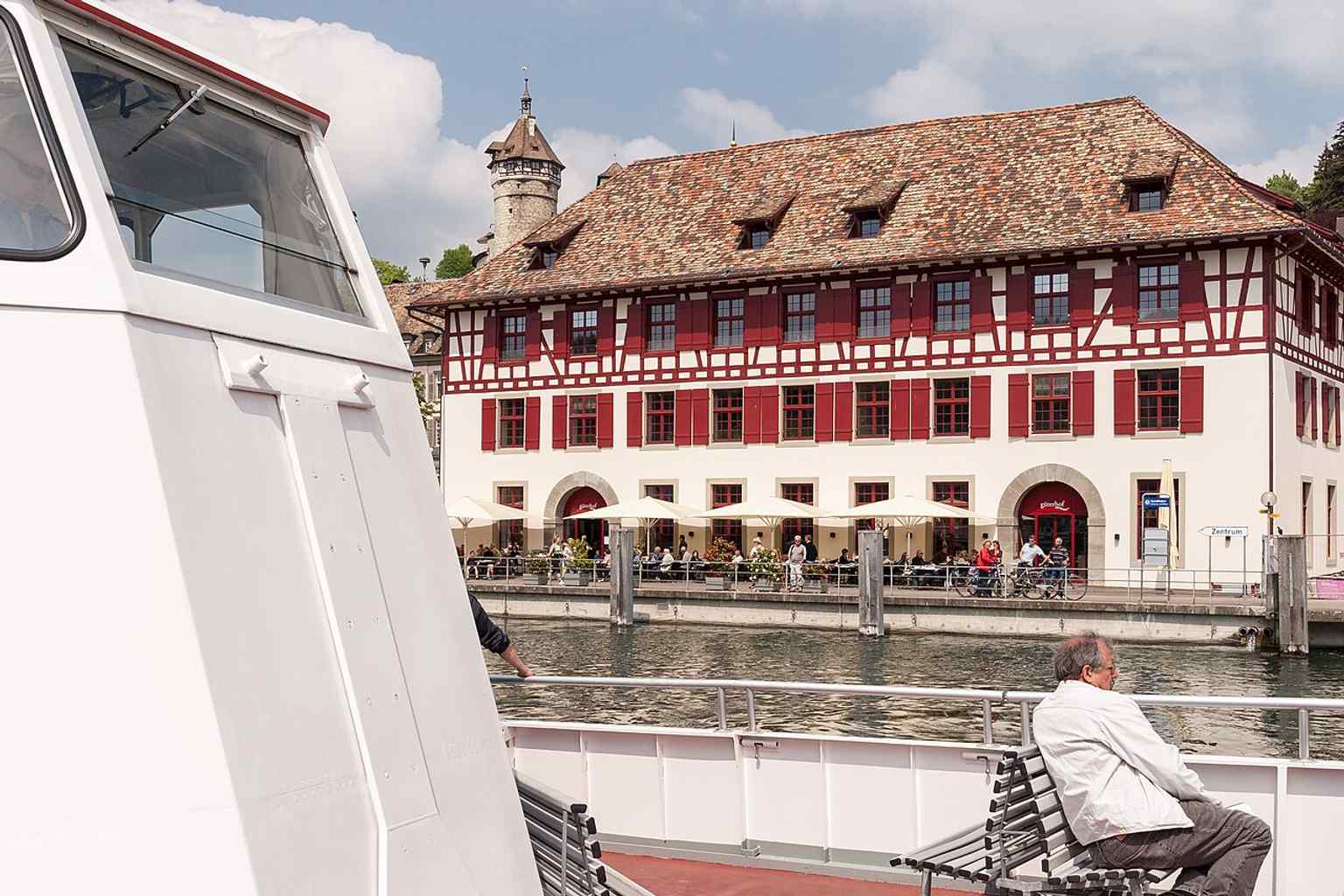
Seen from the Rhine, this classic view shows the Güterhof with Munot in the background — exactly the postcard perspective the building became famous for.Photo: JoachimKohler-HB, Wikimedia Commons, CC BY-SA 4.0. Cropped & resized. The story kept shifting. After eighteen forty-eight, the old warehouse became a goods hall, more like a trading house than a storage shed. A delicate canopy went up facing Freier Platz so merchandise could be transferred under cover. Then, in eighteen forty-nine, they added that little clock turret. Better still, the bell inside came from the demolished Inner Rhine Gate, so a piece of the old fortifications kept marking the hours even after the walls themselves were gone. That’s Schaffhausen for you: it rarely throws power away; it just redresses it.
Then came the railway in eighteen fifty-seven, and river freight lost ground fast. By nineteen thirty-six, architect Emil Gürtler stripped back the facade in a patriotic regional style, exposing limestone blocks and timber framing. With missing window panes and shutters closed, the place looked stern and shut off for decades. Only the major renovation in two thousand seven and two thousand eight brought it back to life. The city found a new operator after an earlier hotel plan collapsed, and the restored building gained a restaurant below and offices above. The little clock and bell work again, which feels only fair. If you want the cleaned-up version, the app’s modern exterior shot shows the house after that rescue.
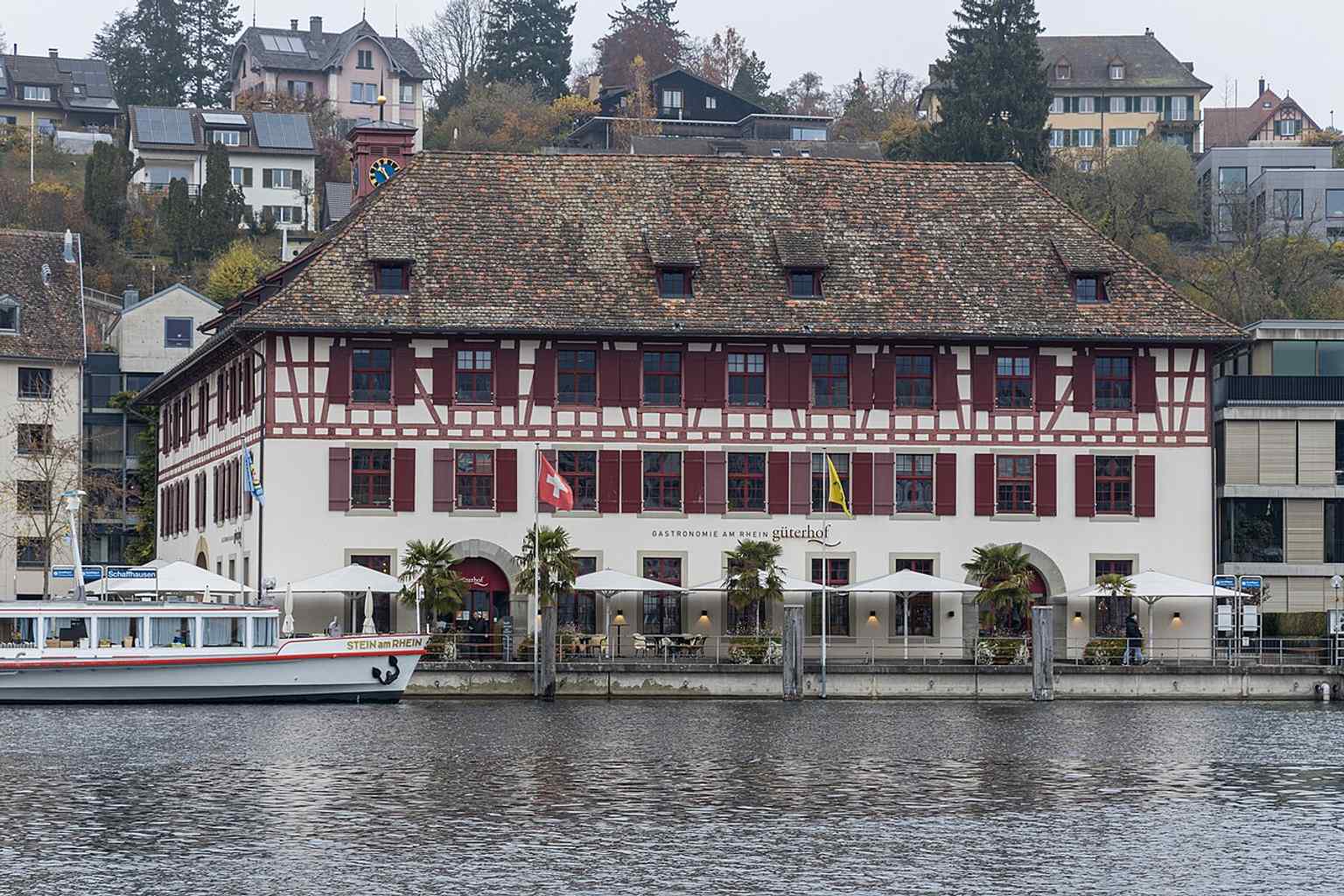
A clear modern view of the renovated Güterhof, which was restored in 2007/2008 and now houses a restaurant and offices.Photo: JoachimKohler-HB, Wikimedia Commons, CC BY-SA 4.0. Cropped & resized. From here, all these movements of goods, people, money, and authority have one obvious next task: they need to cross the river. Head on to the Rhine Bridge Schaffhausen-Feuerthalen, about a three-minute walk from here. And, in passing, if you’re tempted to come back later, the Güterhof now runs as a restaurant and event venue... a fairly polished one, and not exactly cheap.
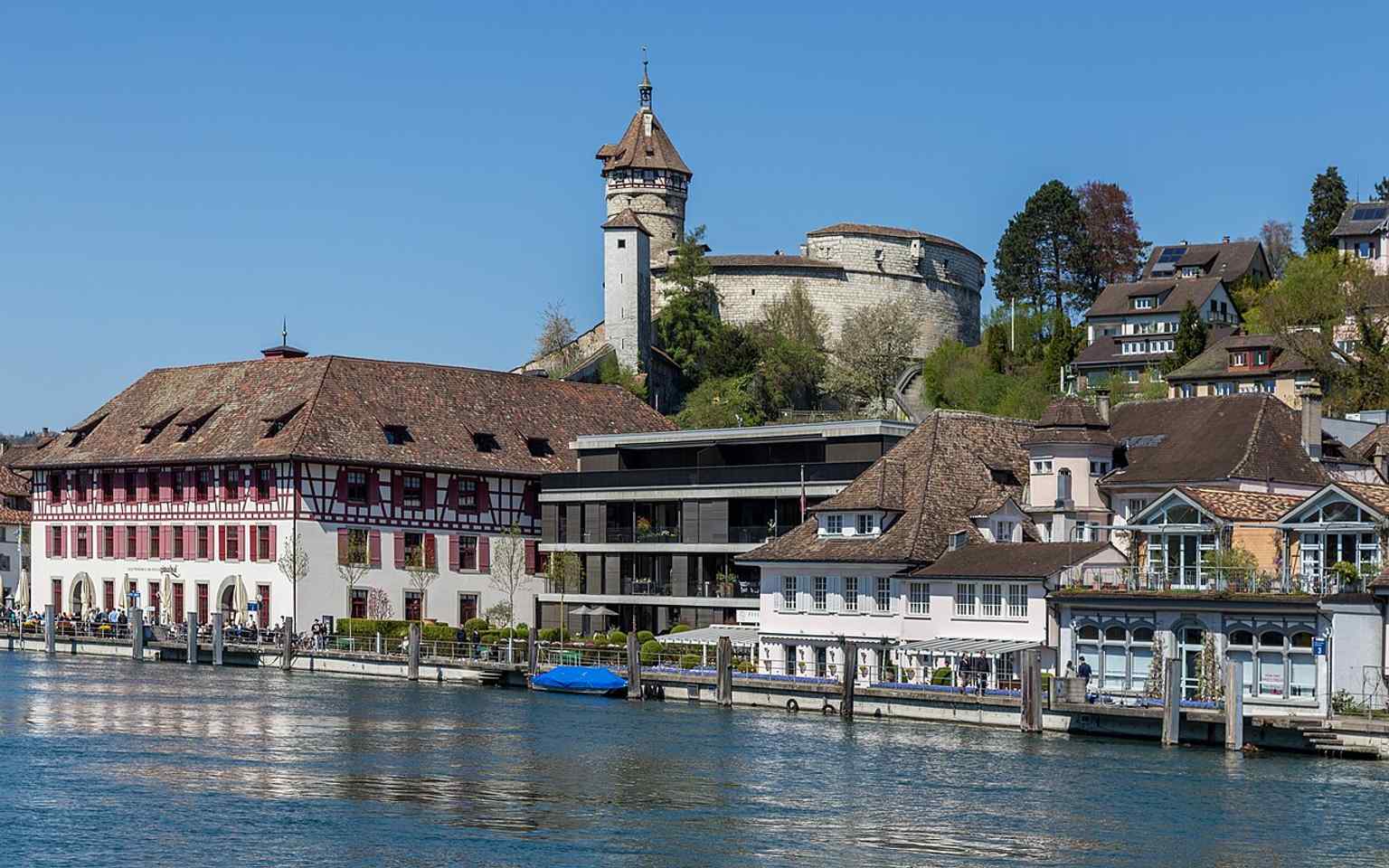
This riverside approach captures the Güterhof beside the Fischerzunft and Munot, reflecting its historic role on Schaffhausen’s Schifflände.Photo: JoachimKohler-HB, Wikimedia Commons, CC BY-SA 4.0. Cropped & resized. On your right is a low, pale concrete bridge with a broad flat deck, two slim river piers, and pedestrian underpasses tucked into both ends. This bridge looks matter-of-fact...…Read moreShow less
Open dedicated page →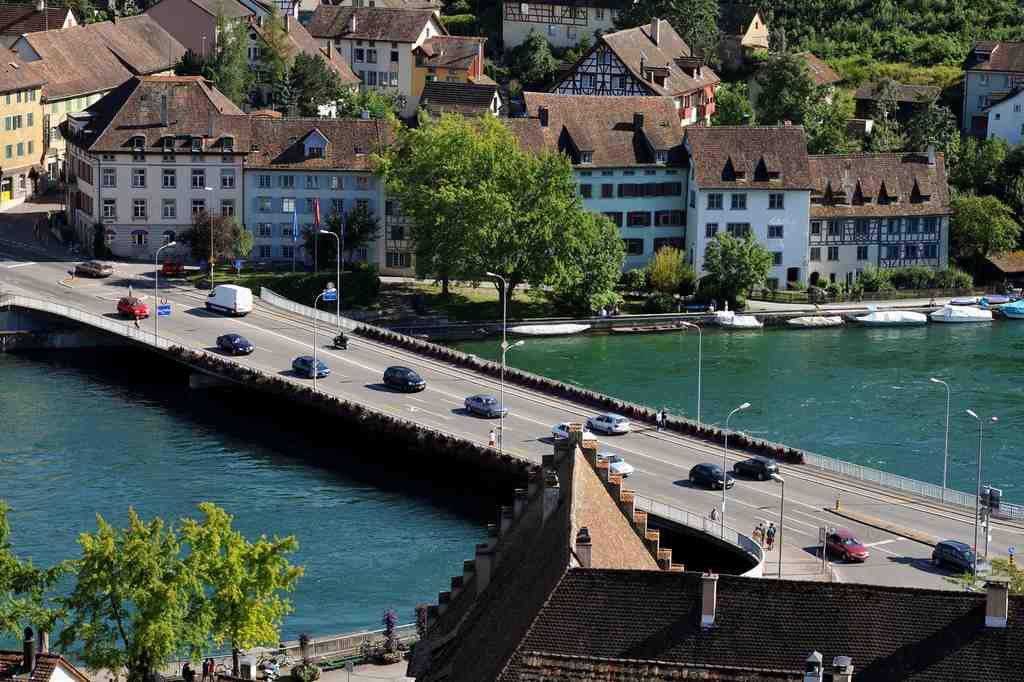
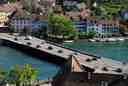
Rhine Bridge Schaffhausen–FeuerthalenPhoto: Хрюша, Wikimedia Commons, CC BY-SA 3.0. Cropped & resized. On your right is a low, pale concrete bridge with a broad flat deck, two slim river piers, and pedestrian underpasses tucked into both ends.
This bridge looks matter-of-fact... and that is exactly its point. Since nineteen sixty-five, it has carried Schaffhausen across the Rhine to Feuerthalen, linking not just two banks but two cantons: Schaffhausen and Zurich. Three traffic lanes run across it, with sidewalks and cycle paths on both sides. Power here no longer wears a monk’s robe or sits in a council chamber. It pours concrete, paints lane markings, and decides how movement works.
That story is much older than this bridge. People likely crossed here already in Gallic times at a ford, a shallow passage through the river. A document mentions a bridge in twelve fifty-nine, probably commissioned by the abbot of the Monastery of All Saints. Then the Rhine kept arguing back. A covered wooden bridge went down in a flood in fourteen eighty. A later stone bridge with eight arches took shape between the mid-sixteenth century and sixteen eleven, but bad construction and repeated high water damaged it again and again. In seventeen fifty-four, the river finally undercut the piers and the whole thing collapsed, leaving only one pier standing. The Rhine can be a fine engineer, if a slightly destructive one.
Schaffhausen answered with ambition. In seventeen fifty-five, the council hired Hans Ulrich Grubenmann, the great timber bridge builder. He proposed a daring single span of one hundred nineteen meters without a pier. The council refused; they did not trust brilliance without backup, which is a very Swiss sentence. So he built a covered wooden bridge using the old river pier, with spans of sixty-three and fifty-six meters, roofed with four hundred thousand shingles and framed from fir trees floated in from the Bregenzerwald. If you look at your screen, you can see that lost bridge in image two. French troops burned it in seventeen ninety-nine during their retreat. The famous tale says Grubenmann kicked away the wedges at the opening and proved the pier unnecessary. Good line, shaky truth. The real bridge had a bend in plan and needed that support.
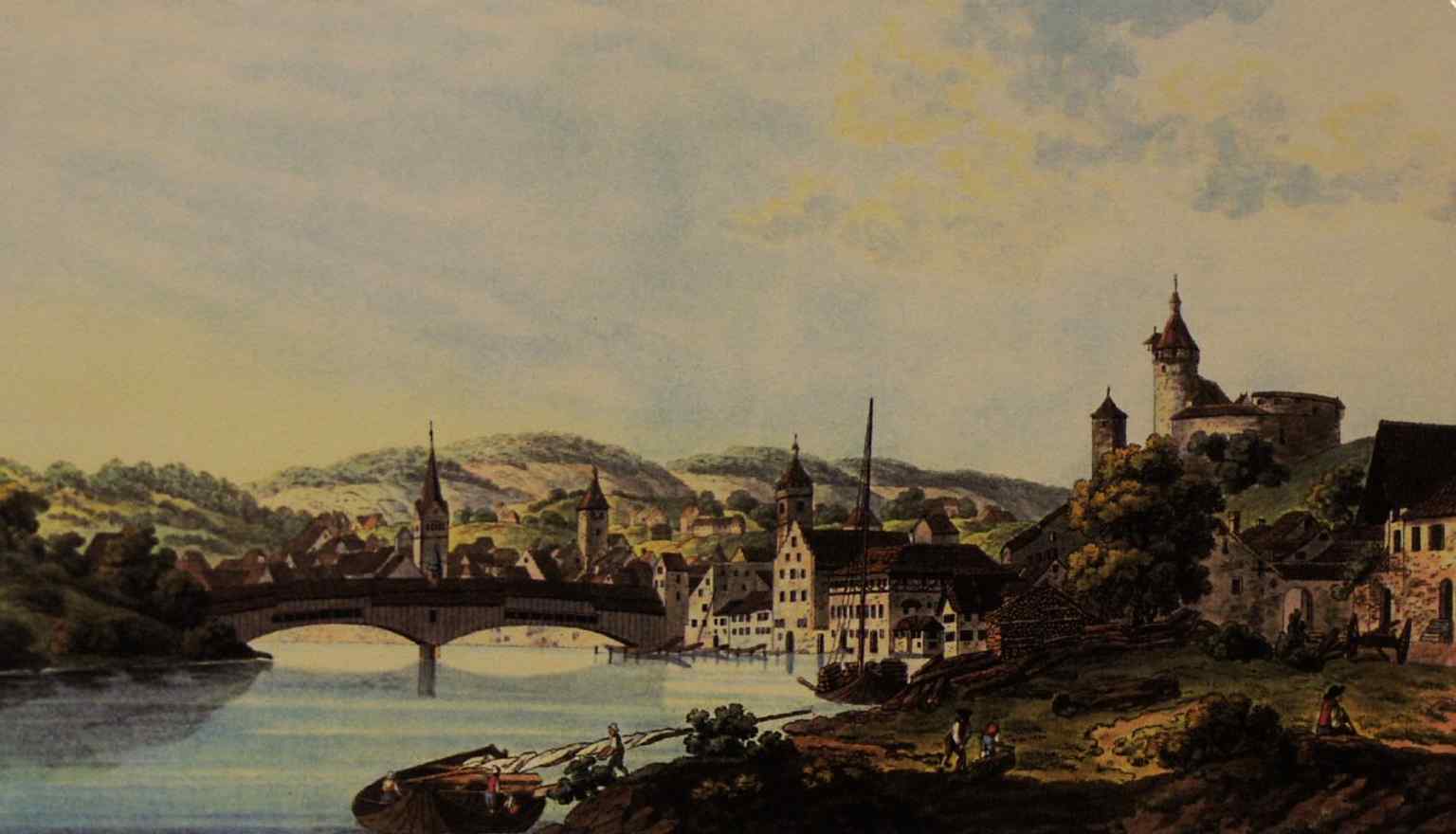
The Grubenmann bridge in Schaffhausen, an important predecessor that was famous for its ambitious wooden engineering and later destroyed in 1799.Photo: Darstellung von Christian von Mechel, Kupferstecher, Basel, Wikimedia Commons, Public domain. Cropped & resized. A fourth wooden bridge followed in eighteen oh five, then the age of cars changed the terms again. This present bridge, a prestressed concrete structure one hundred two and a half meters long, stands on two thin, disc-like piers. Engineers lowered it because river regulation from the new power station fixed the water level, and they even designed it so it could be raised someday for high-Rhine shipping. Then the shipping plans died, paperwork outlasting prophecy as usual. The bridge cost seven million francs in the nineteen sixties, roughly the equivalent of a few dozen million today, and later repairs kept traffic flowing because shutting this crossing entirely was simply not realistic.
If you check image one, you can see how the bridge sits at the city’s edge, less a monument than a decision made visible. So here is the question to carry with you: if a city is shaped as much by what passes through it as by what stands still, is Schaffhausen best read as fortress, marketplace, archive... or crossing?
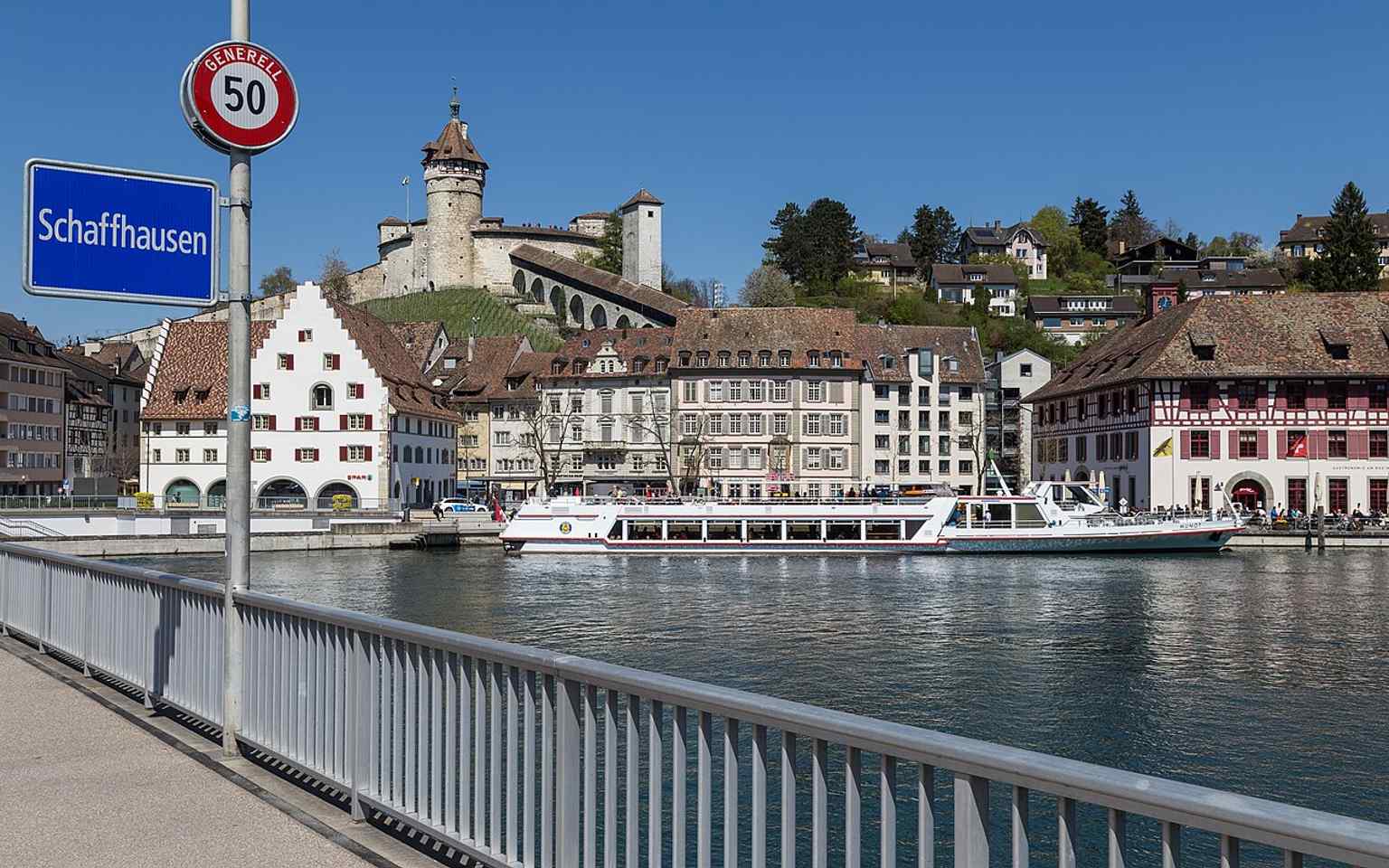
A broad riverside view with Munot in the background, showing the bridge’s place on the city edge where the Rhine forms both a border and a crossing.Photo: JoachimKohler-HB, Wikimedia Commons, CC BY-SA 4.0. Cropped & resized. Maybe the honest answer is all of them. This city makes sense where passage gets negotiated: between banks, between rulers, between old forms and new needs. And fittingly, this bridge never really closes; it is open all day, every day.
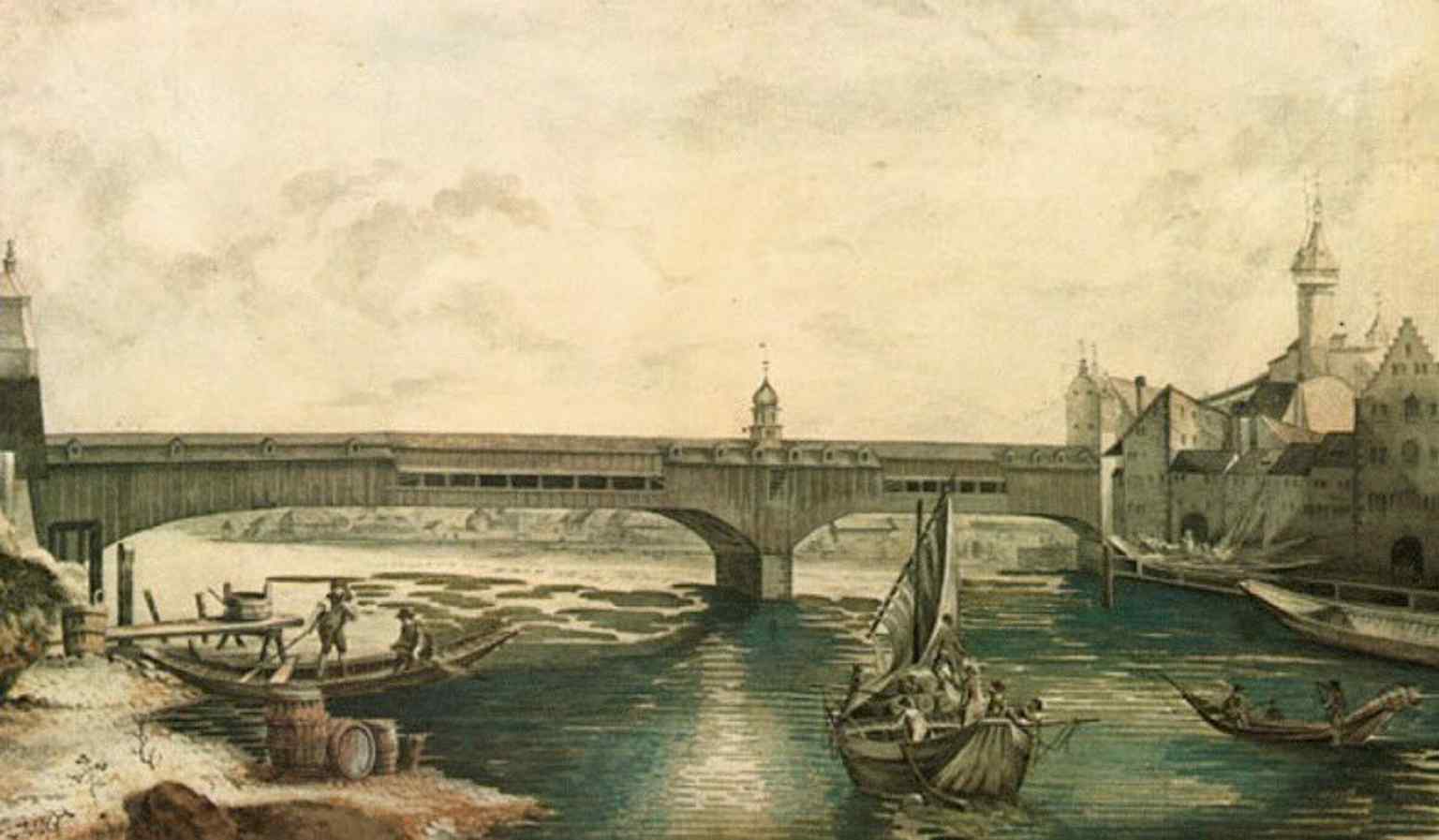
A rare image of the covered Grubenmann bridge before its destruction, helping tell the story of the wooden bridges that came before the modern concrete span.Photo: Unknown authorUnknown author, Wikimedia Commons, Public domain. Cropped & resized.


Frequently asked questions
How do I start the tour?
After purchase, download the AudaTours app and enter your redemption code. The tour will be ready to start immediately - just tap play and follow the GPS-guided route.
Do I need internet during the tour?
No! Download the tour before you start and enjoy it fully offline. Only the chat feature requires internet. We recommend downloading on WiFi to save mobile data.
Is this a guided group tour?
No - this is a self-guided audio tour. You explore independently at your own pace, with audio narration playing through your phone. No tour guide, no group, no schedule.
How long does the tour take?
Most tours take 60–90 minutes to complete, but you control the pace entirely. Pause, skip stops, or take breaks whenever you want.
What if I can't finish the tour today?
No problem! Tours have lifetime access. Pause and resume whenever you like - tomorrow, next week, or next year. Your progress is saved.
What languages are available?
All tours are available in 50+ languages. Select your preferred language when redeeming your code. Note: language cannot be changed after tour generation.
Where do I access the tour after purchase?
Download the free AudaTours app from the App Store or Google Play. Enter your redemption code (sent via email) and the tour will appear in your library, ready to download and start.
If you don't enjoy the tour, we'll refund your purchase. Contact us at [email protected]
Checkout securely with 


.jpg)
%20in%20Schaffhausen%20(2021).jpg)


.jpg)
.jpg)
.jpg)
.jpg)

.jpg)

%20im%20Kloster%20Allerheiligen%20in%20Schaffhausen%20-%20991099352169705501.jpg)


.jpg)
.jpg)
.jpg)


.jpg)
.jpg)
.jpg)


