
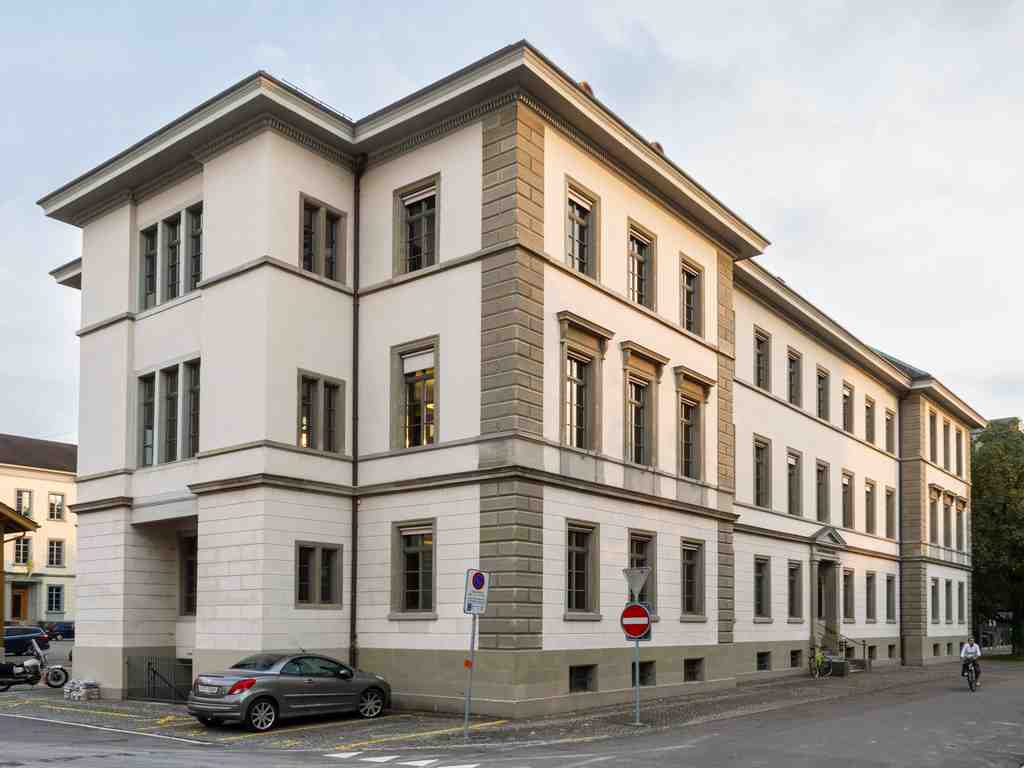
On your left is a long, pale rendered building with a broad rectangular frontage, evenly spaced tall windows, and a formal central doorway that gives it the calm authority of an old schoolhouse.
This is the Cantonal Library of Thurgau, and it tells one of Frauenfeld’s quietest, most revealing stories: memory here rarely survives by accident. Someone notices what might be lost, carries it elsewhere, gives it a shelf, a catalogue, a new life.
The library began in eighteen oh five, not in a grand hall, but in a cupboard. Johannes Morell, the first cantonal librarian and a government councillor, kept the earliest collection in his private apartment. Those first books were practical things, mainly law books for the young canton’s officials and highest courts. So the institution that now guards centuries of writing started as a handful of working volumes folded straight into daily government life.
Then came the great change. When Thurgau dissolved its monasteries in eighteen forty-eight, their books did not simply vanish into dust. In eighteen fifty-two, collections from Fischingen and Ittingen arrived in Frauenfeld and were stored in the attic of this very former cantonal school building, long before the library itself moved here. Those monastic books, reborn in the canton, changed the library’s character. A small administrative collection suddenly became a keeper of prayer, scholarship, literature, and regional memory. Later, books from Kreuzlingen and Saint Katharinental joined them as well.
If you glance at the image in the app, the building’s restrained exterior feels almost fitting. It does not boast. It keeps.
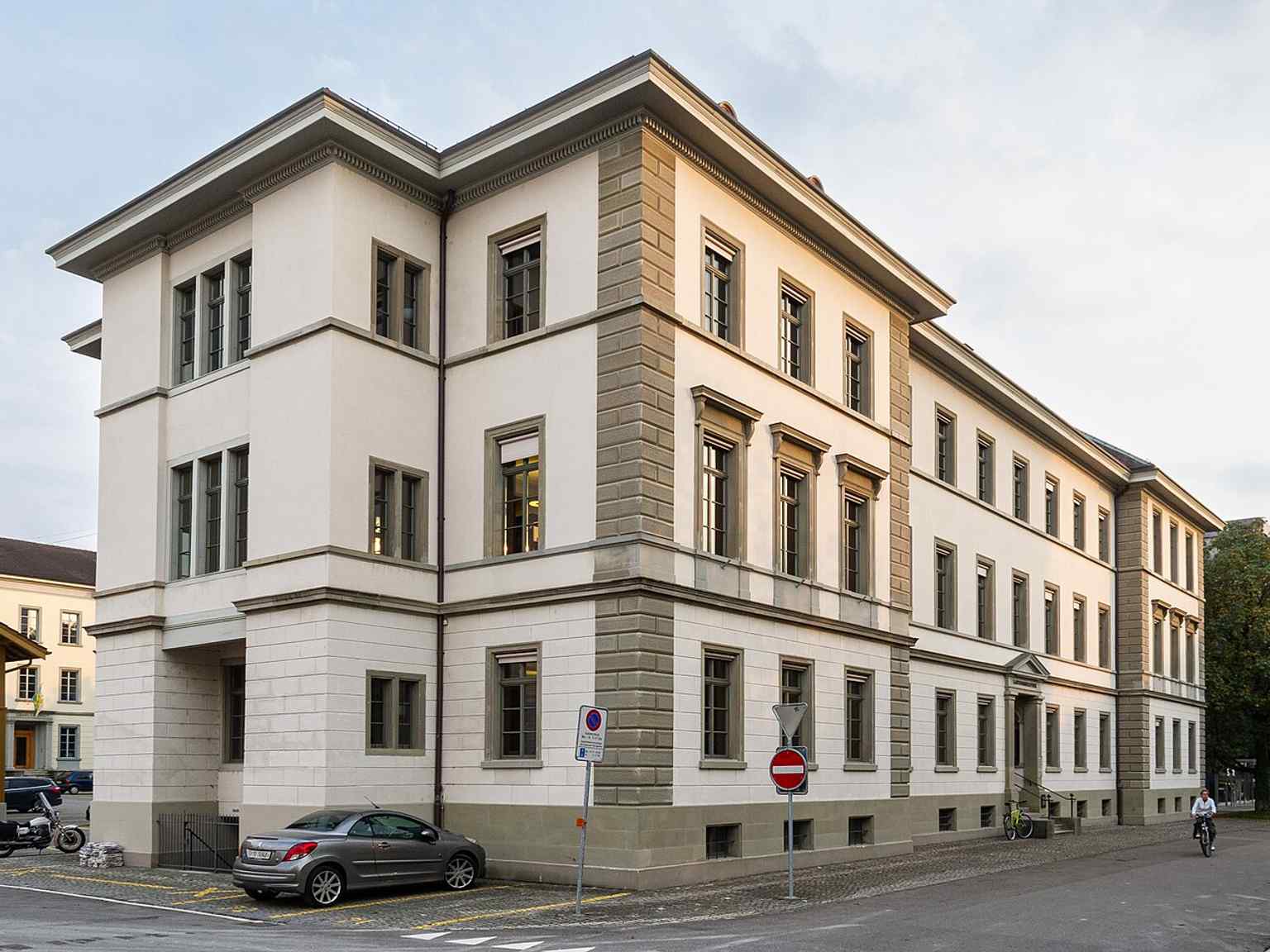
By eighteen fifty-eight, the first printed catalogue already listed about five thousand volumes. Only a few years later, the librarian Johann Adam Pupikofer counted ten thousand works. In eighteen sixty-four, the library absorbed the Frauenfeld city library, which had grown out of a civic reading society. That opened the doors wider, though not everyone in charge welcomed the change. The library had to become several things at once: official, scholarly, and public.
In eighteen sixty-eight, it moved into a purpose-designed space in the government building, complete with a lending counter and reading room. But this address became its home in nineteen thirteen, when the old school building stood empty and the library moved in with the cantonal supreme court. Friedrich Schaltegger, librarian from nineteen twelve, helped shape that new chapter. He also drew up the first catalogue of the library’s earliest printed treasures, nearly eight hundred books from the dawn of printing. That matters more than it sounds. To catalogue is to rescue. What is named can be found; what can be found can endure.
Even fragments survived because someone chose not to throw them away. Two leaves from a medieval romance, Flore and Blanscheflur, lasted because they had been reused as the cover of a document in nearby Oberkirch. Here, preservation often begins with such improbable mercy.
And that is the deeper grace of this place. It does not merely store the canton’s past; it decides, carefully and continuously, what the canton will still be able to remember. In a moment, continue on for about four minutes to the Penguin Fountain, where memory turns lighter, stranger, and a little more playful. If you decide to return another time, the library is generally open Monday to Friday from eight to six, Saturday from eight to two, and closed on Sunday.





