
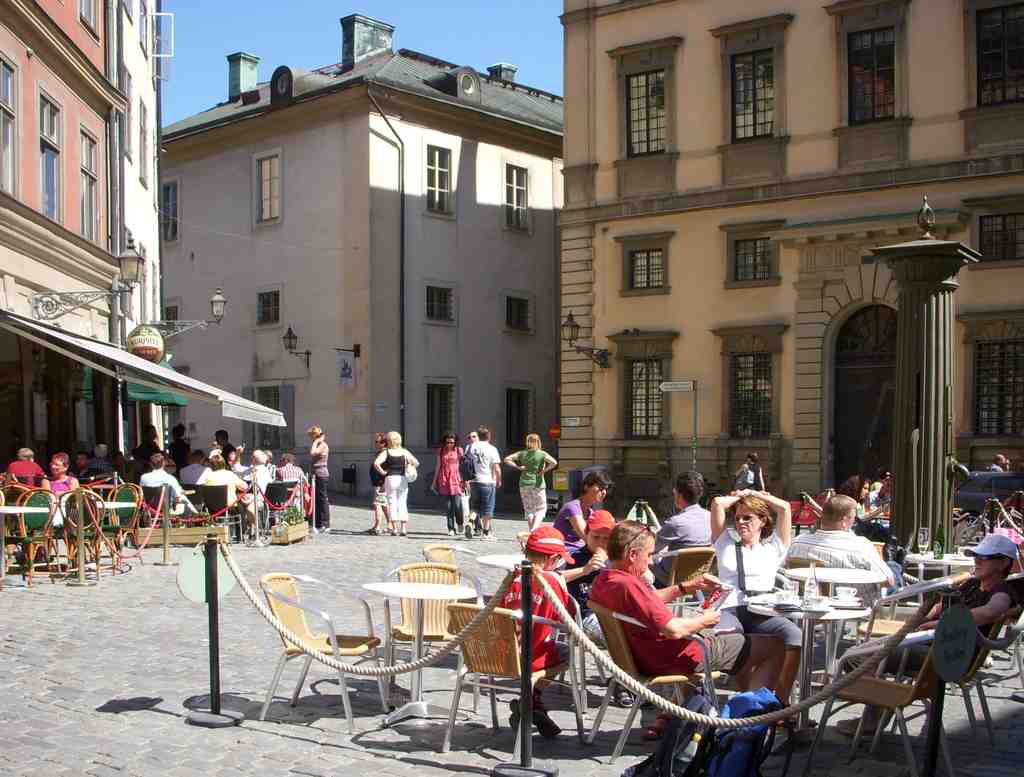
If you’re on the lookout for Järntorget, turn your gaze toward the cobbled square alive with outdoor cafés, a classic cast-iron well at its heart, and elegant buildings closely packed around-just follow the hum of voices and the scent of coffee, and you’ve arrived!
Welcome to Järntorget, the “Iron Square”-and no, it’s not because Iron Man lives here, though with its mighty past, he might want to! As you stand in this cozy corner of Gamla stan, imagine it teeming with people from centuries ago, not just today’s coffee drinkers but bustling merchants, sailors, wagon drivers, and perhaps the odd thief or two (watch your pockets, just in case their ghosts are still around!).
It all started way back around the year 1300, on a bluff formed by the old boulder ridge of Brunkebergsåsen. Once, the shores of Lake Mälaren licked the very edge of this square, with ships docking at Grain Harbour and Merchant Ship’s Harbour on either side. Can you picture it? Boxes of barley, chests of iron, barrels of salted herring clattering across the stones--and the shouts of traders in Swedish, German, English, and languages from even farther afield.
At first, this was called Korntorget, or “Grain Square,” but soon enough, iron became more valuable than bread, and by 1489, the new name stuck. The city’s official scales-think massive medieval weighing machines-were set up right here, where taxes could be counted and the king’s coin purse kept healthy. Iron, copper, and silver poured out from Sweden, while ships returned heavy with salt, cloth, barrels of beer and wine, spices, and glass-ah, the buzzing energy must have been electric!
In the Middle Ages, the iron trade brought foreign faces and fortunes. No wonder the square was much larger than what you see today. Not only did tall city walls rise around its edges, but German traders built their warehouses here, their voices echoing until French, Dutch, and British deals evened the odds. Sheds crept up along the eastern side in the 16th century, probably creaking with every gust of Baltic wind.
Fast forward to the booming 1600s, and things get even livelier. Imagine glancing around and seeing tavern signs like The Blue Eagle, The Lion, The Moon, or The Scales, each promising a different flavor of Stockholm entertainment. Sadly, the city’s big scales packed up and rolled to Södermalm in 1662, and the area saw a glam-up-the king wanted his capital to dazzle! Medieval cottages made way for tall, stately buildings, and the imposing Södra Bankohuset-the oldest national bank building in the world-rose on the eastern side, its facade still strutting an Italian-inspired Renaissance style. The motto above: “Hinc Robur et Securitas”-“Hence Stability and Reliability.” Well, except maybe after too many late nights at the tavern.
Not to brag, but that bank building even outlasted the city’s romantic poets and nefarious plotters alike. Wander past Number 84, and you’re walking with history. Its portal is modeled after an Italian villa, even though I doubt they ever served meatballs in Caprarola.
Now, you might notice-standing right out front-a statue of Evert Taube, Sweden’s beloved troubadour, bronze beret and sunglasses on, as if he just stepped off the train looking for a new adventure. Created in 1985, the sculpture sits directly on the pavement, so it feels like Taube himself might saunter over to Sundbergs konditori (just there on Number 83), grab a pastry, and break out in song. You’re never far from music on Järntorget!
Take a good look up at the surrounding buildings. That plainer white facade atop Number 85 isn’t so plain-a crane still points skyward, a silent salute to the days when goods were hoisted up to attic storerooms. And if you stroll by Number 80, with its Art Nouveau face and cast-iron columns, imagine the bustle of the old ironmongery, or the flashbulbs of the famous Jacoby photo studio, snapping portraits that Swedes still seek today.
Even the well at the center-cast iron, naturally-was donated by the bank in 1829 and modeled on a British prototype. Imagine how many weary hands and thirsty mouths paused here after unloading their cargo, or one of the greengrocers calling out the price of apples during the market days of the 1800s.
Järntorget has shrunk since medieval days, but every stone shouts with stories-of trade, transformation, music, and maybe a bit of good-natured mischief. So pause, sip your coffee, and let the echoes of seven centuries swirl around you




