
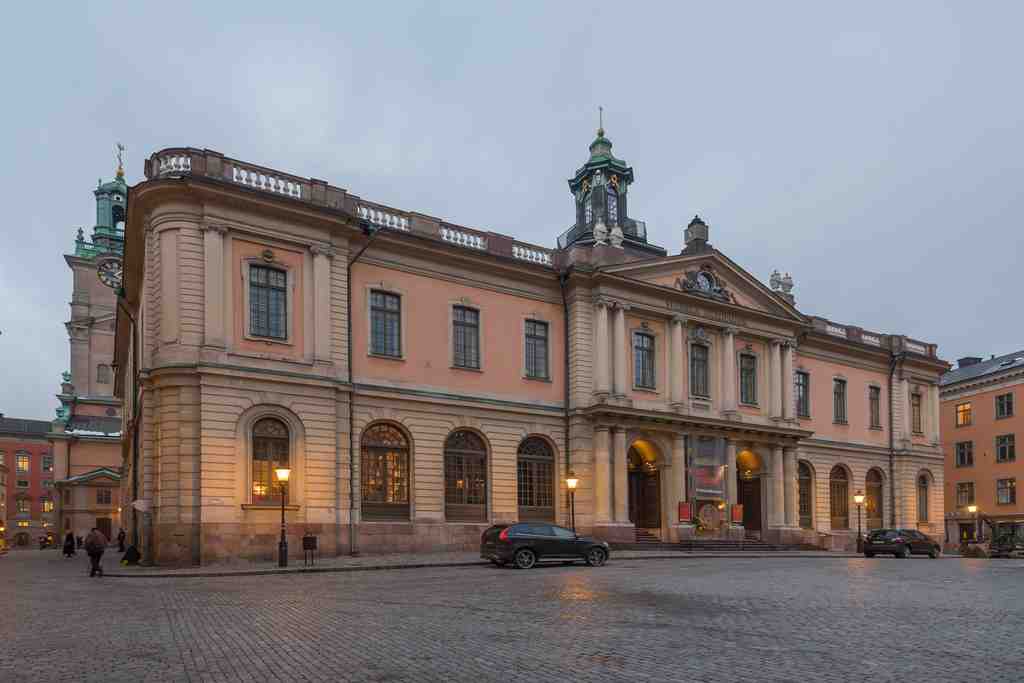
To spot the Stock Exchange, look straight ahead for a grand, salmon-pink building with graceful arched windows, a classical facade, and a prominent central pavilion topped by a small green cupola-a stately sight facing the northern edge of Stortorget.
Take a slow breath in and let your eyes wander over this impressive building in front of you. Imagine it’s the late 1700s: the cobblestones under your feet shimmer from the rain, elegant carriages pull up along the square, and a crowd gathers under flickering lamplight as Gustav III, the king himself, is about to step inside for the grand opening of the new Stock Exchange House.
This striking building-the “Börshuset”-was started in 1768 and finished nearly a decade later, thanks to the vision of architect Erik Palmstedt and a determined city council set on creating a home for Stockholm’s stock market. It replaced a jumble of old, medieval city buildings, giving the neighborhood its modern name, Rådstugan. But this was meant to be more than a place for money: its grand main hall, the Börssalen, would be a stage for the city’s greatest celebrations, a meeting place for ideas and achievements, and the site of many lavish dances and balls. Imagine the twirl of silk skirts and the glitter of candlelight as noblemen and women swayed across gleaming floors-sometimes even the royal family joined the fun.
The building was paid for in part by an extra tax, called the “börstolag,” showing just how important the city thought a new exchange was. But the Börshuset was designed as a challenge too, a proud answer from hardworking townspeople to the aristocrats’ stately palaces-its elegant pillars and high windows were meant to symbolize common achievement, not just inherited nobility.
By 1790, statues began to appear in the hall: take Jonas Alströmer, innovator and potato hero, whose marble bust-carved by Pierre Hubert L’Archevêque-stood as inspiration for future inventors. There were plans for others, sharing space with Stockholm’s biggest personalities: merchants, reformers, and adventurers of the “Age of Liberty.”
But don’t just imagine the daily business of stocks and trade. Picture the evenings when the Börshuset became a playground for the city’s elite. King Karl XV and Oscar I celebrated their coronations here. Up on the top floor, elegant gold-and-white drawing rooms glimmered with laughter and music. From the 1860s, these salons became the city’s official reception halls-rooms where the fate of Stockholm was toasted in sparkling glasses.
There’s a rich echo in the square too: nearby, Erik Palmstedt also designed the beautiful sandstone and cast iron well at Stortorget. Its water-always meant to be “worthy of admiration,” as city engineer Carlberg insisted-might have cooled the hands of many a reveler before returning to the bright sounds of a festival.
In 1914, life in the Börshuset changed forever. Philanthropist Magna Sunnerdahl, inspired by the writer Verner von Heidenstam, donated half a million kronor so that the Swedish Academy could make its home here for good. The city wouldn’t sell, but she secured the Academy eternal rights to the two upper floors-including the very hall where the Nobel Prize in Literature is awarded today. Imagine the hush as decisions are made behind those second-story windows, where generations of scholars have debated Sweden’s greatest literary legacy.
Today, the Stock Exchange no longer buzzes on the ground floor-traders and stock tickers have moved to Frihamnen. Instead, the entrance houses the Nobel Museum, and the building stands as a masterpiece of French-inspired 18th-century classicism, with hints of rococo carved into its face. Every room tells a different story, from glittering feasts to earnest debates and mysterious deliberations: if these walls could talk, you’d never reach the end of their tales.
So, pause here outside the Börshuset and soak in its elegant power-the sound of history echoing in every corner of the square, and maybe, if you listen close enough, the faint strains of a waltz drifting down from those golden salons above.




