
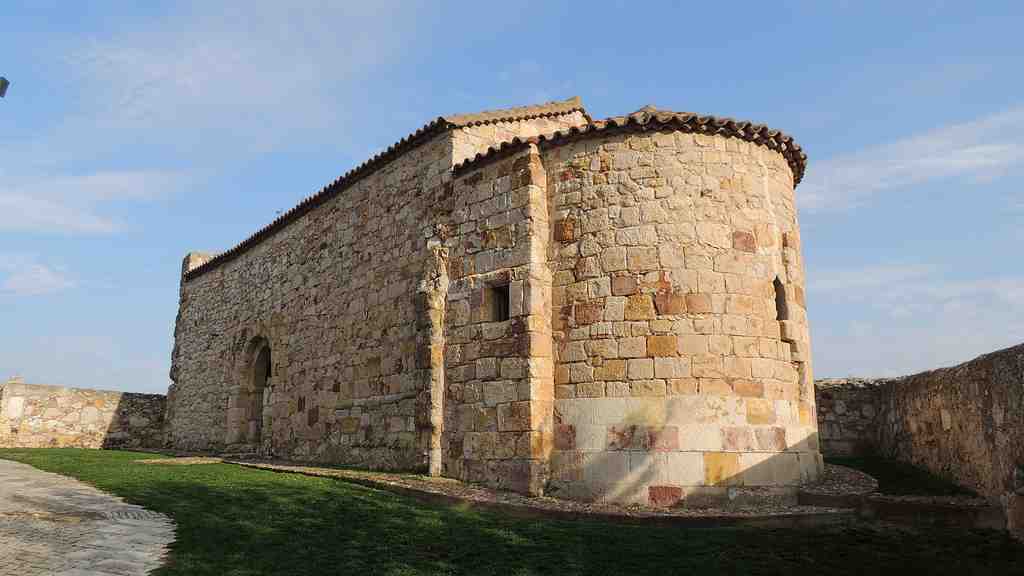
On your right, look for a small sandstone church with a long, low rectangular body, a rounded apse at the far end, and a plain arched doorway cut into the side wall.
This is the Church of Santiago el Viejo, also called Santiago de los Caballeros and Santiago de las Eras... a lot of names for a very small building. It stands outside Zamora’s walls, on the right bank of the Duero, facing the castle from a quieter patch of ground near Olivares and the old Valorio stream. It may be the smallest Romanesque church in the city, but it carries the kind of age that makes paperwork look a little late to the party.
The first written reference appears in eleven sixty-eight. But many historians place the church in the eleventh century, and some even suspect an earlier phase, from the late tenth or early eleventh, perhaps tied to an older parish of Santa María la Blanca. So the date stays hazy... and somehow that suits the place. Not every beginning arrives with a stamped document.
Architecturally, it is pure Romanesque discipline: one nave, meaning one simple main hall, divided into two sections; a semicircular apse, the rounded eastern end for the altar; and a straight presbytery, the space before it, strengthened outside by buttresses. Local sandstone, irregular blocks, sturdy lines, no theatrics. The entrance sits in the south wall, modest as ever.
Its life was unusual too. Cathedral chaplains kept this church, and for a long time they opened it only for the feast of Saint James the Greater on the twenty-fifth of July, when a small pilgrimage came out beyond the walls. So even when the city gathered around stronger, grander buildings, this one held on to a more occasional, almost private devotion.
Then there is the legend. Tradition says Rodrigo Díaz de Vivar, the Cid, kept vigil over his weapons here and King Fernando the First knighted him in the presence of Doña Urraca. Another version claims the Cid later forced Alfonso the Sixth to swear he had no part in Sancho the Second’s death. Modern historians have raised an eyebrow at all that, and Gómez Moreno dismissed the stories pretty bluntly. Fair enough. Memory loves a famous tenant.
Even the carvings inside refuse to be dull: foliage, lions, human figures, Adam and Eve after the Fall, and a few very pointed warnings about lust. Medieval moral teaching did not really do subtlety.
Look back toward the castle and the walls for a moment. From out here, Zamora feels larger than its defenses and older than its legends. This little church, preserved as a protected monument since the third of June, nineteen thirty-one, reminds us that a city’s truest shape also depends on the places that endure quietly at its edge.
If you plan to come back when it is open, it usually closes on Mondays and Tuesdays, and opens from Wednesday through Sunday with split hours on most afternoons.




