
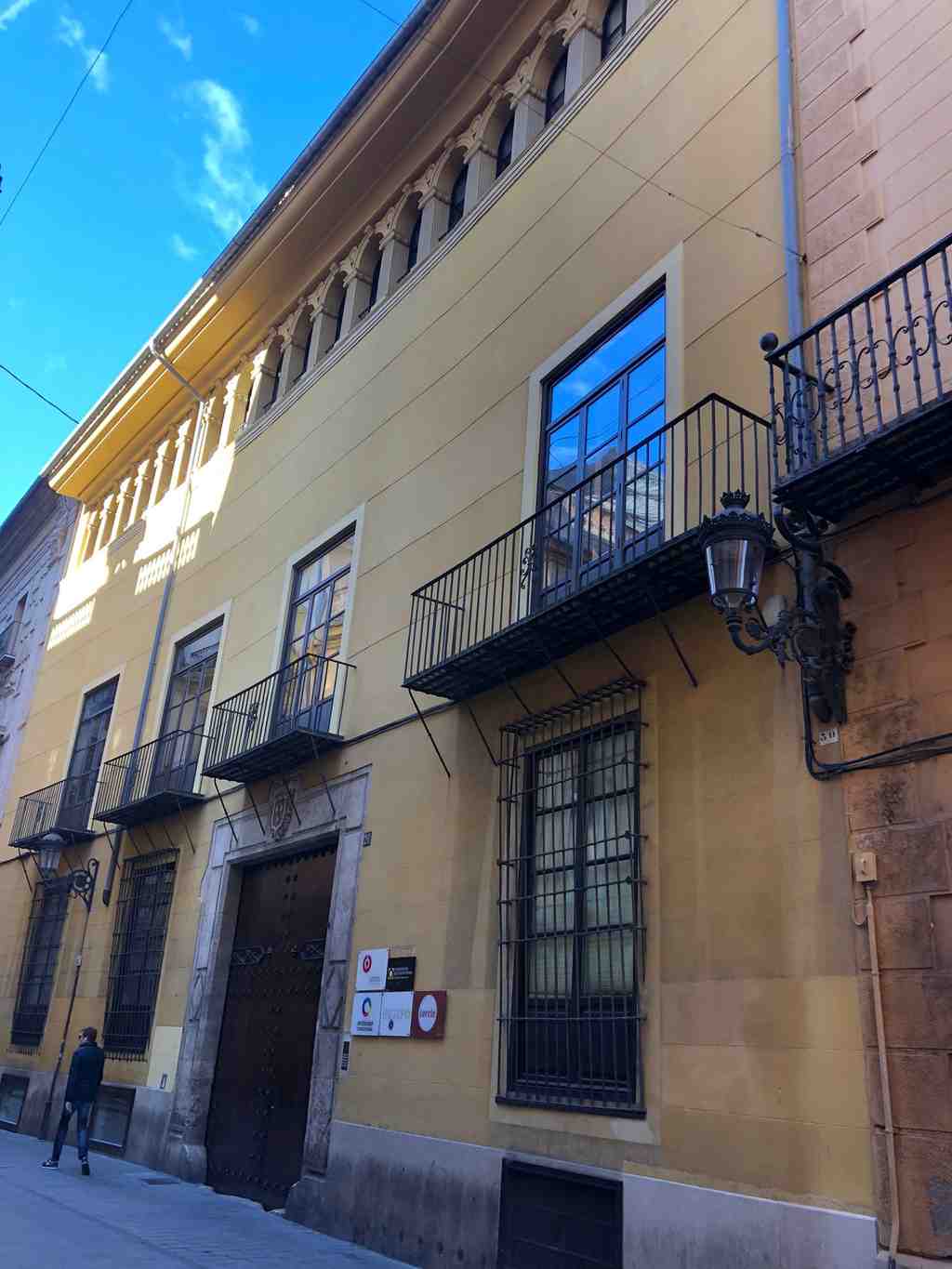
You will spot the Palace of the Merchants right in front of you, a smooth ochre colored facade marked by a massive dark wooden double door set in a flat stone frame, and a distinct row of small arched gallery windows running just beneath the roofline.
We just stepped away from the tiny armies at the L Iber Lead Soldier Museum, but the political maneuvering that happened inside this building was entirely life sized. The man who built this legacy was Berenguer Mercader, born in fourteen seventy one. His family originally hailed from Great Britain but settled in Valencia after the Repartiment. That was the official dividing up of lands and properties by King James the First after he took the city from Moorish rule in the thirteenth century.
The Mercaders did quite well for themselves. Berenguer was not just a nobleman holding the titles of Lord of Bunol and Cheste. He was a power player. He served as chamberlain to King Alfonso the Magnanimous and worked as a high level ambassador, bouncing between royal courts in Naples, Milan, Florence, and Castile. You get the sense he had an impressive collection of frequent traveler miles for the Renaissance era.
Look closely just above the flat stone beam over the main door, an architectural feature known as a lintel. You will find the carved Mercader family crest. In its prime, it featured three gold marks on a bright red background, bordered by a rather confident motto in the local language, ni res li fall, which translates to, nothing is lacking.
It is a fitting motto, especially considering his social life. In his later years, Mercader turned this palace into the ultimate intellectual hotspot. He hosted tertulias, which were popular literary and philosophical salon gatherings for the city elite. The Valencian writer Joan Rois de Corella famously documented these sessions, describing the local statesmen escaping into the flowery green fields of poetry to leave behind the anchors of lazy leisure. The humanist philosopher Joan Lluis Vives also set one of his written dialogues right on this street, with characters casually strolling past this very building, debating whether it was more dignified to ride mules or walk through the narrow alleys.
The structure itself has some hidden depths. While the facade was smoothed out during eighteenth century renovations, the building actually has Gothic bones from the late thirteen hundreds. If you were to walk through those heavy doors, you would find a central courtyard defined by elegant arches and a sweeping Gothic staircase leading to the upper floors. But the real prize is at the very back. This is the only palace on the entire street that manages to hide a private open air garden deep inside its walls.
Today, the building serves as the headquarters for the Union of Agricultural Cooperatives of Valencia, and you can peek inside from noon to five PM, Wednesday through Sunday. It stands as a quiet reminder of a diplomat who clearly knew how to live well. Take a look at the facade, and then we will make our way toward the Prehistory Museum of Valencia.




