
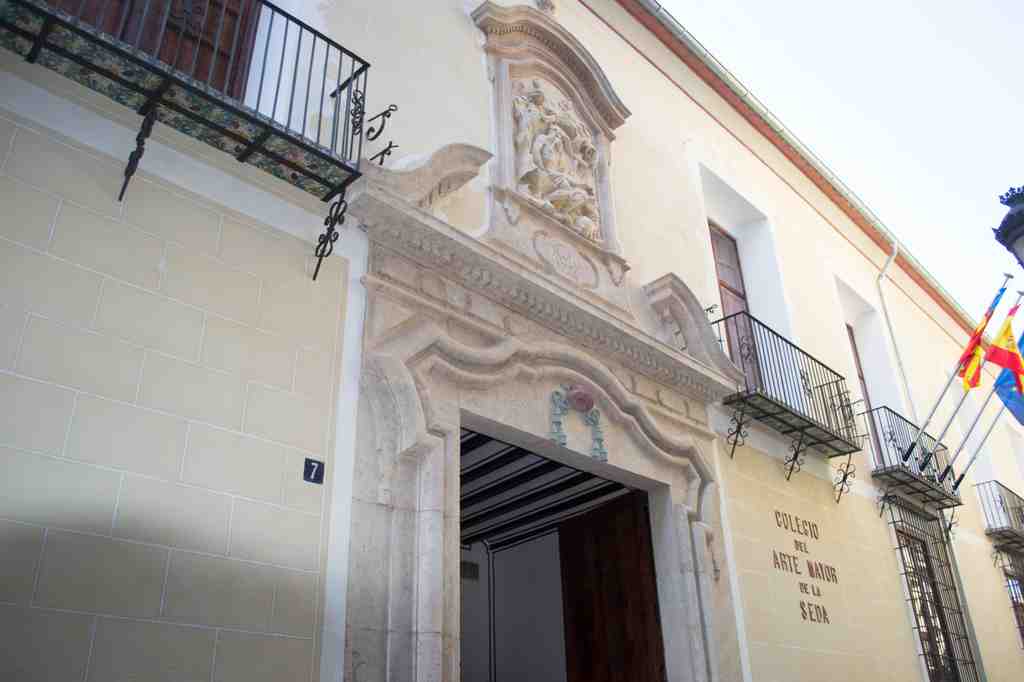
To spot the College of High Silk Art, look for the grand cream-colored building at number 7 with beautiful wrought iron balconies, colorful ceramic tiles beneath them, and an ornate stone entrance topped by a dramatic sculpted relief and a cardinal’s hat right above the doorway.
Now, step closer and imagine yourself in old Valencia, in the heart of the bustling Velluters neighborhood-named for velvet, not because they liked soft furniture, but because it thrived on silk weaving! Picture the year 1494: artisans, noise, the swish of looms, and-yes-a lot of well-dressed people. Here stood the headquarters of the silk guild, a building that saw the humble thread of a silkworm transformed into some of the city’s richest treasures.
The story begins even earlier, though. You see, in the days of the medieval Taifa of Balansiya, locals were already weaving silk. The real magic happened later when Italian masters journeyed here and sparked a velvet revolution-literally! By 1477, silk workers had their own official guild, the Gremio de Velluters, with royal rules approved by Ferdinand the Catholic. Their job? To make sure Valencia’s silk was the softest, brightest, and-most importantly-genuine, because if you tried to cheat, they could burn your cloth right here!
This impressive building began as a gothic home, its very walls resting on even older Islamic foundations. By the eighteenth century, it blossomed into the baroque masterpiece you see today, with ornate stonework, balconies of iron, and colorful tiles from the 1700s. If you look up, don’t miss the proud relief of Saint Jerome-the silk workers’ patron-above the heavy entrance, his cardinal’s hat crowning the doorway. Legend has it the hat is there because people once believed Saint Jerome was the first cardinal, and every dignified silk guild needed a little extra flair!
Inside, the rooms whisper stories of fortunes made and lost, of the silk industry’s heyday-when silk transformed Valencia’s economy. Here, decisions were made that shaped commerce, culture, and even fashion. The grand Sala de la Pometa has a floor decorated with apples and pomegranates (no relation to the fruit seller’s guild, by the way). The Sala de la Fama, or Hall of Fame, is covered with tiles featuring exotic animals-elephants from Asia, caimans from America, leopards from Africa, and horses from Europe. The message was clear: Valencia’s silk was world famous.
But the threads weren’t always golden. In the 1800s, disaster struck. Industrial machines started to hum, hand-weaving jobs dwindled, and the silk worms themselves fell victim to a horrible disease called pebrina. Suddenly, you could almost hear the looms falling silent. Workers, desperate and angry, erupted in protest in what became the Motín dels Velluters, right outside these walls-Valencia’s first great working-class revolt. The silk industry stumbled, and the neighborhood slid into decline.
The building was battered by time and nearly collapsed, especially when someone thought building an underground parking lot next door was a great idea. Spoiler alert: it wasn’t. But in the 21st century, a new fairy godmother (the Hortensia Herrero Foundation) waved a charitable wand, restoring the college and transforming it into the Museum of Silk you can visit today.
Wander inside, and you’ll find more than historic halls: see a spiral staircase worn by centuries of hurrying feet, a chapel lined with glossy green and white tiles, and a spectacular baroque staircase with a lion clutching a cardinal’s hat (either Valencia’s bravest mascot or the fashion police, you decide). Don’t miss the old garden, now a peaceful patio shared with a café where you can sip something cool and imagine you’re the merchant king of silk.
If you’re lucky, in the workshop at the back, you might catch the rhythmic rattle of a Jacquard loom weaving magic as it did centuries ago. And should you ever wonder where the secrets of this place are kept, know that its archive is the most important silk guild archive in Europe-hundreds of years of contracts, rules, and stories just waiting to be discovered.
So take a good look around. Here, silk wasn’t just fashion-it was life, love, protest, power, disaster, and hope, woven into the very fabric of Valencia. And who knows? Maybe you’ll leave with a bit of that golden thread woven into your own story-just try not to spill coffee on it!
Interested in knowing more about the building, file or the visits


