
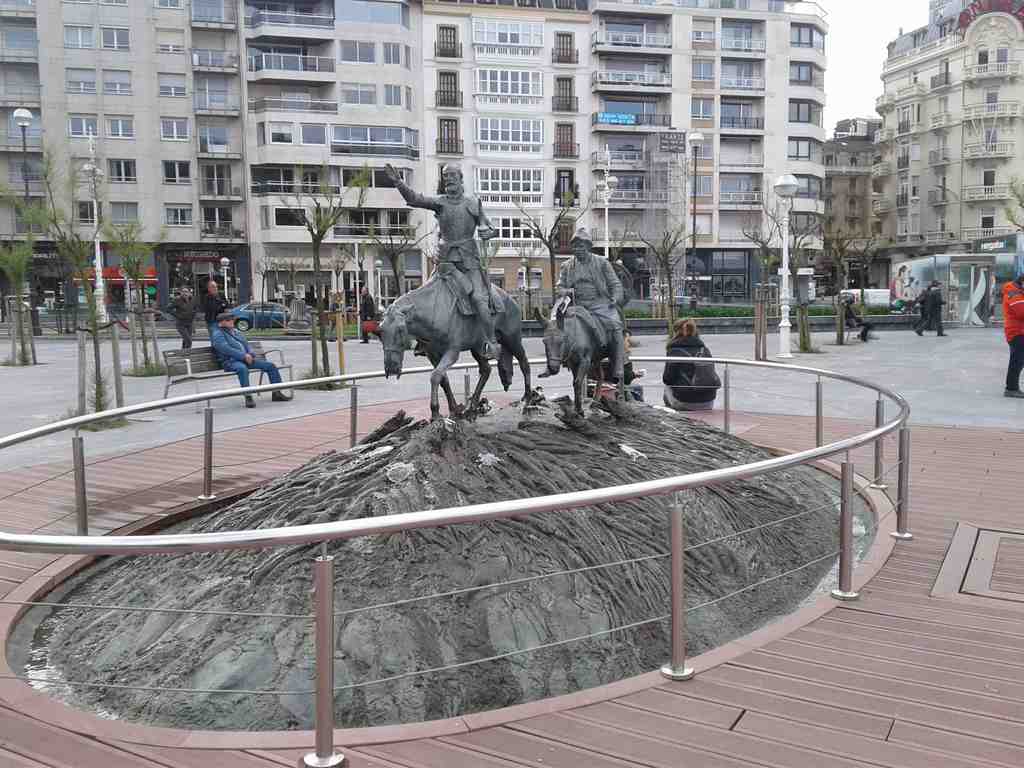
Look to your left for an open paved square centred on a dark bronze monument, where the lean figure of Don Quixote and the sturdier Sancho Panza stand high on a broad plinth.
Plaza de Cervantes does not shout for attention. It gathers it quietly. Since nineteen oh five, this square has carried the name of Miguel de Cervantes Saavedra, the novelist, poet, and playwright whose Don Quixote turned a wandering dreamer into one of the great figures of world literature. The naming came in the same year Spain marked three hundred years since the publication of Don Quixote.
What most visitors never realise is how modest this place began. Writer Serapio Múgica Zufiria described it in nineteen sixteen as little more than a discreet space with a very modest lamp dedicated to Cervantes. Not a heroic monument, not a grand civic statement. Just a lamp. That image makes the square’s later transformation rather telling.
The bronze group you see today has its own curious journey. Sculptor Lorenzo Coullaut Valera created this composition of Don Quixote and Sancho as the model that won the nineteen fifteen competition for Madrid’s great Cervantes monument in Plaza de España, unveiled in nineteen twenty-nine. Later, San Sebastián chose that same image for this square. Not everyone applauded. Some local artists protested, arguing that a work designed for another place and another moment should not simply be transplanted here.
And yet cities do this sort of thing all the time: they borrow symbols, test meanings, and then make them their own. During the Transition to democracy, on the fourth of July, nineteen seventy-six, a huge march against the far right ended here beside La Concha. A literary square became a political stage.
After the square reopened in phases in two thousand and eleven, workers set the sculpture on a new bronze base designed by Zigor García, decorated with fish from the Cantabrian Sea. That small detail matters. Even fantasy, here, must answer to the bay. In a moment, as you walk on to La Concha, you will see how imagination and spectacle open out into the real curve of the shore.




