
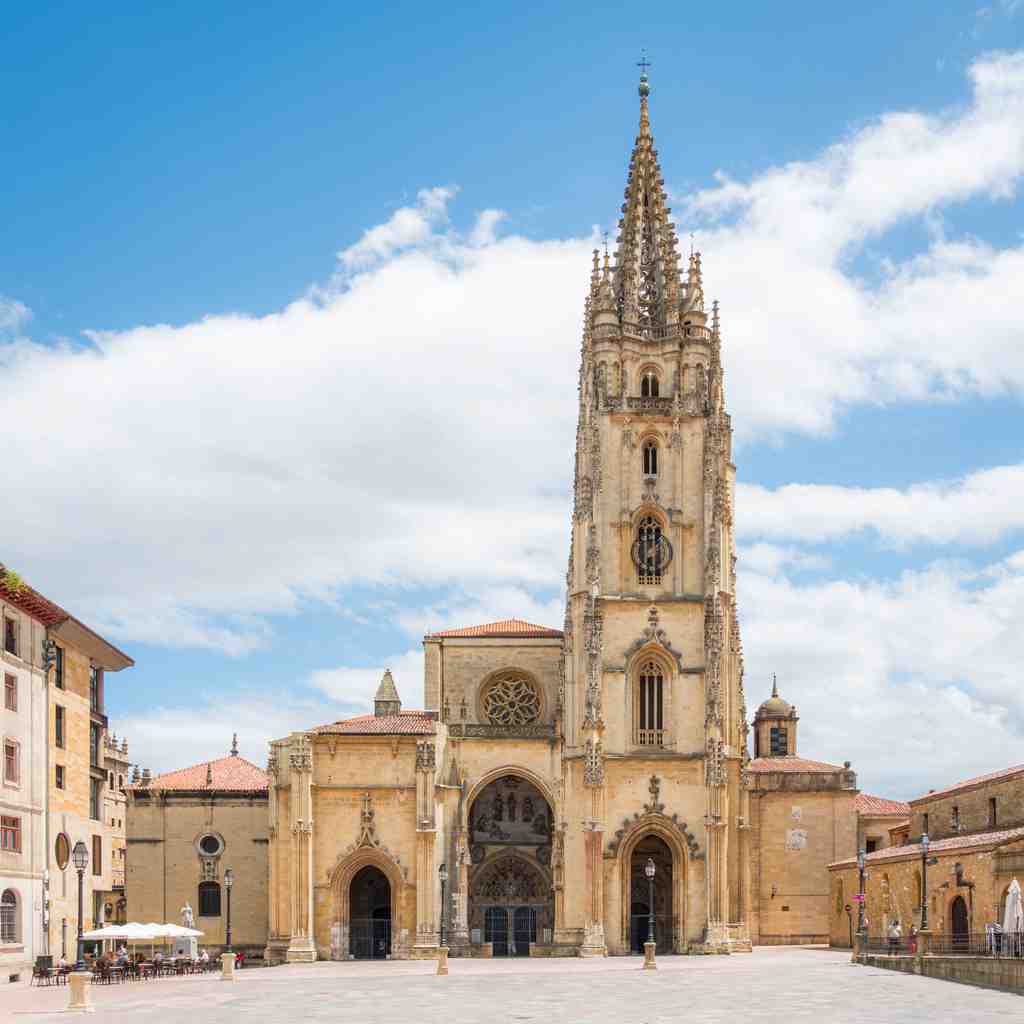
Right in front of you rises the majestic Catedral de Oviedo, with its tall, single spire reaching into the sky above three grand gothic arches-just look straight ahead for the towering stone facade, crowned by intricate carvings and the unmistakable rose window.
Now, let me take you back in time, right here in the shadow of these ancient stones. Imagine the year is 794. The air is tense-Oviedo has just faced a mighty attack, and Fruela I’s original church of San Salvador lies in ruins. But a determined king, Alfonso II the Chaste, decides to rebuild, making this spot the heart of his kingdom. Over centuries, each ruler and architect leaves a mark, transforming what began as a simple basilica into the dazzling gothic monument you’re seeing today. If you listen closely, you might almost hear the echoes of medieval stonemasons chiseling away, shaping pillars and arches.
This cathedral is a true patchwork of history: beneath its gothic splendor lurk layers of the past. Its oldest secret-the Cámara Santa, or Holy Chamber-dates to the 9th century and was built to keep priceless treasures safe. Step inside and you’ll find the Victory Cross and the Cross of the Angels, sparkling with jewels and shrouded in legend-one’s the symbol of Asturias, the other of the city. The Cámara Santa even houses the Arca Santa, an ancient chest said to be brimming with relics and mysteries, including the sacred Shroud. This little chamber, tucked within the gothic giant, is now a UNESCO World Heritage Site-no wonder it’s the cathedral’s crown jewel!
You might notice the incredible blend of architectural styles all around you, like a timeline built in stone. There’s the Romanesque vaults and carved apostles hidden away, the soaring gothic walls and pointed arches that reach for heaven, the renaissance touch in the very top of the spire, and the baroque flourishes in the chapels-this building is a living history book. And if you follow the gaze up that soaring spire-80 meters high!-imagine the 16th-century architects scratching their heads, finally deciding just one tower would do. After all, if you had to maintain more than one tower that tall, you’d need more than faith to keep them standing!
For centuries, this was a holy checkpoint for weary pilgrims on their way to Santiago, and the sight of its lopsided spire was a beacon of rest and safety. But the cathedral’s story hasn’t always been so peaceful. In 1934, a bomb exploded in the crypt during the Asturias Revolution. Priceless art was shattered, ancient relics threatened, but somehow, after the dust and chaos, treasures like the Shroud were recovered from the rubble. Restorers set to work, and just like the kings and artisans before them, brought the building back to life.
But don’t just look up-take in the details at eye level. The three arches of the porch welcome you in, each doorway topped by vibrant reliefs and figures. The main door depicts scenes from Christ’s life, but just above, a keen eye will spot carvings of Kings Fruela I and Alfonso II themselves, still standing guard over their cathedral centuries later.
Listen for the bells, especially the mighty “Wamba”-the oldest bell in use in all Spain, cast in 1219! Even cracked, she rings out for great feasts and moments of high drama, her deep voice echoing over the city, a sound that’s survived everything from war to lightning strikes.
Inside, the cathedral stretches in three grand naves, its roof vaulting high above-imagine the monks chanting, candles flickering, the whole space filled with music and prayer. There’s an altar dedicated to San Salvador, the original patron, surrounded by chapels stuffed with more relics and the tombs of long-gone bishops and kings.
So here you stand, in front of a cathedral that’s seen kingdoms rise, wars rage, bombs fall, and miracles unfold. With each stone, you walk in the footsteps of kings, pilgrims, and dreamers. And don’t forget: with this much history, a few ghosts might be watching, just making sure you’re paying attention to their favorite stories!




