AudaTours logoAudaTours

Oviedo City Audio Tour: Legends, Art, and Stone in the Heart of Asturias

starstarstarstarstar
1.01 reviews
Audio guide10 stops

A city where ancient stones whisper royal secrets and gilded palaces still echo with the footsteps of rebels—Oviedo is a labyrinth of beauty and buried stories. This self-guided audio tour unveils hidden legends behind Camposagrado’s fire-scarred halls, the scholarly sanctum of the Royal Institute, and the eclectic troves of the Museum of Fine Arts. What scandal nearly destroyed a palace in the flames of rebellion? Which mysterious manuscripts lie locked away, jealously guarded by poetic ghosts? How did a painting almost spark a diplomatic crisis right here? Drift from sun-dappled plazas to marble galleries as tales of intrigue and artistry unfold around every corner. Expect the drama of courtroom trials, secret societies, and artistic marvels all set against Oviedo’s timeless streets. Let curiosity lead you forward—unlock the city’s shadowy past and radiant present with every step. Start your adventure where whispers become discoveries.

Tour preview

map

About this tour

  • schedule
    Duration 50–70 minsGo at your own pace
  • straighten
    1.5 km walking routeFollow the guided path
  • location_on
    LocationOviedo, Spain
  • wifi_off
    Works offlineDownload once, use anywhere
  • all_inclusive
    Lifetime accessReplay anytime, forever
  • location_on
    Starts at Camposard

Stops on this tour

lock_open 3 free previews · 7 unlock with purchase

  1. Camposard
    1
    To spot the Camposagrado Palace, look for a grand square-shaped stone building with elegant balconies and decorative corners, just across the open plaza and glowing golden in the…Read moreShow less

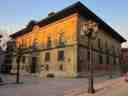
    To spot the Camposagrado Palace, look for a grand square-shaped stone building with elegant balconies and decorative corners, just across the open plaza and glowing golden in the late afternoon sun. Now, take a moment to let your footsteps echo off these ancient stones, because you’re standing in front of a palace that has seen more drama than a telenovela-welcome to Camposagrado! Built in the 1700s for the Marquis de Camposagrado, this palace was a real showstopper from day one. Imagine craftsmen carefully laying those sandstone blocks, and two rival architects-one a fan of swirling Baroque style and the other a lover of clean Neo-Classical lines-trying to outdo each other as they created these floors and columns. If you peek around, you’ll notice the different textures: the lower level’s fancy, dramatic look is pure Baroque, while upstairs is all about classical elegance with its slender columns. Back in the day, two grand doors welcomed carriages and guests, and if walls could talk, these would whisper stories of parties, political intrigues, and maybe a few secrets shared near the staircases. But the palace had its share of tough times, too. In 1934, during a stormy miners’ strike, it caught fire and its future looked bleak-only to rise again, restored and proud, thanks to a clever architect named Enrique Rodríguez Bustelo. Today, it stands not just as a beautiful monument but as the Regional Court, judging cases instead of hosting dazzled nobles. So, don’t worry, you’re not in trouble-unless you try to steal one of those stone blocks as a souvenir!

    Open dedicated page →
  2. To spot the Royal Institute of Asturian Studies, look for a stately stone building on Plaza Porlier with a distinctive plaque on its wall-just like the metal one in front of you,…Read moreShow less

    To spot the Royal Institute of Asturian Studies, look for a stately stone building on Plaza Porlier with a distinctive plaque on its wall-just like the metal one in front of you, which features a crowned crest surrounded by laurel leaves. Now, let’s dive into the story! Imagine you’re in post-war Asturias in 1946, when scholars and thinkers gather here in the grand old Palace of the Counts of Toreno. In the quiet square, the only sound is the echo of footsteps on cobblestone as some of the brightest Asturian minds hurry inside, clutching manuscripts and dreams. This institute, called RIDEA, was created to protect and explore everything wonderful about Asturias-its culture, art, science, and even its most mysterious legends. You might think it’s just a group of people reading dusty old books, but these are defenders of Asturian identity! Their first big studies ranged from language quirks-like how the letter “h” is pronounced in the east of Asturias-to entire dictionaries of Asturian rhyme. Over the years, the place became a treasure chest of Asturian stories, filled with manuscripts handwritten by famous minds like Jovellanos, Pardo Bazán, and Palacio Valdés. Picture scholars carefully turning these ancient pages, the rustle of parchment making you want to whisper. And if you detect a little royal sparkle here, you’re not wrong! In 1991, Prince Felipe himself became honorary president, and by 1992, the king granted the title “Royal” to this institute-so it’s not just any old place, it’s officially royal. If you catch an extra twinkle from the windows, maybe it’s just history winking at you. Today, here in this beautiful old building, the institute opens its archives to all who are curious. Who knows-maybe the next discovery about Asturias will start right where you’re standing! But don’t try sneaking out a manuscript, or the ghosts of old Asturian poets might give you a poetic scolding!

    Open dedicated page →
  3. To spot the Museo de Bellas Artes de Asturias, just look for the grand old stone building right ahead, with elegant balconies and three flags waving above its decorated…Read moreShow less

    To spot the Museo de Bellas Artes de Asturias, just look for the grand old stone building right ahead, with elegant balconies and three flags waving above its decorated doorway. Alright, time to paint you a picture with words! Imagine you’re standing here in Oviedo’s old town in the 1800s-cobblestones under your feet, distant horses clopping by, the air thick with the promise of grand ideas. Suddenly, the King’s decree comes through: this city needs a home for its treasures! But instead of a castle or some gloomy vault, they gathered art inside this beautiful palace-the Palacio de Velarde-which later joined up with its neighboring houses to become what you see now, the Museum of Fine Arts of Asturias. It's as if the building itself is a patchwork masterpiece, holding secrets from three different eras inside its walls. Step in, and you’ll find paintings bursting with color by Spanish masters, faraway Flemish landscapes where you almost expect a cow to wander out, and even glass and earthenware that once sat on someone's ancient dinner table. Of the 10,000 treasures the museum owns, only a few hundred are shown at once, so every visit is like opening the world’s best art-themed surprise box. Just think-right now, you’re at the threshold of an art adventure that was nearly two centuries in the making! Now, who’s ready for a face-to-face with some masterpieces…and perhaps a canny old ghost or two from Oviedo’s past?

    Open dedicated page →
Show 7 more stopsShow fewer stopsexpand_moreexpand_less
  1. Right in front of you rises the majestic Catedral de Oviedo, with its tall, single spire reaching into the sky above three grand gothic arches-just look straight ahead for the…Read moreShow less

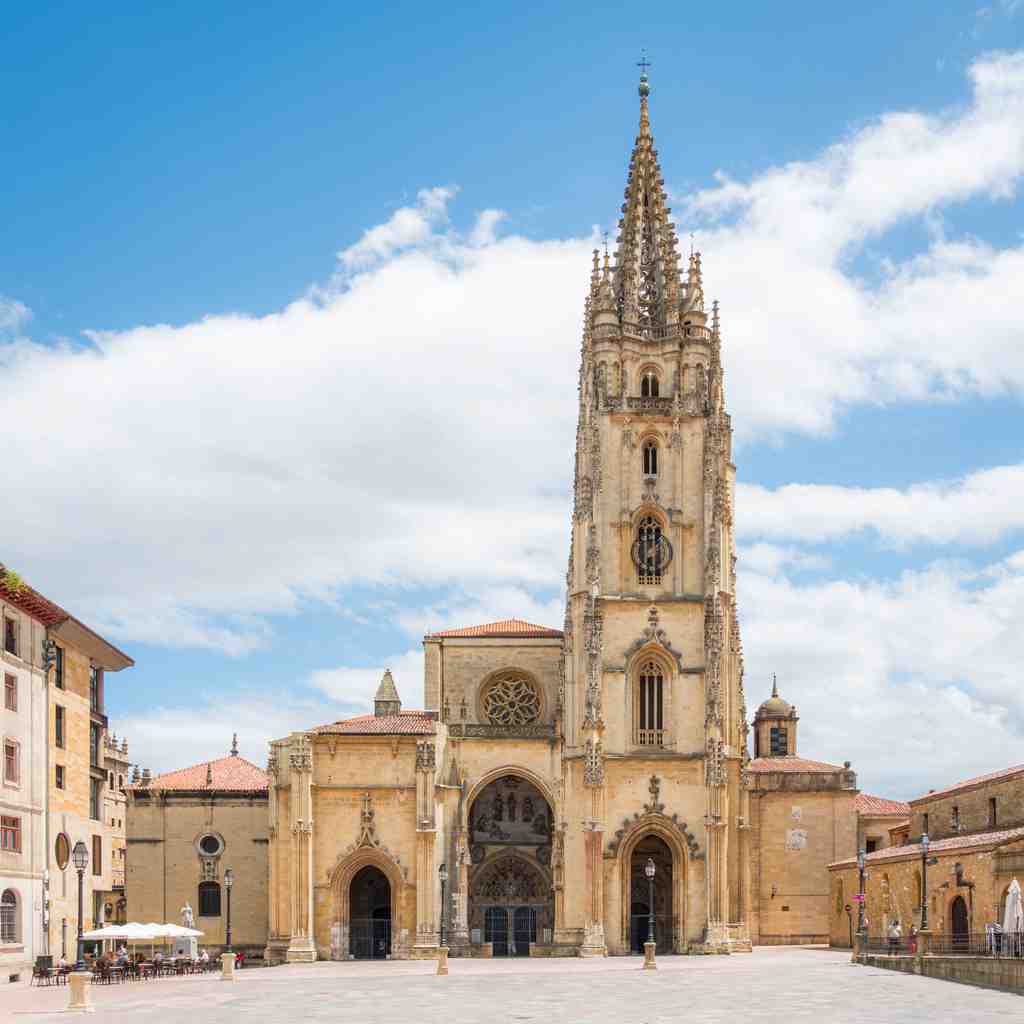
    Right in front of you rises the majestic Catedral de Oviedo, with its tall, single spire reaching into the sky above three grand gothic arches-just look straight ahead for the towering stone facade, crowned by intricate carvings and the unmistakable rose window. Now, let me take you back in time, right here in the shadow of these ancient stones. Imagine the year is 794. The air is tense-Oviedo has just faced a mighty attack, and Fruela I’s original church of San Salvador lies in ruins. But a determined king, Alfonso II the Chaste, decides to rebuild, making this spot the heart of his kingdom. Over centuries, each ruler and architect leaves a mark, transforming what began as a simple basilica into the dazzling gothic monument you’re seeing today. If you listen closely, you might almost hear the echoes of medieval stonemasons chiseling away, shaping pillars and arches. This cathedral is a true patchwork of history: beneath its gothic splendor lurk layers of the past. Its oldest secret-the Cámara Santa, or Holy Chamber-dates to the 9th century and was built to keep priceless treasures safe. Step inside and you’ll find the Victory Cross and the Cross of the Angels, sparkling with jewels and shrouded in legend-one’s the symbol of Asturias, the other of the city. The Cámara Santa even houses the Arca Santa, an ancient chest said to be brimming with relics and mysteries, including the sacred Shroud. This little chamber, tucked within the gothic giant, is now a UNESCO World Heritage Site-no wonder it’s the cathedral’s crown jewel! You might notice the incredible blend of architectural styles all around you, like a timeline built in stone. There’s the Romanesque vaults and carved apostles hidden away, the soaring gothic walls and pointed arches that reach for heaven, the renaissance touch in the very top of the spire, and the baroque flourishes in the chapels-this building is a living history book. And if you follow the gaze up that soaring spire-80 meters high!-imagine the 16th-century architects scratching their heads, finally deciding just one tower would do. After all, if you had to maintain more than one tower that tall, you’d need more than faith to keep them standing! For centuries, this was a holy checkpoint for weary pilgrims on their way to Santiago, and the sight of its lopsided spire was a beacon of rest and safety. But the cathedral’s story hasn’t always been so peaceful. In 1934, a bomb exploded in the crypt during the Asturias Revolution. Priceless art was shattered, ancient relics threatened, but somehow, after the dust and chaos, treasures like the Shroud were recovered from the rubble. Restorers set to work, and just like the kings and artisans before them, brought the building back to life. But don’t just look up-take in the details at eye level. The three arches of the porch welcome you in, each doorway topped by vibrant reliefs and figures. The main door depicts scenes from Christ’s life, but just above, a keen eye will spot carvings of Kings Fruela I and Alfonso II themselves, still standing guard over their cathedral centuries later. Listen for the bells, especially the mighty “Wamba”-the oldest bell in use in all Spain, cast in 1219! Even cracked, she rings out for great feasts and moments of high drama, her deep voice echoing over the city, a sound that’s survived everything from war to lightning strikes. Inside, the cathedral stretches in three grand naves, its roof vaulting high above-imagine the monks chanting, candles flickering, the whole space filled with music and prayer. There’s an altar dedicated to San Salvador, the original patron, surrounded by chapels stuffed with more relics and the tombs of long-gone bishops and kings. So here you stand, in front of a cathedral that’s seen kingdoms rise, wars rage, bombs fall, and miracles unfold. With each stone, you walk in the footsteps of kings, pilgrims, and dreamers. And don’t forget: with this much history, a few ghosts might be watching, just making sure you’re paying attention to their favorite stories!

    Open dedicated page →
  2. To spot the Monument to Jovellanos, look for a grand stone structure set against the old monastery wall, fronted by a large sculpted crest in the middle and faded inscriptions,…Read moreShow less

    To spot the Monument to Jovellanos, look for a grand stone structure set against the old monastery wall, fronted by a large sculpted crest in the middle and faded inscriptions, just off the quiet corner of the street. As you stand here, close your eyes for a moment and picture the year 1798-Oviedo’s old stone walls echo with the sound of distant horses’ hooves. Here, the air is thick with anticipation. People are gathering, gossiping about the big event: the unveiling of Spain’s very first public monument for an ordinary citizen. But wait, this isn’t just any citizen! This is Gaspar Melchor de Jovellanos, born up the coast in Gijón, a local hero with a mighty brain and an even bigger heart for Asturias. He fought hard for the region-dreaming of new industries, better roads, and progress everywhere. Imagine the fuss when Madrid’s star architect, Juan de Villanueva, sent up the plans. The monument was supposed to shine as a little slice of the Enlightenment. But this poor thing has had quite the journey! Over the years, it was dragged from place to place, not once, not twice, but three times. Parts of it have even been lost or broken, as if it couldn’t decide where it wanted to rest its stones. Today, it sits a little battered but proud, clinging to this wall-almost like it’s hiding from another move! If you get close, see if you can make out the Latin inscription and the mighty Spanish coat of arms. There’s the crest of Asturias too, crowned and set between mysterious worn-out shields. If those stones could talk, I bet they’d have some juicy tales of rainstorms, loud city debates, and maybe the occasional midnight cat prowling through. So next time you feel a bit lost, remember: even the grandest monuments sometimes end up in a cozy corner, and that’s not so bad after all!

    Open dedicated page →
  3. To spot the House of Dean Payarinos, look ahead for a grand two-story mansion with elegant tall windows, striking wooden balconies to either side, and a charming neoclassical…Read moreShow less

    To spot the House of Dean Payarinos, look ahead for a grand two-story mansion with elegant tall windows, striking wooden balconies to either side, and a charming neoclassical façade right on the open square. Now, as you stand in front of this impressive building, imagine stepping back to the year 1900 - picture the streets bustling with people and the smell of fresh pastries floating through the morning air. The man behind this mansion was Benigno Rodríguez Pajares, a canon with a mission: he wanted a home fit for both admiration and a bit of envy from his neighbors. He called in one of Oviedo’s top architects, Juan Miguel de la Guardia, who didn’t just hold a ruler and a dream-he delivered an architectural treat. The building style mixes a dash of everything-neoclassical like ancient Rome, but with its own unique Asturian flavor. Those wooden balconies and the grand pediments over the windows? They were the social media profiles of their time-guaranteed to get attention. But here’s where our story takes a twist! Fast forward to the 1980s, and the inside of this mansion is transformed-walls come down, new rooms are built, and musicians’ laughter and piano notes start echoing through the halls. Today, it’s the main entrance to the Eduardo Martínez Torner Conservatory, a place where new melodies fill the air and students sometimes wonder if the old house's spirit ever hums along with them! So, next time you hear music drifting out, just remember: this house loves a good tune as much as a juicy bit of gossip.

    Open dedicated page →
  4. To spot the Medieval Wall of Oviedo, look left along the narrow street: you’ll see a long, weathered stone wall rising up along the edge of the road, textured with rough limestone…Read moreShow less

    To spot the Medieval Wall of Oviedo, look left along the narrow street: you’ll see a long, weathered stone wall rising up along the edge of the road, textured with rough limestone blocks and a patch of green plants here and there. Congratulations, adventurer! You are now standing next to Oviedo’s old guardian: the Medieval Wall. Imagine the city centuries ago, surrounded by these very stones, with the streets bustling and voices echoing under the shadow of these once-mighty fortifications. It all began back in the reign of King Alfonso II, called “the Chaste”-now, there’s someone who probably never had to deal with pesky neighbors! In the early 800s, Alfonso II decided to move the capital to Oviedo. Not only did he set up palaces and churches, he wrapped the entire city in a sturdy limestone hug: this wall. Picture the sound of clinking stone and wooden hammers as the city’s first workers laid the wall, enclosing sacred places like the Monastery of San Vicente, the true heart that grew into modern Oviedo. Over the centuries, the wall became more than a simple barrier-it became a silent witness to Oviedo’s dramatic history, from royal intrigue to everyday life. The wall is even mentioned in the will of King Alfonso II, and pops up time and again in ancient records, like a recurring character in the world’s longest-running TV series. But the story doesn’t stop with Alfonso II. Fast forward to 1258, and Alfonso X “the Wise” decided Oviedo needed an upgrade. He ordered a newer, stronger wall-two parallel stretches of limestone stuffed with rubble in between, making it up to 1,400 meters around, 4 meters high, and more than two meters thick. Imagine trying to peek over that on your tiptoes! The city council paid for most of it, while the church chipped in the rest. Not exactly a bake sale fundraiser, but it worked. For centuries, the wall did its job-and sometimes, it overdid it. By the 17th and 18th centuries, it wasn't so much keeping enemies out as keeping the townsfolk in. The city began to overflow, spilling beyond its ancient borders like jam from a generously filled pastry. People built houses right up against the wall-some even stuck the town hall on top of an old city gate! The new San Pelayo Monastery was built directly over a chunk of wall, with its very foundations hugging the old stones. But as Oviedo grew, large parts of the wall slowly disappeared, stone by stone, to make space for a modern city. In the 20th century, there were even moments when the wall’s fate hung by a thread. It received historic monument status in 1931, but still-pieces vanished, including the famous Gascona Tower in 1963. A few dramatic moments later, in 1977, the city finally stepped in to save what was left, adding a dash of archaeological drama and a bit of urgent weed-whacking. Today, what you see here is a rugged survivor-a remnant of a 1,200-year-old dream to protect and define Oviedo. These battered stones have seen everything: kings, soldiers, secret night crossings, festivals, and modern cars zipping past. In places like Plaza de Riego, Calle Paraíso, or even beneath the Monastery of San Pelayo, the story of the wall continues, waiting to be rediscovered by curious explorers like you. Stand here, take a deep breath, and let your imagination fill the streets with armored guards, market vendors, and echoes of ancient footsteps-because every stone is a piece of Oviedo’s soul, ancient yet still alive.

    Open dedicated page →
  5. But this lively spot got a makeover in the 19th century. The name changed to honor Rafael del Riego, a true Asturian hero-military man, politician, and, frankly, a bit of a…Read moreShow less

    But this lively spot got a makeover in the 19th century. The name changed to honor Rafael del Riego, a true Asturian hero-military man, politician, and, frankly, a bit of a troublemaker in the best way. In 1820, he led a bold revolution echoing through the streets, fighting for freedom and rights. Wherever you see people standing tall for change, remember, that spirit ran wild right here! They even built a monument to Riego in the square. Maybe he’s still here, keeping an eye on the place, making sure things don’t get too quiet or, you know, too boring. So take a deep breath, listen to the city’s music, and let your feet sink for a second into the cobbles where reformers and rulers walked before you. And remember, if these walls could talk, they’d probably have a thousand tales… and a few juicy secrets. Onward to the next stop!

    Open dedicated page →
  6. If you look just ahead, you'll spot a grand, sandy-colored stone church with a single, tall bell tower reaching up on the left-its ornately carved entrance and the tower’s pointed…Read moreShow less

    If you look just ahead, you'll spot a grand, sandy-colored stone church with a single, tall bell tower reaching up on the left-its ornately carved entrance and the tower’s pointed spire make it easy to pick out against the sky, right next to Oviedo’s Town Hall. Welcome to the Iglesia de San Isidoro el Real-where the stones practically hum with stories! Imagine yourself back in the lively, bustling 1500s, standing on this very piazza as masons chip away beneath the watchful eyes of Jesuit priests plotting their grand new temple, a church built upon the bones of an even older Romanesque church. If these walls could talk, they’d tell you about vanished arches, moved around like chess pieces; the original church’s doorway, believe it or not, now stands all the way in the San Francisco Park since 1925. Try not to imagine it walking there on its own, archway and all! This place is at the very heart of Oviedo’s history, officially showing up in documents from 1217, making it the city’s third oldest church after San Tirso and San Juan. By the late 1500s, wealthy Magdalena de Ulloa tossed her widow’s veil and funded the neighboring Jesuit college, so the church you see sprang to life in 1587, with Jesuits hoping nobody would notice if they slipped a bit of baroque flair into the city’s soul. Of course, not everything survived. In 1873, while most of the college was torn down for a bustling new market, San Isidoro stood strong-imagine the clang of hammers and the mumble of merchants, as this elegant church watched its old friends-classrooms and dormitories-get swept away. But the church itself? Like an old actor who won’t exit stage left, it remained, the sole survivor of a once-lively Jesuit campus. Inside awaits a whole treasure chest of stories. There’s just one nave, a Latin cross floor plan, and only one bell tower, because-fun fact-the second one was cut for budget reasons. It’s almost a tradition here: even Oviedo’s grand cathedral ran out of cash! Walk in, and the scent of old incense and polished wood fills the air. Every side chapel holds its own secret: one for San Ramón Nonato, another for the Jesuit saint Francis Xavier, a third for Our Lady of the Snows, and a Calvary that brims with dramatic, lifelike sculptures of Christ, the Virgin, John, and a kneeling Magdalene-carved, painted and gilded by masters like Luis Fernández de la Vega and Antonio Borja. Speaking of mysteries, look for the incredible reliquaries: one contains a piece of Pope John Paul II’s bloodstained cassock from the 1981 assassination attempt, set inside Oviedo’s famed Cross of Angels. That’s the sort of thing Indiana Jones would cross a continent to see! Under the marble and the centuries-old timber, San Isidoro is a place that honors both the living and the dead. Step over to the right and you’ll find a mausoleum dedicated to Oviedo’s heroes who fell in the Carlist Wars-engraved names whispering tales of courage and tragedy, with every festival of the city’s legendary “Desarme” (Disarmament) rooted in these very stones. There’s even an “excusing” statue of San Isidoro, created for pestering processions in the 1700s, and yes, he’s just as persuasive as you’d expect! But what is a church without music? High above, the 17th-century baroque organ from Alonso Menéndez Forcinas stands ready, its pipes resting like a row of soldiers. In the silence of the afternoon you can almost hear a swirl of sacred music, echoing as it has at concerts for Sacred Musical Cycles through the years. Peer up at the rich baroque altarpiece-carved, painted, and glittering-as San Isidoro gazes out from his niche, surrounded by saints and biblical scenes, Annunciations to the left, shepherds dotting the right. Each level, each statue-St. Ignatius, St. Francis Javier, St. Matías-tells part of the story. And, in one corner, the revered connection with Rome itself: on certain days, stepping inside grants you the same spiritual reward as if you’d visited the mighty Basilica of Santa Maria Maggiore in Rome. Now that’s a shortcut for pilgrims if I’ve ever heard one! Just outside, on the eastern façade, the cofradía-the brotherhood-still meets, carrying the traditions of the Jesuits, the mourners, and holy processions for centuries. Through war, peace, feast, famine, and the odd fundraising headache, San Isidoro el Real has stood as both the guardian and storyteller for Oviedo’s beating heart. So as you stand here, let the ancient stones remind you: in Oviedo, history isn’t just preserved-it’s still singing. Yearning to grasp further insights on the the building, the main altarpiece or the parish church? Dive into the chat section below and ask away.

    Open dedicated page →
  7. In front of you is Fontán Square, a lively rectangular plaza surrounded by colorful, traditional buildings with covered arcades and bustling outdoor cafés-just look ahead for the…Read moreShow less

    In front of you is Fontán Square, a lively rectangular plaza surrounded by colorful, traditional buildings with covered arcades and bustling outdoor cafés-just look ahead for the open space filled with people and market stalls right in the heart of the old town. Welcome to the legendary Fontán Square, where Oviedo’s history bubbles up like the waters that once gave this place its name! Imagine standing here hundreds of years ago-not in a plaza, but at the edge of a natural lagoon, supplied by bubbling springs. If you close your eyes and listen, you might just hear the gentle splashing of water and distant voices as noble Oviedo families promenade along the banks, while farmers trudge in from the countryside, arms weighed down with milk, fresh vegetables, cheese, and chickens. Back then, this was the city’s playground-a place for the upper-class to stroll and socialize, and for country folk to peddle their wares. The lagoon attracted more than just buyers and sellers: where there’s a crowd, there are craftsmen, so soon you’d find blacksmiths clanking away, basket weavers showing off their handiwork, and laughter floating above the hubbub. But as you might guess, a lagoon in the heart of a growing city isn’t exactly a recipe for fresh air. As the water stagnated, the smell got... let’s say, "noticeable"-and the city decided enough was enough. In August of 1523, the lagoon was drained, and by 1559, a fountain and a public washhouse had replaced the old waters. The area began to transform, piece by piece, into a lively urban space. Fast forward a bit, and a grand new chapter begins-Magdalena de Ulloa, the widow of Luis de Quijada (let’s call her Oviedo’s answer to a fairy godmother), decided to build a Jesuit college right here in 1587. Once the building was done, clever townsfolk recycled leftover bricks and stones to lay out the early foundations of the square. Why let good construction materials go to waste, right? The area kept transforming through the 1600s, evolving from open markets to a proper "corral de comedias"-imagine a theater right here, full of locals gasping, laughing, and cheering the actors on. Eventually, this was replaced by the grand Campoamor Theater, but those echoes of applause? Some say they’re still hiding in the cobblestones! By 1792, the town hall decided it was time to snap things into shape, and under the guidance of architect Francisco Pruneda y Cañal, the square was rebuilt with a grand plan: a neat rectangle with four entrances, forty shop stalls, and stylish porticoes circling the square. It didn’t quite work out perfectly-Oviedo is nothing if not quirky-but the charming mismatched heights and uniquely shaped stores give the plaza its cozy, welcoming feel. Look around, and you’ll notice the colorful facades, the porticoes supported by columns, and-if you squint-a little bit of mischief. That’s because the square’s legendary low fountain, built in 1657, was famous for making everyone-no matter how tall-bend down deep for a drink. It humbled even the proudest nobles, so locals made plenty of jokes about it. The humorist Luis de Tapia even wrote a poem about this fountain’s “special talent” for humbling the haughty-nobody in Oviedo could escape a bent back and a slightly bruised ego at the Caño del Fontán! The square didn’t always have it easy. By the late 20th century, time had taken its toll: buildings sagged, paint peeled, and the heart of the square began to falter. In a bold move, the city decided to demolish almost everything-but kept the corner where the sidrería Casa Ramón was. Like a phoenix from the ashes (or perhaps a cider from the apple press), the square was reborn and reopened in 1997, dazzling and full of life. Today, Fontán Square is two plazas in one-the grand, arcaded space in front of you, and the nearby Daoiz y Velarde, surrounded by baroque palaces. Step here on a Thursday, Saturday, or Sunday, and you’ll be swept up in the famous market, a whirl of voices, colors, and smells. So take a moment. Hear the voices of the past, feel the centuries of change beneath your feet, and, if you can, imagine what it might have been like to stoop for a drink at that mischievous little fountain-because in the Fontán, history never stands still, and there’s always something sparkling just below the surface!

    Open dedicated page →

Reviews

1.0
starstarstarstarstar
1 reviews

Frequently asked questions

How do I start the tour?

After purchase, download the AudaTours app and enter your redemption code. The tour will be ready to start immediately - just tap play and follow the GPS-guided route.

Do I need internet during the tour?

No! Download the tour before you start and enjoy it fully offline. Only the chat feature requires internet. We recommend downloading on WiFi to save mobile data.

Is this a guided group tour?

No - this is a self-guided audio tour. You explore independently at your own pace, with audio narration playing through your phone. No tour guide, no group, no schedule.

How long does the tour take?

Most tours take 60–90 minutes to complete, but you control the pace entirely. Pause, skip stops, or take breaks whenever you want.

What if I can't finish the tour today?

No problem! Tours have lifetime access. Pause and resume whenever you like - tomorrow, next week, or next year. Your progress is saved.

What languages are available?

All tours are available in 50+ languages. Select your preferred language when redeeming your code. Note: language cannot be changed after tour generation.

Where do I access the tour after purchase?

Download the free AudaTours app from the App Store or Google Play. Enter your redemption code (sent via email) and the tour will appear in your library, ready to download and start.

verified_user
Satisfaction guaranteed

If you don't enjoy the tour, we'll refund your purchase. Contact us at [email protected]

Checkout securely with

Apple PayGoogle PayVisaMastercardPayPal
Loved by travellers

Thousands of tours started.
Plenty of opinions.

4.8 across the App Store and Google Play. Here's a few we keep coming back to.

starstarstarstarstar
This was a solid way to get to know Brighton without feeling like a tourist. The narration had depth and context, but didn't overdo it.
Christoph
Christoph
Brighton Tour
starstarstarstarstar
Started this tour with a croissant in one hand and zero expectations. The app just vibes with you, no pressure, just you, your headphones, and some cool stories.
download Get the app

Pop your headphones in.
Step outside.

Free to download. Tours in every city. Start in 60 seconds — no account, no card.

Download on the App StoreGet it on Google Play
starstarstarstarstar_half
4.8
AudaTours app icon
headphones
~ 4 min until your first tour starts
public
1,000+ cities worldwide
all_inclusive
AudaTours
Unlimited

Every tour. Every city. One subscription.

3101 tours2271 cities138 countries50+ languages

