
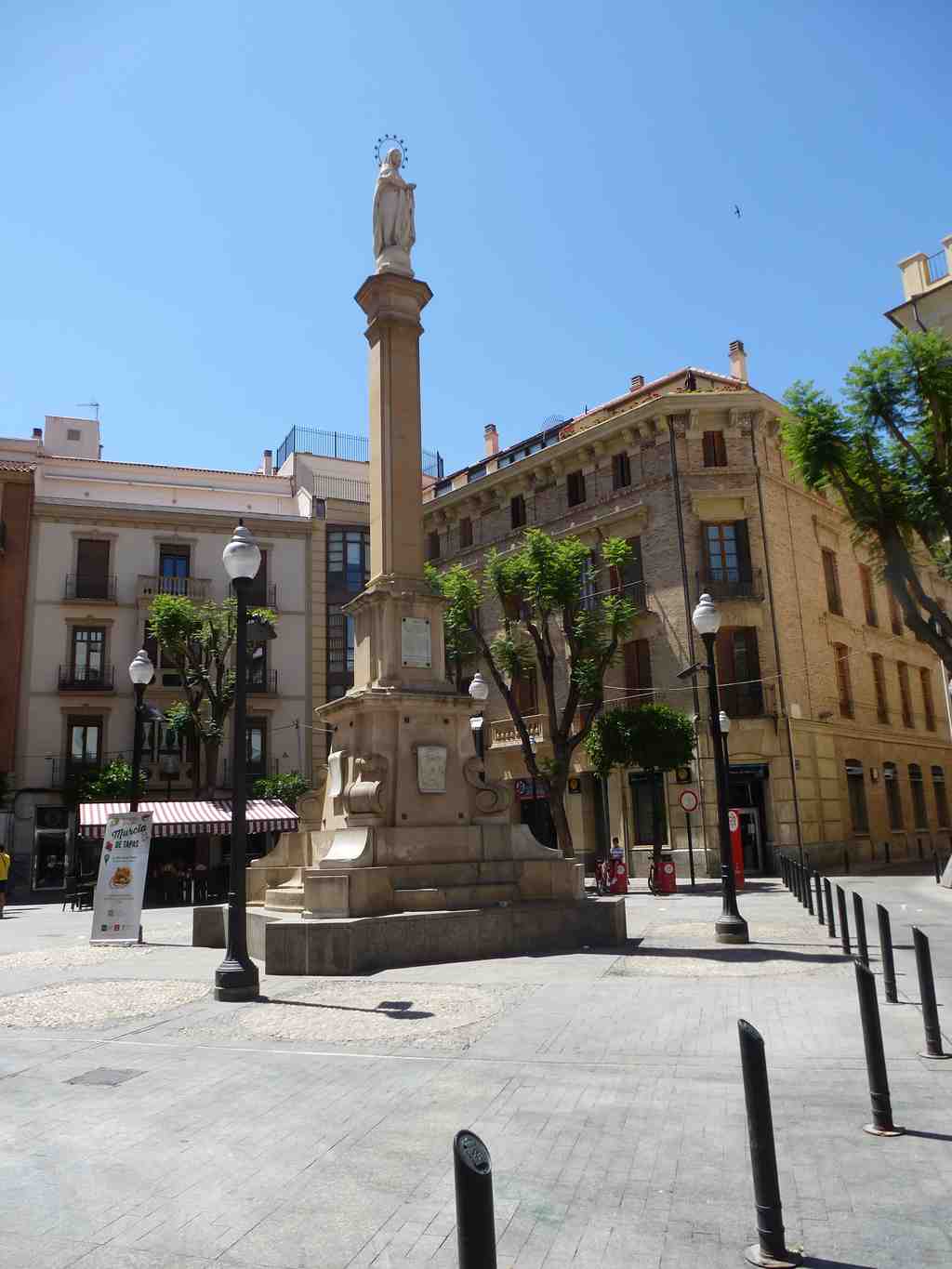
You will know you are in the right place when you spot the towering, square stone pillar rising from a stepped base, crowned by a pale statue of a figure with a halo of stars. This is Plaza de Santa Catalina. Today, it is a unified pedestrian zone packed with tapas venues, but do not let the relaxed atmosphere fool you. For centuries, this was the absolute political epicenter of Murcia.
During the Islamic period, this area was the highly active neighborhood of Zabazala, an Arabic term meaning head of prayer, anchored by a major mosque. When the Christian conquest swept through, the new rulers implemented their standard urban renewal strategy. They knocked down the mosque, built the Church of Santa Catalina right over the foundations, and engineered the surrounding space into the city's main square.
By the fifteen hundreds, this plaza was the undeniable center of civic life. Proclamations were read, local politicians argued, and public hangings were executed right outside the church doors. It was civic engagement, medieval style. The church itself featured a soaring late Gothic tower, which for a long time was the absolute tallest structure in Murcia. This height was extremely practical. It served as an early-warning watchtower to spot incoming Berber pirates sailing from the North African coast, giving locals just enough time to secure their valuables.
If you look around, you will see a fascinating mix of brickwork and nineteenth-century architectural problem solving. Over at the bright yellow eighteen sixty mansion known as Casa Palarea, you can spot classic curved iron window grilles, a design allowing residents to look down the street while remaining protected. That building now houses the museum of the renowned Murcian painter Ramón Gaya.
But there is a major phantom building here, too. In sixteen oh one, the city constructed a massive institution called the Contraste de la Seda. Silk was serious business in Murcia, and this building was the regulatory headquarters. Officials systematically inspected the silk and rigorously weighed gold and silver coins to prevent counterfeit currency from crashing the local economy. It was an absolute economic fortress. Naturally, the city tore it down in nineteen thirty-two. Now, the towering nineteen forties La Unión y el Fénix building stands exactly in its footprint.
As the city expanded into the eighteenth century, political power shifted toward the Cathedral area, and Santa Catalina became a little quieter. The central stone monument you saw when you arrived was designed by the architect Carbonell and added in nineteen fifty-four, honoring the Immaculate Conception.
It is quite the layered structural history for a spot where you can now just sit and order a plate of cured meats. Whenever you are ready to keep exploring, we can easily make our way to the next stop.




