
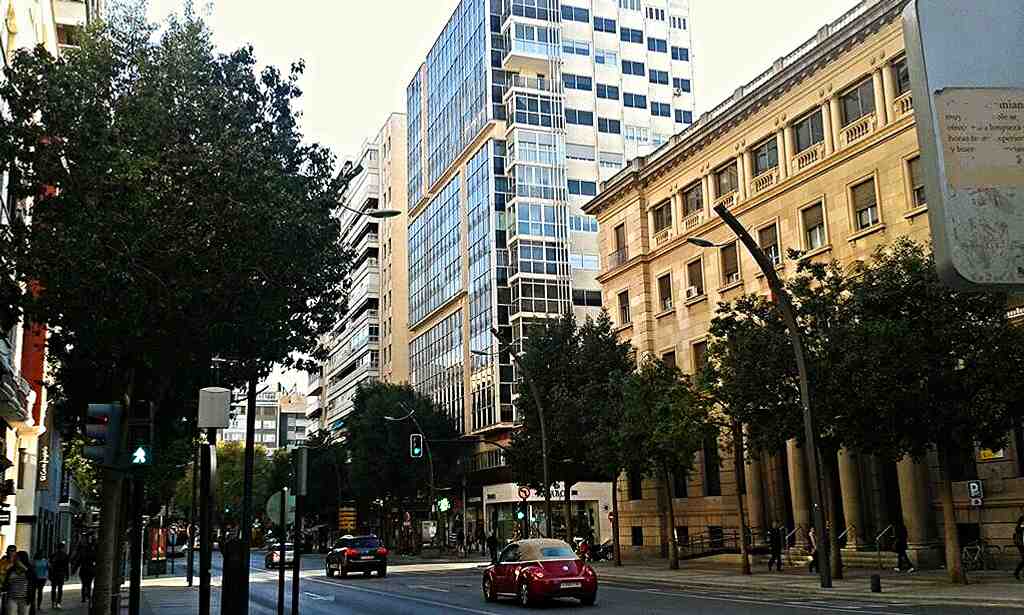
You have arrived at the Gran Vía Escultor Francisco Salzillo, a broad asphalt avenue defined on your right by the sharp architectural contrast between a classical sandstone building with heavy pillars and a sleek, geometric tower paneled in reflective blue glass.
Now, look straight down this wide boulevard. It is hard to imagine, but to build the very street you are looking at, the city had to bulldoze its own history. Until the mid nineteen fifties, this area was a dense, medieval labyrinth of narrow, winding alleys. As motor vehicles arrived in the early twentieth century, the city realized that cars and medieval street grids are natural enemies. They needed a massive central artery to connect the north and south train stations, and they wanted to shake off their provincial image to become a modern, influential metropolis.
Of course a little real estate speculation never hurts, either.
To carve out this grand avenue, hundreds of old buildings were demolished starting in the late nineteen thirties, including a renaissance mansion and two full convents. But by nineteen fifty, the grand project hit a massive historical speed bump. Right in the planned path sat the Madre de Dios Arab Baths. They were legally protected, having been declared a National Monument in nineteen thirty-one.
So, how do you pave over a protected medieval treasure? You wait. The city let the ancient baths severely deteriorate. Then, after a partial roof collapse, the mayor at the time, Domingo de la Villa, simply blamed the damage on heavy rain and ordered the whole thing torn down in February nineteen fifty-three. The demolition sparked a massive public outcry, which is quite an achievement considering Spain was under a dictatorship with strict media censorship at the time.
With the pesky monument out of the way, the street was fully cleared and paved by nineteen fifty-six. Originally named after a political figure of the regime, it was wisely renamed after the beloved local sculptor Francisco Salzillo once democracy returned.
As you look down the street, you can see a timeline of architectural fads. That heavy, classical stone building on the right is the Bank of Spain, designed in a historicist style, a type of architecture that deliberately mimics grand, ancient temples to project wealth and stability. It was actually built before the street was even opened. Then came the modernists in the nineteen sixties and seventies, dropping in towering structures of concrete, metal, and glass, like the seventeen story Hispania building, completely abandoning the classical look.
The result is exactly what you see today, a thoroughly modern avenue built quite literally on the rubble of the past. Feel free to linger a bit, and we will continue our walk shortly.




