
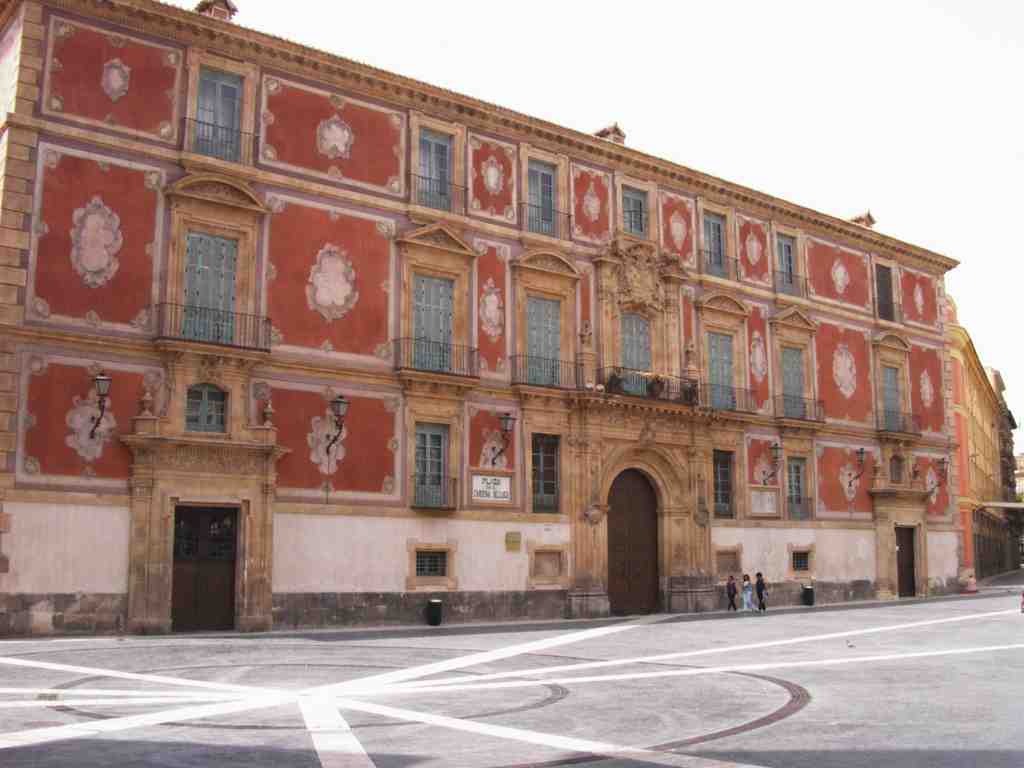
On your left is the Episcopal Palace, a massive rectangular building instantly recognizable by its striking red facade covered in white painted medallions, centered around a grand arched wooden door and an ornate stone balcony.
Now, the story of how this eighteenth-century Rococo masterpiece, an architectural style famous for its highly ornate and theatrical designs, came to be is a perfect example of extreme urban planning. You see, the original bishop's palace used to sit directly opposite us, essentially exactly where this grand open plaza is today. But in the mid-eighteenth century, the city built a spectacular new facade for the Cathedral, which is right next door. The problem? The old palace completely blocked the view of the new cathedral. The solution? They simply demolished the bishop's palace. Creating this wide open space was entirely about giving the cathedral room to breathe and, frankly, show off.
So, they had to build a new palace right here. Construction kicked off in seventeen forty-eight, but they started with a section overlooking the river known as the hammer. They built the viewing deck first so the bishop could enjoy the gardens while the rest of his house was being slowly assembled. I respect those priorities.
Look closely at the exterior. Unlike most Spanish Baroque buildings that relied on carved stone, this facade features elaborate frescoes by Genoese masters. They used trompe l'oeil, a painting technique that creates an optical illusion of three-dimensional space, to add fake architectural details. And if you direct your attention to the large stone coat of arms directly above the main balcony, you will spot a delightfully dry structural joke. The shield belongs to Bishop Rojas y Contreras. Notice the castle carved into it? It is upside down. This was not a mistake by a tired stonemason. It is a visual pun on his surname, Contreras, which translates to the opposite or the reverse.
This building has seen an absurd amount of drama. During the Peninsular War, French troops used it as their headquarters. In eighteen sixty-two, Queen Isabel the Second stayed here. To impress her, local officials threw a wildly lavish, out-of-season version of their famous Burial of the Sardine parade. It is exactly what it sounds like, a massive mock-funeral procession for a giant fish figure. The event was so expensive it completely bankrupted the city, and they could not afford to hold the festival for the next two years.
Later, during the Spanish Civil War in the nineteen thirties, the building was seized and turned into the Communist Party headquarters, earning the nickname the Red Palace. In the chaotic final days of the war in March nineteen thirty-nine, rival republican factions actually fought each other right here. Machine guns were mounted on the cathedral tower, firing down on this very building. If you inspect the iron grilles on the facade, you can still find the bullet holes.
The palace is open Monday through Friday from nine AM to two PM, and again from five to eight PM, but remains closed on weekends. Appreciate the bold frescoes here, and we can proceed when you are ready.




