
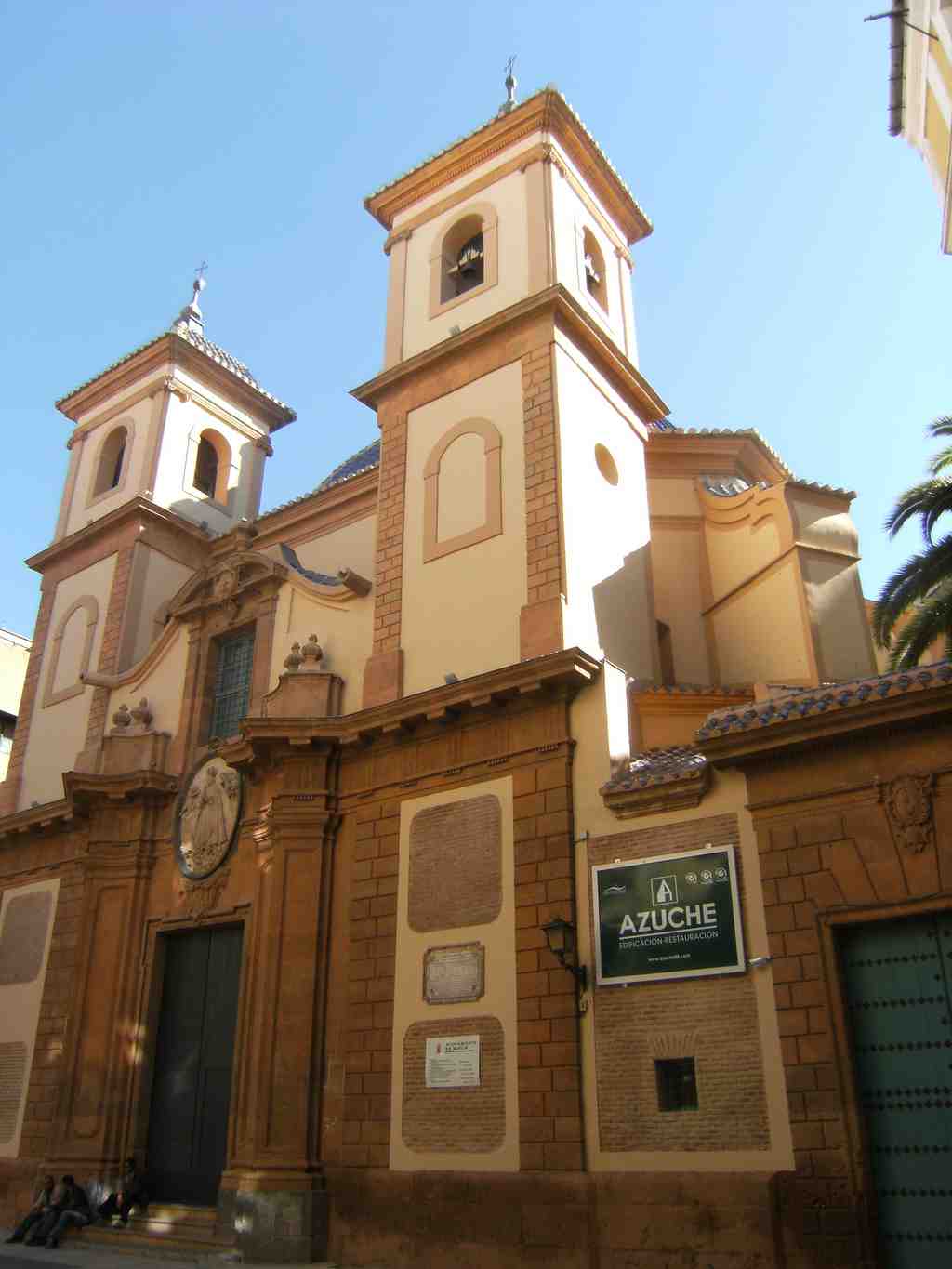
You will recognize the building by its twin square towers flanking a pale stucco and exposed brick facade, featuring a prominent oval medallion set right above the main wooden doors.
Welcome to the Museum of the Church of San Juan de Dios. If you are looking for a building with an identity crisis, you have found it. This site has been a royal Islamic palace, a Templar hospital, a church, and now, a museum.
Let us start from the bottom up, because the basement here is hiding a massive secret. Beneath your feet lie the archaeological remains of the Alcázar Mayor, the grand Islamic fortress that once dominated the city. Down there, archaeologists uncovered a beautifully painted twelfth-century prayer niche, known as a mihrab, along with a royal pantheon. They found nine tombs intact within the royal cemetery, including adults, young children, and two newborns, likely belonging to a high-ranking family of the Muslim court.
When the Christians took control of Murcia in twelve forty-three, the future King Alfonso the Tenth claimed this fortress. Alfonso, known as Alfonso the Wise, became incredibly attached to this specific location. He built the first Christian church in Murcia right over the Muslim oratory. In his will of twelve eighty-four, he demanded to be buried here. But, being a pragmatic man, he added a backup clause. If his body could not make it to Murcia, he requested that his entrails be removed and sent here instead.
Things did not go exactly as planned. His heart was originally supposed to go to the Holy Land, but the logistics failed. So, for two hundred and forty-one years, the king's heart and entrails rested in this very spot, before Emperor Charles the Fifth ordered them moved to a nearby cathedral in fifteen twenty-five.
After Alfonso, the Knights Templar set up shop, transforming the complex into a hospital. For centuries, this site was the most important medical facility in the city. Eventually, the Brothers of the Order of San Juan de Dios took over administration in sixteen seventeen, giving the church the name it holds today.
The structure you are looking at now replaced the original in seventeen eighty-one, designed by architect Martín Solera. And from an engineering perspective, it is brilliant. Solera abandoned the standard cross-shaped layout. Instead, he gave the church a highly unusual elliptical floor plan. The door is on one long side of the oval, and the altar sits directly opposite. This clever geometry turns the entire church into a theatrical stage, drawing every eye directly to the center where they kept the Eucharist, the ceremonial bread of the Christian faith, in a jewel-encrusted display. It is a masterpiece of Rococo design, utilizing curved walls and eight massive pillars to create a sweeping sense of motion.
If you want to see the Islamic ruins, the elliptical nave, or the impressive religious sculptures inside, the museum is open from ten A-M to one thirty P-M Tuesday through Sunday, with evening hours most days, though it is completely closed on Mondays.
Take a moment to soak in the layered architecture of this remarkable building. When you are ready, we can head to the next stop.




