Málaga Audio Tour: Centro Magic between Castles & Cathedrals
Between Moorish walls and Baroque splendor, Málaga beats with a second heart. In the Alcazaba de Málaga, shadows whisper of intrigues and sieges. Just a few steps further, the Malaga Cathedral rises to the sky like an unfinished promise. This self-guided audio tour through Centro leads directly through alleys, squares, and quiet corners. Stories open doors that most visitors overlook, from political power struggles to scandals and forgotten moments. Who decided over life and death in the Alcazaba when the city burned? What trace connects the Cathedral to a rebellious night that no one wants to explain? Why does San Miguel Cemetery bear a name that repeatedly appears in old reports in connection with one specific sealed tomb niche? Every step draws you deeper in. From stone to stone, Málaga becomes new, dramatic, close, unexpected. Start now and hear the city's hidden heart.
Tour preview
About this tour
- scheduleDuration 40–60 minsGo at your own pace
- straighten6.1 km walking routeFollow the guided path
- location_on
- wifi_offWorks offlineDownload once, use anywhere
- all_inclusiveLifetime accessReplay anytime, forever
- location_onStarts at Main Alameda
Stops on this tour
Before you, a wide avenue stretches out with huge, dense tree canopies like a green roof; look to your right at the bright statue on the pedestal and the old lanterns between the…Read moreShow less
Before you, a wide avenue stretches out with huge, dense tree canopies like a green roof; look to your right at the bright statue on the pedestal and the old lanterns between the trees. Welcome to the Alameda Principal, simply called 'the Alameda' by many: one of Málaga's great arteries, separating the historic core from the modern expansion area and reliably connecting the city from east to west. Today, it feels like a comfortable mix of a promenade and a traffic artery. But the Alameda earned its place the hard way - literally from sand. Because where you stand now was once the coast. Medieval walls ran along the north side, with the sea and beach in front. Then came the Guadalmedina River, bringing sediments for centuries, and suddenly new land emerged between the walls and the port. In the 1600s, there was even a notorious suburban area here, the 'Isla de Arriarán' - known for pubs, taverns, and plenty of picaresca, meaning petty criminal charm with a wink. Not exactly the address where you'd take your mother-in-law for a stroll. In the 1700s, the city began to bring order to this chaos. In 1721, the council had plans drawn up, plots of land were sold, and from 1783, the project really gained momentum: Málaga wanted an elegant promenade boulevard, inspired by great examples like Paris or Madrid. Military engineers lent a hand, land was reclaimed from the sea, and in the end, the city got what was considered modern at the time: a wide promenade with trees and a central square. In 1791, the Fuente de Génova was added as an embellishment - a kind of statement: 'We're not just about trade, we're also about style.' In the 1800s, the Alameda became the stage for wealthy families. Palaces, hotels, fine shops - and, of course, the social spectacle. Anyone with rank and name showed themselves here. So much so that the rich were eventually mockingly called the 'Oligarchy of the Alameda.' And yes: gossip behind fans was practically an outdoor sport here. The amusing detail: The name 'Alameda' refers to poplars, but today's stars are Ficus trees from India, planted in 1876 during a major redesign. These mighty canopies above you are thus an import - like good ideas, just with more shade. Later came the first public lighting: first oil and gas, then electricity. And in 1899, the monument to the second Marqués de Larios was erected, a kind of thank you to the bourgeois success story - plus a very practical landmark. Politics also regularly redecorated here: sometimes royal, sometimes named after Wilson, sometimes after Pablo Iglesias, then completely different again during the dictatorship. The boulevard remained, the signs changed - like fashion, but with more consequences. Today, Málaga is trying to give the Alameda more of a promenade feel again: less bus chaos, more pedestrian space, more protection for the old trees. And honestly: it suits this street.
Open dedicated page →To your left, the Atarazanas Market now appears - and even if it smells of fresh fish, ripe tomatoes, and a bit of wet stone today, there's a rather wild journey through time…Read moreShow less
To your left, the Atarazanas Market now appears - and even if it smells of fresh fish, ripe tomatoes, and a bit of wet stone today, there's a rather wild journey through time hidden here. This is Málaga's central city market, but the ground beneath it was once a shipyard from Muslim times. Hence the name: 'atarazana' means something like shipyard. And the best part: a section of this old Nasrid complex has survived - a monumental marble gate. Look at the main facade: This gate is not a decorative quote; it's a genuine piece of the 14th century. Based on the coats of arms, it can be dated to the time of Muhammad V, right in the middle of late Nasrid Granada (approximately 1354 to 1391). A gate from a shipyard that now leads to a market - that's Málaga humor, just in stone. The rest of the building, however, is a child of the 19th century. Between 1876 and 1879, the current market was built, designed by the architect Joaquín de Rucoba. At that time, the city finally wanted to move away from improvised open-air selling spots - honestly: hygienically, it was probably rather 'brave'. Decades earlier, there was already contention over the old, semi-ruined buildings: sometimes a barracks, sometimes a military hospital, then almost a ruin. In 1822, people wanted to demolish parts because they blocked the passage; in 1840, the demolition of the towers was officially approved. And in 1868, political upheaval plus social policy were added: walls gone, work created for poor people, and a proper market was to be built. If you look at its shape: slightly trapezoidal, with three naves inside. The skeleton is made of metal - much of it came from an old iron industry in Sevilla, the same foundry that also helped build the famous Triana Bridge. This is reminiscent of other iron markets of that era in Spain, inspired by the Parisian halls: lots of light, lots of structure, practical yet proud. At the back, you'll see a large round arch with glass, and everywhere this mix of styles: Neo-Arabic, but with clear echoes of Nasrid and Caliphate periods. Additionally, iron ornamentation, and round medallions with fish, cornucopias, and even a human face - as if the building itself were going shopping. Between 2008 and 2010, everything was thoroughly renovated: new fittings, renewed stalls, a bright, translucent roof like before, and the old Puerta de Atarazanas was properly showcased again. Archaeological finds were also made underground - because this place apparently can never stay still. And then there's the large glass artwork from 1973: 108 panels depicting Málaga's monuments, like a colorful 'best of' above people's heads.
Open dedicated page →Now look to your right: Between the narrow rows of houses, the bright, Baroque bell tower of the Kirche San Juan rises high, with a large archway below as its entrance. This is…Read moreShow less
Now look to your right: Between the narrow rows of houses, the bright, Baroque bell tower of the Kirche San Juan rises high, with a large archway below as its entrance. This is the Iglesia de San Juan Bautista, and it has one of those biographies where you think: it should be tired by now, but it's still standing quite upright. After the Christian conquest of Málaga in 1487, the Catholic Monarchs immediately made their mark here: four new parishes were to reorder the city ecclesiastically, and San Juan was one of them. This was not a fancy center back then, but a densely populated neighborhood that incorporated former suburbs of the Islamic city. In short: a lot of everyday life, a lot of vibrancy, and this church right in the middle of it. In the beginning, San Juan was rather Gothic in style: pointed arches, pillars, plus Mudéjar influences, that typical Spanish blend of Christian architectural forms and craft traditions still strongly shaped by Al-Andalus. The first tower version was completed in 1543. But as is often the case: hardly is something built, when it's already being rebuilt. In 1554, things really got started, under a bishop with the fitting name Bernardo Manrique, and the master builder Diego de Vergara was involved. Parts of the main nave structure were torn down, the church was significantly extended, and the pointed arches were replaced by rounder, 'modern' forms. And above today's vaults, an older Mudéjar wooden structure remains hidden to this day, like a well-kept secret above your head. In 1620, additional structural elements were added, but then an earthquake struck in 1680 and toppled the tower. The new tower was built in stages between 1732 and 1776. That's exactly what you see here: a tower-gate that not only reaches upwards but also stages the entrance. Below, the large round arch, above it these clearly structured sections - almost as if the tower were saying: 'Yes, I am Baroque, but I have my order.' And then the dark chapters. On May 12, 1931, during the so-called 'Burning of the Convents,' San Juan was also attacked. Within hours, the interior was devastated. Sculptures from the 17th and 18th centuries, paintings, processional crosses, a part of the archive dating back to 1520 - much was lost. As if that weren't enough, a fire in a chapel in 1980 destroyed more figures. This church wasn't just built; it has been reassembled again and again, piece by piece, like Málaga itself. Today, San Juan is also Cofradía territory: Brotherhoods of Semana Santa have their home here. In the main area, the Cristo de la Vera Cruz is venerated, a work dating back to the early 15th century. And yes, even Antonio Banderas has a very real connection here: He has been part of the 'Fusionadas' since childhood and bears responsibility during Holy Week for the Virgen de Lágrimas y Favores. In Málaga, this isn't a celebrity anecdote; it's a locally lived tradition.
Open dedicated page →
Show 9 more stopsShow fewer stopsexpand_moreexpand_less
To your right, a wide, straight pedestrian street opens up with light stone paving, black streetlights, and elegant, uniformly tall building facades with many balconies. Welcome…Read moreShow less
To your right, a wide, straight pedestrian street opens up with light stone paving, black streetlights, and elegant, uniformly tall building facades with many balconies. Welcome to the Calle Marqués de Larios, usually simply called 'Calle Larios' by locals - Málaga's catwalk, shopping street, and stage all in one. Look at the facades: the corners are rounded, almost softened. This is no coincidence, but rather clever late 19th-century design. The architect Eduardo Strachan was inspired by ideas from Chicago: metal structures, more height than was common at the time, and a clean symmetry that now appears to you like an optical tunnel. If you look straight ahead, balcony lines and cornices converge almost primly at a vanishing point. The city wanted to appear modern with this - and, quite practically, the breeze from the port was supposed to flow through better here. Fresh air as urban planning, before it was commonplace. Because before, the center here was more a tangle of narrow alleys, some without good hygiene. For the new grand street, an entire microcosm was erased: streets with names like 'Seven Curves,' plus cat and dog alleys. Sounds cute, but was probably less romantic when the air was stagnant and everything became too cramped. The solution: a wide, straight axis connecting the center with the newer areas towards Alameda and the park. The whole thing was financed not only for idealistic reasons but also with substantial private money. In 1880, the city planned a joint-stock company for financing: one million pesetas in capital - a huge sum for the time, roughly equivalent to several million euros in today's terms. The Larios family bought the lion's share. The man whose title is on the street sign here, Manuel Domingo Larios, left his mark on the project. At the bottom, at the beginning of the street, on the grand avenue, he even stands as a monument figure, looking as if he's about to personally negotiate the rents. Construction took place from 1887 to 1891. And the inauguration? That had drama. There was a refined side distributing sweets from carriages - and workers who simply threw them back. That's Málaga: even confectionery becomes political when the mood is right. A curious side note: No one from the Larios family was present at the opening; after earlier unrest, they had already experienced firsthand how quickly a mob can appear at their door. In the 20th century, Larios became the most elegant shopping address and a symbol of Málaga's bourgeois version of 'We made it'. There was also a small revolution in everyday life here: one of the first shops with fixed prices. No more haggling - the end of the 'Come on, amigo' discount. Then came a truly nasty moment in 1907: a major flood tore out the wooden paving, which had looked like elegant parquet. Afterwards, it was replaced with robust granite - less glamorous, but significantly less prone to washing away. And today? Calle Larios is one of the most expensive shopping streets: in 2018, it was at the forefront in Spain for rental prices, with peak values of up to approximately 3,600 euros per square meter per year. Sounds like a lot, and it is - and explains why large brands tend to reside here rather than small, long-established shops. Since becoming a pedestrian zone in the early 2000s, the street has become even more desirable: more strolling, more window shopping, more 'just looking' ending with bags. At Christmas, it also becomes a light show, where all of Málaga collectively seems to stop and look up.
Open dedicated page →To your left, the honey-colored Cathedral rises - look up at the tall, illuminated spire and the massive stone structure with its round arches and rows of windows. Welcome to the…Read moreShow less
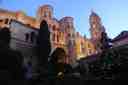
To your left, the honey-colored Cathedral rises - look up at the tall, illuminated spire and the massive stone structure with its round arches and rows of windows. Welcome to the Santa Iglesia Catedral Basílica de la Encarnación, Málaga's grand 'almost finished' story in stone. Position yourself briefly so you can clearly see the main facade: This facade means business - two levels, strictly ordered, wide columns, and an entrance that acts as if it's the navel of the world. And honestly: in a way, it is. Because right here, within the old boundaries of the Arab city wall, once stood the great main mosque. When the Catholic Monarchs conquered Málaga in 1487, the message was clear: a Christian new beginning belonged on this spot. Symbolic politics, but in very expensive natural stone. Construction began in 1528. And then… it lasted. A very long time. So long that it 'took along' several eras, like a construction site where the management changes so often that suddenly different styles have a say simultaneously. Originally, it was conceived as Gothic, then it became a Renaissance project involving great names - including Diego de Siloé. Later, other star architects of Andalusia joined in. The result is this mixture: Renaissance as the main course, a bit of earlier Gothic as an appetizer, and from the 18th century, Baroque as dessert, whether you like it or not. If you imagine the dimensions: Inside, the vaults rise to almost 42 meters. In Andalusia, that's at the very top of the league - and throughout Europe, the nave is among the truly tall ones. You can feel it from the outside: this structure doesn't appear delicate, but resolute. Especially at the large, rather unadorned choir apse: much volume, little ornamentation - like a safe that says: 'Significance is stored in here.' The Cathedral was consecrated in 1588, although it was essentially still a permanent construction site. And that's exactly where its nickname begins: 'La Manquita,' the One-Armed Lady. Because to this day, a second tower side and much more are missing - roof details, sculptural program, parts of the furnishings. Why? Money, timing, politics: In the 18th century, a new attempt was made, also out of concern that the unfinished parts could become statically dangerous. To pay for this, the Crown imposed a levy on ships in the port - the more weight, the more they paid. So Málaga was essentially on a subscription model: trade in, construction progress out. And then comes the plot twist: Towards the end of the century, funds dried up because money was diverted - as support for the American rebels in the War of Independence. Translated, this means: A part of Málaga's Cathedral budget ended up on the other side of the Atlantic, so that history could happen. Quite ironic: A Cathedral in Spain remains unfinished because freedom in America is co-financed. Today, a bilingual plaque commemorates this connection. The Cathedral also bears scars. In the Spanish Civil War, many artworks were destroyed or damaged; afterwards, restoration took place, much was replaced, altars were brought from other regions, reconstruction, saving what was possible. And even in more recent times, there was trouble: Because certain roof areas were never properly completed, moisture penetrated, the interior crumbled, nets had to secure it. From 2009, urgent repairs were carried out, with further ones later - and since 2015, you can even go up to the roof, with views over the city.
Open dedicated page →To your left, a wide view opens over a paved promenade and green palm trees, down to light stone remnants, and beyond to Málaga's rooftops and a distinctive tower on the…Read moreShow less
To your left, a wide view opens over a paved promenade and green palm trees, down to light stone remnants, and beyond to Málaga's rooftops and a distinctive tower on the horizon. What you see here is not 'a' building, but Málaga's official historic ensemble: a protected city center where many centuries have layered so densely on top of each other that the city appears like a rewritten note page. And yes, it's exactly as chaotic and fascinating as it sounds. Málaga's layout was essentially shaped by two enduring stars: the Gibralfaro hill and the Guadalmedina River. Between the two, a protected area towards the port emerged, ideal for trade, arrival, departure, return. And each new power didn't start from scratch here, but built upon what was already there. Practical, but also a bit cheeky: 'Thanks for the walls, we're putting our flag on them now.' In antiquity, it begins with the Phoenicians. Their Malaka was primarily a trading post, and they understood money: fish processing, salt production, even purple dye production - a luxury color from sea snails, the stuff for people who don't want to be overlooked. Traces of their fortifications are not hidden in open-air display cases today, but rather unromantically in cellars and basements around the park and near Calle Císter. From 197 BC, it becomes Roman. Under the Empire, Malaca rises, gains urban rights under Latin law, and leaves behind not only stones but also text: the 'Lex Flavia Malacitana,' a piece of city law partially found in the 19th century. The Roman center was located above the port at the foot of the Alcazaba hill: temples, triumphal arch, theater - the full program. And Roman everyday remnants appear everywhere: mosaics, basins for fish sauce and salt production, even in the vicinity of today's museums. Then the situation shifts in the early Middle Ages: Western Rome weakens, followed by Visigoths, and in the 6th century, the Byzantines get involved. These boundary lines are no longer trenches today, but street layouts. In the 7th century, the Visigoths reclaim the city, and in 711 comes the Muslim conquest - with a clearly defined Medina, walls, and gates. Some traces of this are still there: parts of the pathways, integrated wall remnants, and major landmarks like Alcazaba and Gibralfaro. From 1487, after the Christian conquest, everything gradually changes: monasteries, hospitals, new religious order, later broad interventions in the city structure. In the 19th century, many convents disappear, their plots are parceled out, and bourgeois architecture takes the spotlight - with glazed bay windows, wrought-iron balconies, and the self-confidence of a city that wants to be 'modern'. If you look around here, it seems quiet. But you are actually standing in a zone where every era still has a score to settle - and they were all paid in stone.
Open dedicated page →To your left, the Kirche von Santiago Apóstol appears: a warm, sand-colored facade with a red-framed portal, and behind it, this tall, bright brick tower clearly outlined against…Read moreShow less
To your left, the Kirche von Santiago Apóstol appears: a warm, sand-colored facade with a red-framed portal, and behind it, this tall, bright brick tower clearly outlined against the sky. This is a church with two faces - and both are quite Málaga. After the Christian conquest of the city in 1487, new religious anchor points were needed, and Santiago became one of the first large parishes that the Catholic Monarchs had established within the old city walls. For a while, it even served as a kind of substitute cathedral until the grand Cathedral further up in the city was truly completed. So yes: this building once took on 'chief' duties before returning to normal service. If you look at the tower: that's the part that often sticks first. It stands there made of bricks, slightly set off from the main building, and it reveals the early style of the church: a mixture of Gothic forms and Mudéjar elements - meaning Christian building ideas, constructed with the know-how and patterns that lived on from the city's Islamic tradition. This cultural overlay was not a theoretical concept here, but simply everyday life: craftsmen, materials, ornaments, all in one pot. On the tower, you'll find this typical, geometric decorative surface that looks like a woven carpet - and to this day, it marks this corner of the old town like a silent signpost. The first construction phase then stretched over decades, roughly from the early 16th century to the middle of the century. And inside - if you go in later - much of this early structure still remains: a basilica with three naves, strong arches, and even a wooden roof construction that is now hidden under later ceilings, but not gone. Then came the 18th century and had, let's say, 'renovation energy.' Baroque was the new language, and Santiago received a thorough overhaul: large barrel vaults, opulent stucco decoration, a dome in the choir area instead of the older ribbed forms. It's like an old song that someone remixes: the melody remains, but suddenly there's more bass. The church is also famous because of a baby with astonishingly good PR: Pablo Picasso. He was baptized here on November 10, 1881. At the time, it was, of course, just an entry in the church register - today, it's one of those Málaga stories that people love to retell because it makes the city feel a bit grander. And Santiago is not just a museum, but a living place: several brotherhoods are based here, including 'El Rico,' famous for the tradition of pardoning a prisoner each year. Yes, a religious brotherhood with an annual 'release feature' - Málaga simply has its own style of staging mercy. Additionally, popular venerations like the Cristo de Medinaceli regularly attract many visitors. In more recent times, things have also been tweaked and improved: the facade was restored, older paintings came back to light, and a few years ago, much white and brightness was brought back inside - including a re-accessible crypt. So even an old church is allowed to breathe again at some point.
Open dedicated page →To your right, you see the Alcazaba as a long, honey-colored wall line with angular towers, terracing up the slope, framed by lush greenery against the mountain behind. The word…Read moreShow less
To your right, you see the Alcazaba as a long, honey-colored wall line with angular towers, terracing up the slope, framed by lush greenery against the mountain behind. The word 'Alcazaba' comes from Arabic, al-qaṣbah, and essentially means: citadel - only this one isn't just a castle, but a palace with armor. It sits at the foot of Monte Gibralfaro in an elevated position, close enough to the center to be a seat of government, and high enough to say a very clear 'no' if in doubt. Today, the walls appear calm and neat, but this complex was once significantly larger: the approximately 15,000 square meters you see now are not even half of its former extent. Málaga has dismantled quite a bit over the centuries - sometimes out of necessity, sometimes out of convenience, as people tend to do. Architecturally, the Alcazaba is a prime example of Islamic military architecture, especially from the Taifa period in the 11th century: double wall rings, many towers, many 'if you want to get in here, you first have to go that way' moments. A restoration architect even compared it to the Crac des Chevaliers in Syria - a Crusader fortress that also relies on 'unfair advantage through architecture'. Its history is a relay race of powers. Hammudids used it as a residence, then came Almoravids (1092), Almohads (1146) and later, in 1279, it passed to Muhammad II and thus into the orbit of the Nasrid kingdom of Granada. And yes: with so many hands involved, it was constantly built, patched, reinforced. Partially with material that was already there - including columns and capitals from the neighboring Roman theater. Recycling sounds modern, but back then it was simply practical. The most dramatic act comes in 1487 with the conquest by Ferdinand the Catholic: siege from May 5, fierce defense, thousands of fighters. On August 18, the Alcazaba was finally surrendered - after negotiations in which the Mudéjar, meaning Muslim inhabitants under Christian rule, sought to secure a future. The higher-lying area at Gibralfaro held out for another two days until hunger and thirst had the final say. On August 19, the Catholic rulers entered and placed the cross and Castilian standard on the tower - symbolic politics before the word was invented. Ferdinand also handed over to the city the figure of the 'Virgen de la Victoria,' a gift from Emperor Maximilian I, who henceforth became the patron saint. Afterwards: long years of decay. Earthquakes, bombardment by French ships in 1693, later alterations, even residential development in parts of the walls. Only in the 20th century, especially from the 1930s, did the great rescue begin by architects, art connoisseurs, and researchers who decided: We will not let this piece of Málaga simply crumble away. When you go inside, you'll notice how cleverly the whole thing is conceived: defense on the outside - and tranquility within. Rectangular patios, gardens, water basins, rooms that play with light and shadow. And right next to it, traces from other times: during excavations, Roman walls were found, small basins for garum production - Roman fish paste that probably smelled as 'acquired taste' as it sounds - and even a room that served as a night prison for Christian captives who had to work during the day. Splendor and harshness lie quite close together here. Ready for the next stop, the Römisches Theater von Málaga? Simply walk about 2 minutes north.
Open dedicated page →Now look to your right: Before you, a semicircular sea of light stone rows opens up, a wooden stage below, and behind it, the slope climbs up to the fortress wall. You are…Read moreShow less
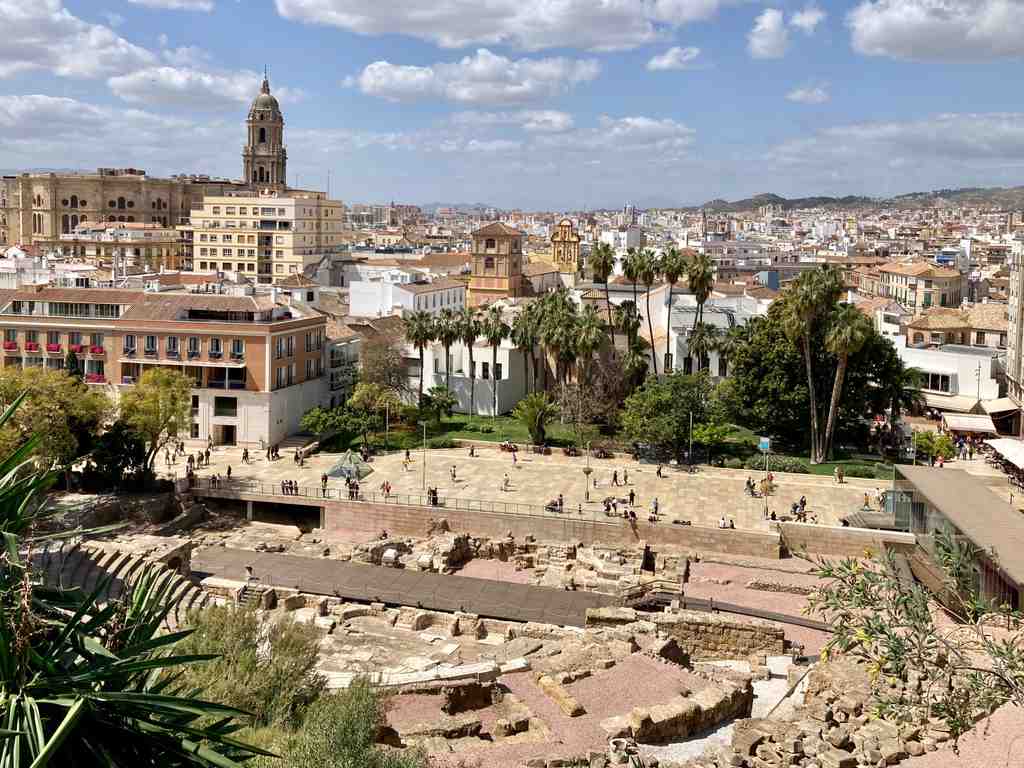
Now look to your right: Before you, a semicircular sea of light stone rows opens up, a wooden stage below, and behind it, the slope climbs up to the fortress wall. You are standing at the Römisches Theater von Málaga - the clearest 'I was here' note the Romans left for the city. In the middle of the historic center, right at the foot of the hill on which the Alcazaba is enthroned, this theater lies like an opened stone shell. And it's cleverly built: the Romans simply took a part of the slope as a natural backrest, entirely in the style of Greek theaters. Where the rock was missing, they helped out with massive foundations. Practical, robust, and typically Roman: nature plus engineering, no false modesty. If you look at the seating rows, you'll recognize how much is still there: large parts of the cavea, meaning the auditorium. Below lies the semicircular orchestra - not a place for an orchestra back then, but for the important people. Imagine marble seats, prim and proper, and quite certainly convinced that they 'understood the play better' than everyone else. The floor was even laid with large marble slabs, which must have looked almost ostentatious in the light. And there, where wood lies today, was the scaena, the stage area - today recreated with a wooden platform, so you can feel again where plays were performed. Behind the stage once stood a magnificent scenic facade, with openings, columns, and statues. A bit like a very expensive set that was not only meant to be beautiful but also carried a message: Rome is here, so is order, and the emperors along with it. In the inscriptions - partly on reused marble - lies another Roman classic: local elites paid for such constructions to buy prestige. This was called 'Evergetism': spending money, earning applause, shining politically. No receipt needed, the inscription was the bill. The exciting thing: This theater wasn't a perennial hit forever. Towards the end of the second century, it was used less frequently, eventually practically abandoned in the third century. And then comes the plot twist that Málaga is particularly good at: culture becomes industry. Facilities for fish processing were built here, including basins for garum - that famous Roman fish sauce that probably smelled as if it would shorten marital discussions. Later, the basins were even repurposed as tombs. A place with many lives, not all of them glamorous. And now the modern surprise: in 1951, the theater wasn't 'discovered' because someone romantically listened to the ground, but because construction was underway. At first, it was thought to be the remains of a city gate - until it became clear: this is an access to a theater. Decades of debate followed, and in the nineties, the big decision was made: a modern building, the then 'Casa de la Cultura,' was demolished so that the theater could be uncovered and restored. Today, it is protected as a cultural monument, managed by Andalusia, and you can walk through the area on wooden walkways - including an interpretation center from 2010, an angular mix of steel, wood, and glass, adorned on the outside with text fragments of a Roman law. Rome, but with a modern edge. Ready for the next point? Simply walk southwest for about 10 minutes, and you'll be at the Stierring der Malagueta.
Open dedicated page →To your right lies La Malagueta, Málaga's bullring. Even if you have nothing to do with tauromachy: this building has a presence. The warm brick, the round arches, the decorative…Read moreShow less
To your right lies La Malagueta, Málaga's bullring. Even if you have nothing to do with tauromachy: this building has a presence. The warm brick, the round arches, the decorative details on the outside - it looks like a confident 'I've been here longer than you.' The arena was designed by Joaquín Rucoba. If the name sounds familiar: this is the same architect who also designed the Mercado de Atarazanas. Rucoba was apparently the type Málaga trusted to build large, practical buildings that still looked good. Construction began on June 16, 1874. Then came a forced break: work stopped at the end of 1874 and only resumed in October 1875. No romantic legend, rather a classic of construction: money, organization, politics - something always gets stuck. La Malagueta was opened on June 11, 1876, with a Corrida and bulls from the Murube breeding farm. The poster featured great names of the time, including Rafael Molina, known as 'Lagartijo'. I imagine the crowd streaming in back then: dust in the air, the clicking of fans, a mix of thrill and social event. And then this peculiar footnote of history: parts of the building plans - specifically those for the structure, pillars, and balustrades - are now in Barcelona, at the Real Cátedra Gaudí. Why? No one really knows. The rest of the project documents are stored more prosaically: in the archive of the Province of Málaga. The arena also has darker chapters. In 1939, in the last months of the Civil War, it was used as a provisional prisoner-of-war camp because other camps were overcrowded. And in 1943, people were again trapped here: foreign refugees who had fled from France before World War II. The same walls, completely different reality. Architecturally, the whole thing is neoclassical and designed as a sixteen-sided polygon. After renovations, the capacity is a good 9,000 seats, the sand circle measures 52 meters in diameter. Behind the scenes, it's a small city of its own: horse stables, infirmary, rooms for the toreros, corrales, and narrow boxes for the animals. Today, it also houses an immersive center for tauromachy - and since the restoration from 2017, completed in 2019, La Malagueta also aims to function as a cultural and congress venue year-round. In doing so, the original brick facade was highlighted again, as if the building were saying: 'Alright, now I look like myself again.'
Open dedicated page →To your left, high up on the green hill, you see a long, honey-colored wall line with battlements and towers, winding through the trees like a crown: the Castillo de…Read moreShow less
To your left, high up on the green hill, you see a long, honey-colored wall line with battlements and towers, winding through the trees like a crown: the Castillo de Gibralfaro. This isn't just 'a castle with a view,' but Málaga's very convincing argument for why one should fundamentally not underestimate hills. Long before anyone thought of selling postcards, a Phoenician lighthouse stood on this hill. That's exactly where the name comes from: literally 'Mountain of the Lighthouse'. Practical, because it immediately makes clear who's in charge up here: those who see what's coming. From old ruins, Abd ar-Rahman III made a proper fortress - at a time when power looked best when it was made of stone and difficult to capture. It was properly fortified in 1340 under the Nasrid king Yusuf I: Gibralfaro was expanded and used as an Alcázar, meaning a fortified noble residence. The decisive point, however, was military: this complex was intended to house troops and, above all, protect the Alcazaba below. Because if besiegers position their artillery on the hill, things quickly become uncomfortable for everything below. And that's exactly what happened in 1487: The Catholic Monarchs besieged Málaga all summer. Imagine heat, dust, tense nights, and this constant calculation: How long will water and supplies last? In the end, the fortress fell. Afterwards, Ferdinand the Catholic used the Castillo as his residence, while Isabella preferred to stay in the city - which can be read as a polite way of saying: 'Honey, I'll take the room without constant cannon danger.' If you pay attention to the structure: two wall rings, eight towers - not subtle. Outside, zigzag walls, the Coracha, connect the Castillo with the Alcazaba. Inside, you can walk all the way around on the ramparts, like a medieval security service with a better view. At the top is the main patio with a small interpretation center, plus the Torre Mayor (17 meters), old baths, and a Phoenician well. And then the Pozo de Airón: 40 meters deep, carved directly into the rock - because 'securing water' sometimes literally means wresting a hole from the earth. Below in the parade ground, there used to be barracks and stables. The Torre Blanca, facing northeast, is particularly visible; inside, there was a cistern, rooms, storage - everything a fortress needs to be able to say 'no' for longer. Today, Gibralfaro rather says 'Welcome': From the main tower zone, you get this huge view over Málaga, and on clear days, you can even see as far as the Rif Mountains in Africa and towards the Strait of Gibraltar. No wonder the castle adorns the coats of arms and flags of the city and province. And it can also party: in summer, jazz and classical music play here in the parade ground during Gibfest - a fortress that has learned that music causes less trouble than sieges. Even Hollywood was here: in 1959, scenes for 'Scent of Mystery' with Elizabeth Taylor were filmed here.
Open dedicated page →To your left, between palm trees and small citrus trees, you see bright stone mausoleums, a pointed Neo-Gothic tower shape, and behind it, a round, whitish dome that sits like a…Read moreShow less
To your left, between palm trees and small citrus trees, you see bright stone mausoleums, a pointed Neo-Gothic tower shape, and behind it, a round, whitish dome that sits like a calm lid over the whole. Welcome to the Cementerio Histórico de San Miguel, a place in Málaga that reveals about as much about the city as a family album - only made of stone, iron, and very enduring silence. This is one of Spain's most significant historical-monumental cemeteries, and the astonishing thing is: it has been almost completely preserved as an ensemble. The portal, chapel, many pantheons, and even the rooms for farewells and wakes still stand essentially as they did in the 19th and early 20th centuries. San Miguel originated from a rather practical problem: health. In 1787, King Carlos III prohibited further burials in churches and monasteries for hygienic reasons. Sounds reasonable, but it was only taken seriously in Málaga when yellow fever - then called 'vómito negro,' black vomit - struck the city in 1804. Suddenly, the idea of a cemetery outside, well-ventilated and away from houses, was no longer just royal bureaucracy, but a survival strategy. In 1806, the city bought a plot of land outside the walls for this purpose; in 1810, the cemetery was opened in neoclassical style and consecrated to Archangel Michael. Typical city administration: first opened, then realized a fence wouldn't be bad either. Money was scarce, so from 1821, the brotherhoods helped - they built the protective ring precisely with stacked niche walls. In 1829, the cemetery was finally completely enclosed, and in 1837, the chapel was added, dedicated to Santa Isabel of Hungary, patroness of Christian charity. Inside, eight strong pillars support a dome, topped with a lantern - and what remains today are primarily a crucifix and two Baroque altars. From the mid-19th century, San Miguel then became the stone calling card of the Málaga bourgeoisie: plot sales, mausoleums, competition for style. The first major construction was in 1844 for Salvador Barroso - including skull motifs, because back then, symbolism was liked not subtly, but unequivocally. Later, around 250 pantheons were added: Neo-Gothic, Neo-Byzantine, Art Deco. Look at the wrought-iron grilles: many come from 19th-century Málaga ironworks, genuine local production for eternity. A goosebump-inducing moment in history: On December 11, 1831, the liberal General José María de Torrijos and his companions were buried here - later, they were more honorably reinterred in the city, at the Plaza de la Merced. In 1987, San Miguel was closed because the city moved closer, until the cemetery suddenly lay in the middle of the neighborhood. Today, it is concentrated on the two monumental courtyards, partly used as a columbarium, and since 2015, it has been officially protected Andalusian cultural heritage. Restorations have been ongoing since 2017 - so that this place can continue to tell its story. If you have a moment: walk slowly, listen to the silence, and see how Málaga has carved its great names, its dreams, and its pride into stone here.
Open dedicated page →
Frequently asked questions
How do I start the tour?
After purchase, download the AudaTours app and enter your redemption code. The tour will be ready to start immediately - just tap play and follow the GPS-guided route.
Do I need internet during the tour?
No! Download the tour before you start and enjoy it fully offline. Only the chat feature requires internet. We recommend downloading on WiFi to save mobile data.
Is this a guided group tour?
No - this is a self-guided audio tour. You explore independently at your own pace, with audio narration playing through your phone. No tour guide, no group, no schedule.
How long does the tour take?
Most tours take 60–90 minutes to complete, but you control the pace entirely. Pause, skip stops, or take breaks whenever you want.
What if I can't finish the tour today?
No problem! Tours have lifetime access. Pause and resume whenever you like - tomorrow, next week, or next year. Your progress is saved.
What languages are available?
All tours are available in 50+ languages. Select your preferred language when redeeming your code. Note: language cannot be changed after tour generation.
Where do I access the tour after purchase?
Download the free AudaTours app from the App Store or Google Play. Enter your redemption code (sent via email) and the tour will appear in your library, ready to download and start.
If you don't enjoy the tour, we'll refund your purchase. Contact us at [email protected]
Checkout securely with