
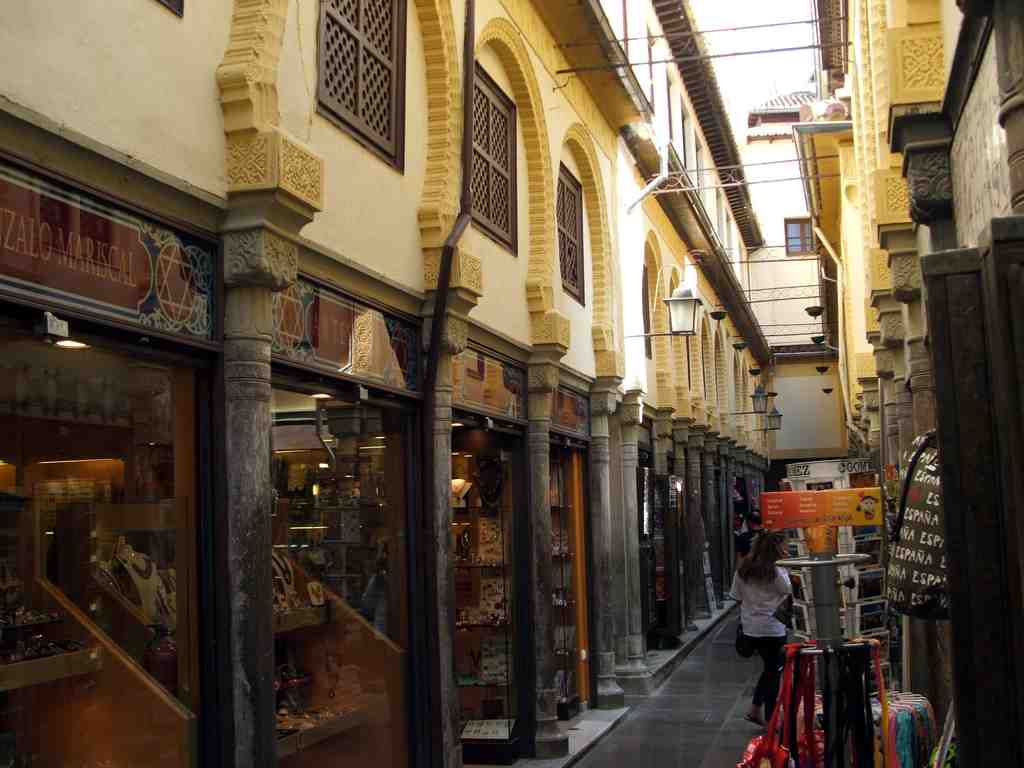
The Alcaicería gets its name from the original main bazaar that stood here during Granada's Arab-Islamic era, under Nasrid rule from the 13th to 15th centuries. Unfortunately, a fire in 1843 destroyed the original bazaar, but it was lovingly rebuilt in its current form.
This area holds great significance since the Zirid period in the 11th century when the city's Great Mosque (now replaced by the cathedral) was constructed here. Initially, it was a lightly urbanized space, belonging to the ruling Zirids as a semi-rural estate called almunia. The construction of the Great Mosque was perhaps a strategic move to promote the city's growth in this direction, leading to the development of the city's first major markets.
During the Nasrid period, as Granada expanded, the Alcaicería became the bustling commercial heart of the city. The Nasrid emir Yusuf I played a key role in raising its profile by building a madrasa (the Madrasa al-Yusufiyya) and a caravanserai (the Funduq al-Jadida) nearby, as well as remodeling the Alcaicería as a whole. The district surrounding the Great Mosque was filled with souqs (markets) and various commercial establishments.
The Alcaicería itself was a distinctive bazaar owned directly by the Nasrids. It was locked and guarded at night, showcasing luxurious goods such as silk and other valuable items, which were taxed at a higher rate by the Nasrid authorities. This exclusive market covered a vast area of nearly 4,600 square meters and was bordered by Libreros, Oficios, Tinte, and Zacatín streets, as well as Bibarrambla Square.
Close to the market, you'll find al-Qanṭara al-Jadida, the New Bridge, leading to the state-owned Funduq al-Jadida. When the Catholic Monarchs conquered Granada in 1492, the Alcaicería came under Spanish crown ownership. It continued to operate as a guarded market, officially known as the Real Sitio y Fuerte de la Alcaicería, or the Royal Site and Stronghold of the Alcaicería.
In 1843, tragedy struck again when a fire ravaged the market, leading to its reconstruction on a smaller scale. The Alcaicería was rebuilt with a Neo-Moorish style, reflecting the enchanting Nasrid architecture. The reconstruction resulted in a reduced size and the removal of some smaller internal streets to make way for larger apartment blocs.
Today, the Alcaicería remains a vibrant market street where you can immerse yourself in the hustle and bustle of local commerce. As you explore, take in the beautiful architecture and imagine the rich history that surrounds you.
So, let's continue our journey through Granada and discover more hidden gems together!




