
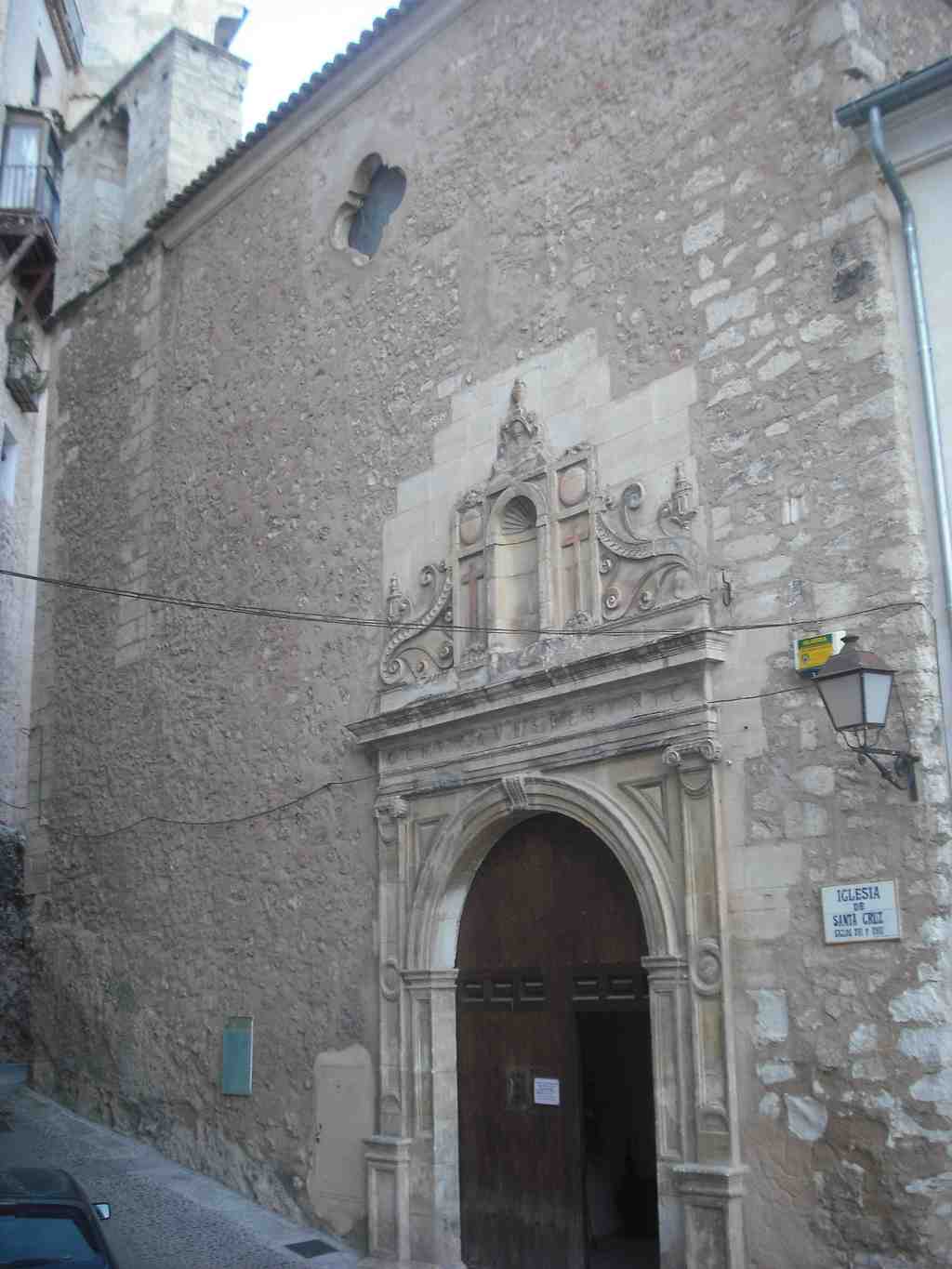
To spot the Iglesia de Santa Cruz, just look for a stone church with a simple, pale-facade set into the street and a large wooden doorway framed by a classical arch and topped with a niche, nestled right against the winding wall to your right.
Right here before you stands the Iglesia de la Santa Cruz, one of Cuenca’s earliest parish churches. Imagine stepping onto this street hundreds of years ago: no cars, just the echo of footsteps and a brisk mountain wind rolling up the gorge. The church was quite modest at first, with only one nave, its rough stone walls blending right into the rocky landscape. The roof above your head? Originally wood, fitted by skilled carpenters whose hammers filled the air with.
Now, around the mid-1500s, Cuenca was buzzing with the news: the church was getting a makeover! A master builder named Juanes de Mendizábal the Elder led the charge for three whole years, but the real excitement happened when the energetic Bishop Fresneda decided things needed a total facelift. He called in Francisco de Goycoa, the city’s star architect, so important he was known as the Big Boss of Church Building. But, between you and me, Goycoa was more of a delegator-he let his trusted apprentice, young Mendizábal (the nephew!), do the heavy lifting.
With each new plan, the church grew grander. They made the walls taller, tossed up sturdy arches, and lined them with elegant Doric columns. Picture the scene: stone dust flying, the sharp ring of chisels echoing through the church as two generations of builders argued-“Your arch leans left!” “No, that’s the old-fashioned way!”
By the eighteenth century, the church got another major update-a beautiful barrel vault of stone to replace the now-old-wooden ceiling. But alas, gravity plays no favorites. The new roof, built from lighter stone, eventually gave way because those medieval walls couldn’t quite cope. Oops!
The entrance you see-a simple, rounded arch flanked by columns-has welcomed Cuenca’s faithful for centuries. For a quirky twist, the sacristy had to be tucked right under the main chapel, squeezed in by the edge of the Huécar gorge. Step inside and-if you listen carefully-you can almost hear those old carpenters and stonemasons chatting away as they worked.
In recent years, the church found new life as part of the region’s top modern art center. So the next time you walk in, let your imagination straddle the old and new-one foot in the dust of medieval Spain, the other in the colorful world of contemporary art.


