
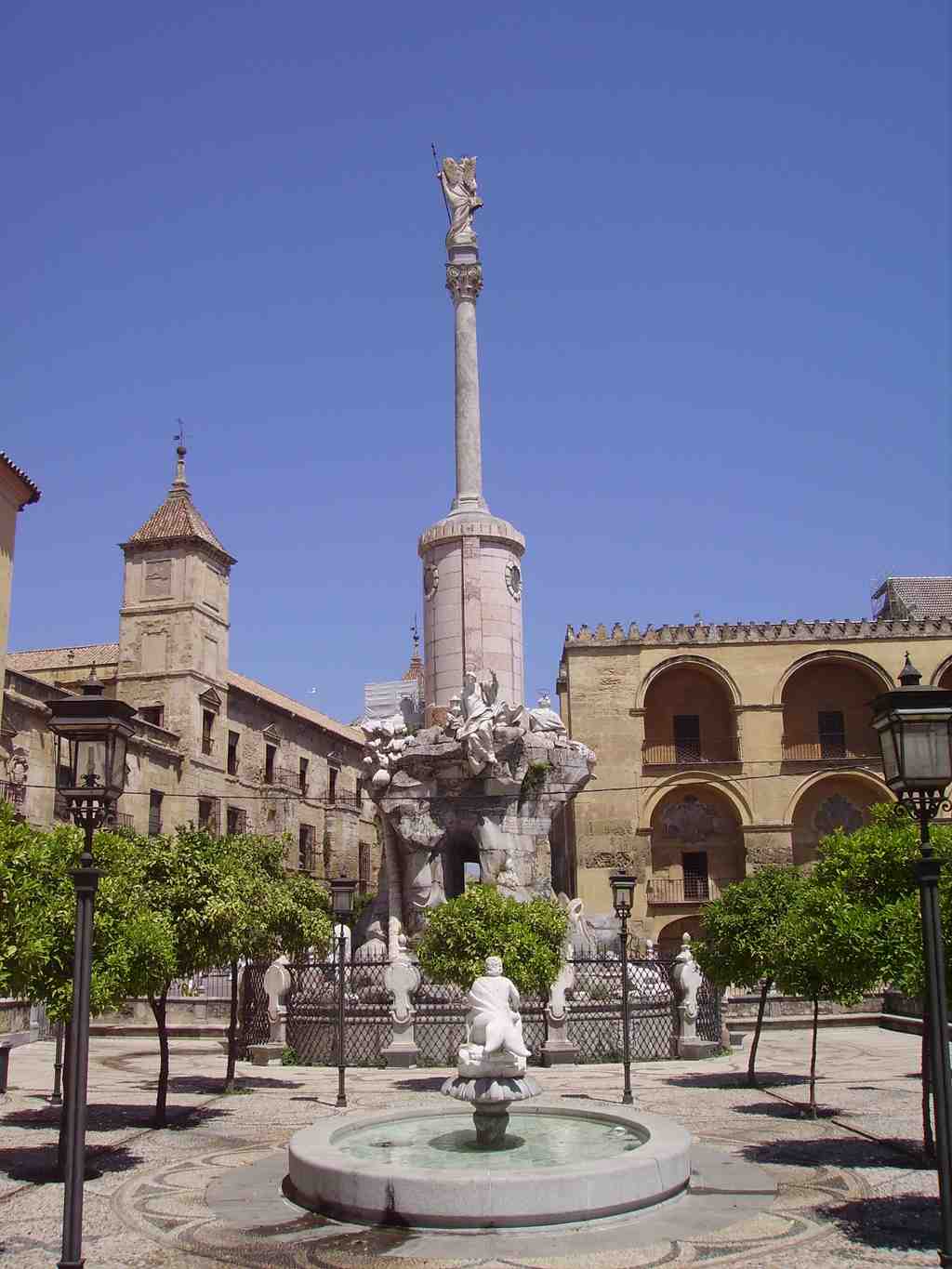
Right in front of you, rising above the orange trees and the cobbled square, you’ll see an ornate, towering monument crowned by a statue of an angel on a slender marble column-simply look towards the Puerta del Puente and you can’t miss it!
Welcome to the Triumph of San Rafael at the Puerta del Puente! If you think this looks like the world’s fanciest toothpick holder, you’re not alone-except this “toothpick” happens to be over 27 meters tall and topped with the city’s very own guardian angel, San Rafael. Now, let’s turn back the clock and set the scene. Imagine it’s the early 1700s here in Córdoba. The city is bustling, history hangs in the air, and there’s a wild idea floating around among church officials: they want to put up a massive monument to San Rafael, the archangel who watches over Córdoba. After all, who wouldn’t want such heavenly security?
So in 1736, two officials, Juan Antonio del Rosal and Diego Manrique de Aguayo, send a letter all the way to Rome-because where else would you find top-notch monument designers? But when the design comes back, the Córdoba council is not impressed. Maybe too much marble? Not enough dramatic flair? They promptly toss the design and ask for another. This time, they choose a famous painter (who probably preferred canvas to castles) and a sculptor with royal connections, and things look promising. The new design gets the green light in 1738, and excitement bubbles up-until, just as quickly, the key officials sadly pass away. The project stalls with only the foundations dug, leaving Córdoba with an invisible monument for decades.
Fast forward to 1756. A new bishop, Martín de Barcia, arrives and quickly becomes Córdoba’s biggest San Rafael fan. So much so, in 1765, he insists: it’s monument time! Work starts again, right here on ground that once housed a 13th-century hospital. Digging deep into the earth, workers unearth an old tombstone inscribed “Don Pascual, Bishop of Córdoba”-a mysterious nod from the past. Soon after, they track down the bishop’s other relics, which, in classic Córdoba fashion, were previously used as a fountain in a nearby convent. Why just have a monument when you can also have a treasure hunt?
The monument’s construction is led by a Frenchman, Miguel Verdiguier, who tweaks the plans just enough to add an extra bit of French flair. But trouble strikes again: the devout bishop Martín dies in 1771 with the angel still unfinished. The money runs out. The whole project, a monument decades in the making, is put on pause once more. Finally, in 1779, a large sum is released and the monument rises up, completed in 1781 after nearly half a century of starts and stops.
Now, take a closer look! The monument is a drama in marble: a black marble base, rough mountain-like shapes rising up, topped with a little fortress of red jasper-turrets and all. There’s a column streaked with color, and high above, San Rafael stands vigil, one hand lifted skyward. Around the base are white marble statues of Córdoba’s martyr saints: San Acisclo, Santa Victoria, and Santa Bárbara, all keeping a watchful eye. If you glance toward the street, you’ll spot a stone lion holding a shield that basically says, “Hey evil, keep moving!” Oh, and tucked among the rocks, there’s an eagle with a ribbon in its beak proclaiming, “I swear by Christ that I am Rafael, the angel set by God to guard this city.” With secret symbols, statues, and a tale of dedication (and frustration!), no wonder San Rafael looks so steadfast up there-he probably had to wait ages for the scaffolding to come down!
Today, as you stand here with the scent of orange blossoms on the breeze and the city’s ancient walls behind you, picture all the determination and even a little drama that shaped this masterpiece-built not just for beauty, but as a symbol of Córdoba’s unwavering spirit and its watchful protector. Now, ready for the next adventure? Let’s keep moving!




