
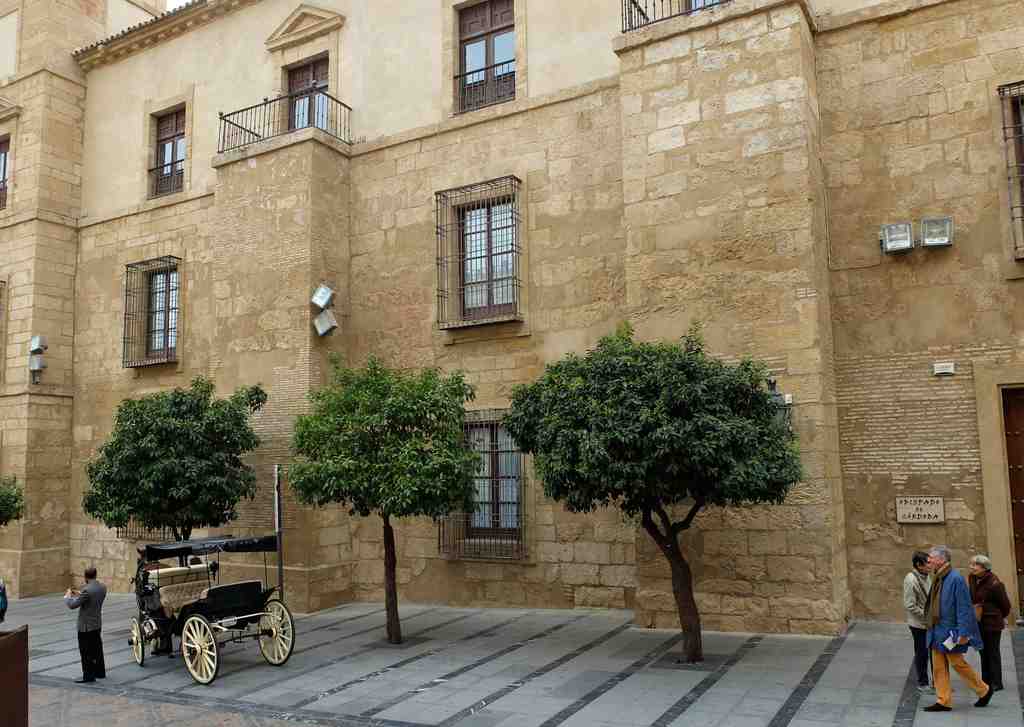
To spot the landmark, look for a long, sandy-colored stone building with small balconies, iron-barred windows, and a sturdy, fortress-like facade right in front of you, with a few leafy orange trees and an old-fashioned carriage underneath.
Welcome to the mighty Alcázar of the Caliphs! Now, you’ll have to squint a little and let your imagination do some heavy lifting, because today, much of what you see has been built over, transformed, and stitched together from centuries of history, like a royal quilt with a few missing patches. Still, stand here for a moment, breathe in the air, and picture a time when the very ground you stand on was part of one of the glitziest, most powerful palace-fortresses in medieval Europe.
Travel back with me to the 8th century - this was once the heart and brain of Al-Andalus, home of emirs and caliphs, the place where audacious rulers plotted and prayed, where secrets whispered through cool marble halls, and where the destinies of countries were decided. At its height, the Alcázar was a sprawling complex with grand gardens, audience halls, government offices, baths, and even a royal cemetery lurked within its walls. And oh yes, the architects of the past were keen on showing off: imagine Caliph Abd ar-Rahman III strolling along the palace walls, looking down from his balcony as armies marched below or festivals and executions were held in the square.
Of course, getting into this fortress wasn’t easy. The palace was protected by thick walls and secured by grand gates - each with its own tale, like the “Gate of the Lion” (which, disappointingly, had more to do with security than actual roaring lions), and the “Iron Gate” with door knockers supposedly taken from plundered lands. One gate, the “Gate of Justice,” was where people would come to plead their cases before the emir. Picture tense moments: anxious citizens standing outside, hoping for decisions that could change their lives forever, while guards watched from above, probably trying not to fall asleep on duty.
Inside, this place was buzzing with activity. Scribes hustled between the offices of the viziers, couriers crisscrossed the halls, and the aroma of blossoming orange trees drifted over exquisite courtyards. At night, lamps glimmered like fireflies, and deep beneath it all, steaming water warmed the bathhouses - the Caliphal Baths - which you can still visit today! The Alcázar even boasted one of the greatest libraries in Western Europe, though I hear overdue book fines were rather steep back then...
And it had indoor plumbing! Abd ar-Rahman II oversaw improvements to the city’s water supply, even inventing waterwheels (or “norias”) along the Guadalquivir River. Imagine the low, steady creak of the Albolafia wheel drawing water up for the thirsty palace gardens.
But history is never simple, and this palace saw its share of drama. After reaching its height under the Umayyad caliphs, Cordoba’s government briefly moved to a shiny new palace, Madinat al-Zahara, just outside the city. Yet when that rival palace was destroyed, rulers and the powerful came rushing back, clinging to this place like moths to a royal flame.
Then in 1236, the Christian conquest swept in like a plot twist in a long-running series. The Alcázar’s story changed: part became a bishop’s palace-if you look closely, you’ll spot traces of ancient walls now stitched into church buildings-while the rest grew into the Alcazar of the Christian Kings, a castle still standing proud today.
Yet, for all the twists and turns, little of the original Islamic palace remains except, delightfully, those famous Caliphal Baths (the hammam) hidden nearby, and perhaps a haunting echo of voices past drifting through the stone. What stories these walls could tell-of scholars and soldiers, plots and poetry, laughter in sunlit courtyards and tense whispers behind thick doors! So as you stand here, let yourself drift on the scents and sounds of centuries, knowing you’re in the very heart of old Cordoba’s secrets and splendor.


