
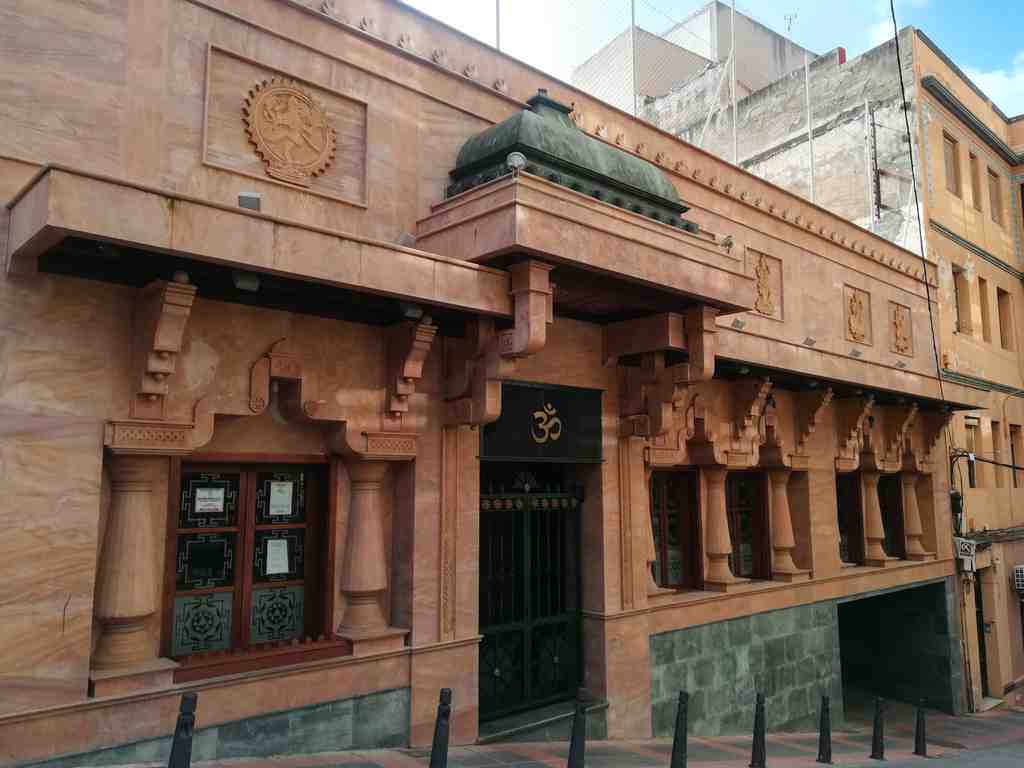
As you approach the Hindu Temple of Ceuta, look over to your left-you can’t miss it! The temple's front is a warm, earthy orange color, and it’s decorated with carved pillars and bold patterns that instantly stand out among the more traditional Spanish buildings nearby. Notice the ornate, rectangular frames along the upper wall-it’s almost like the temple is wearing a row of ancient shields. And right above the entrance, the golden Om symbol gleams atop a dark green awning.
Now, imagine you’re stepping onto the streets of Ceuta in the late 1800s, when the first Hindu families made their way here, bringing with them spices, fabrics, and a whole new world of stories. Fast forward to 1948, and the air is buzzing with plans-the city’s Hindu merchants decide to form Spain’s very first Hindu association. That’s got to be worth a celebratory dance, right?
But wait, the real magic happens decades later. In 2007, after years of dreaming and planning, this neo-Vedic style temple finally rises from the ground-thanks to the ideas of architects Andrés Ruíz Manrique, Hicham Abselam, and Nordin Abselam, as well as some very determined community members. Let’s just say, there were probably more sighs of relief than at a yoga retreat!
The temple, also known as a “mandir,” feels like a portal. Step inside, and the world outside melts away. You’re surrounded by quiet reverence and the subtle hint of incense-perhaps with the faint echo of a mantra, if you’re lucky. On the outside, every angle, every column, tells the story of a community that has thrived here for over a century.
So as you stand here on Calle Echegaray, take a moment. You’re not just at any building-you’re at a cultural monument, a reminder that even in a tiny corner of Spain, far from India, devotion and celebration know no borders. By the way, if you drop a coin and hear it roll down the temple steps, don’t worry-it might be the universe granting you good luck!
When you’re ready, let’s step forward to your next destination-something entirely different awaits.




