
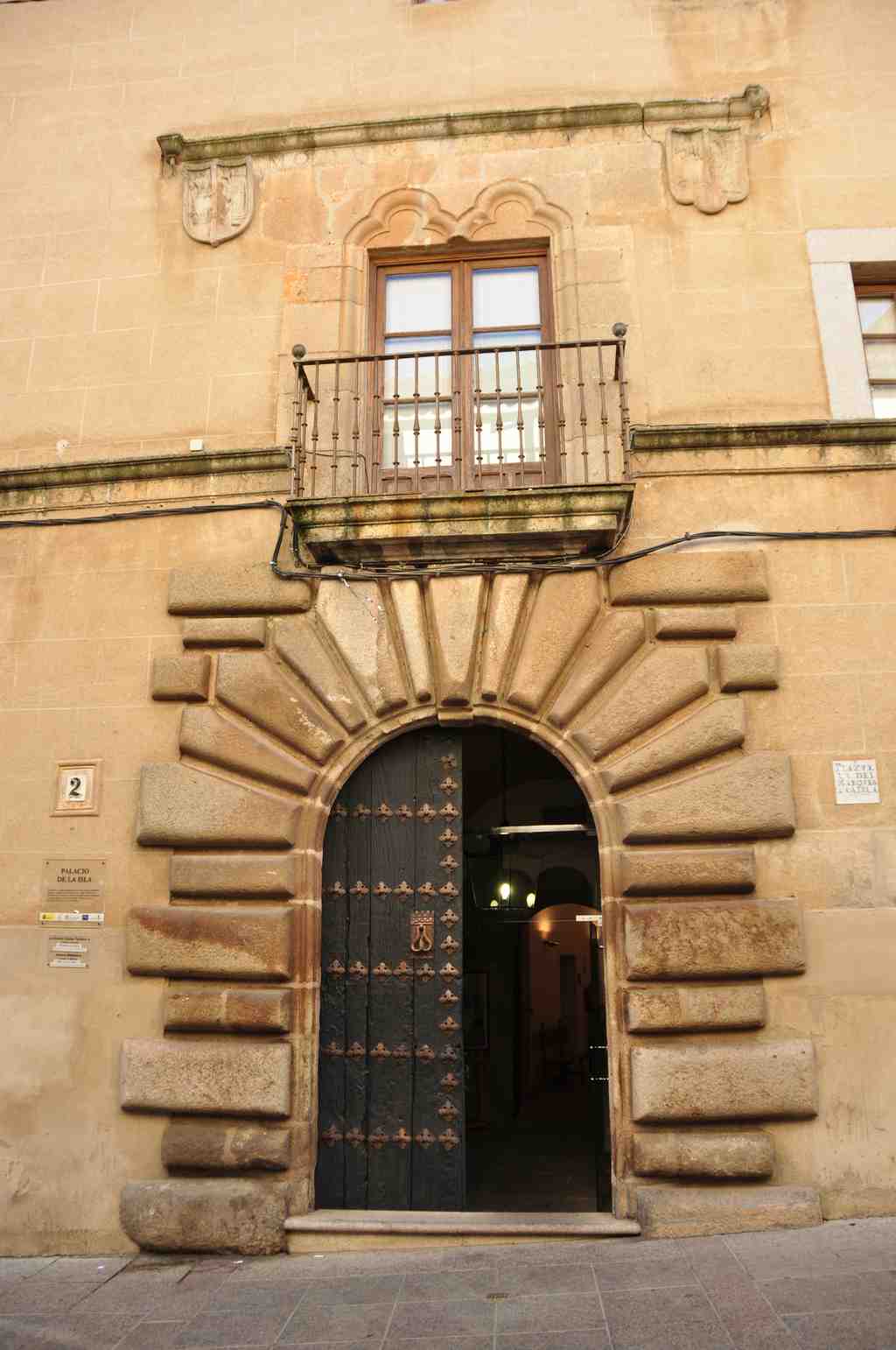
To spot the Palacio de la Isla, look for a grand, sandy-colored building with a bold, arched stone doorway and a small balcony with wooden doors hovering just above it-in fact, that impressive entrance is a bit like the building’s version of a dramatic moustache!
Alright, here you are, standing in front of the legendary Palacio de la Isla! Imagine the echoes of centuries swirling around you-medieval footsteps, the mutterings of nobles, perhaps even a family feud or two (don’t worry, I think they’ve calmed down by now). Built in the 1500s, this palace was the stage for a little family drama. The Blázquez-Mayoralgo family moved to Cáceres and built this home, but their distant cousins-already established here for ages-weren’t exactly sending welcome baskets. Oh no, there were raised eyebrows and probably a few dramatic sighs. In fact, the rift was so intense that it led to Latin messages being carved forever into stone. On the front, you can read “Moderata durant. Nobilitat animus non acta parentum,” which means: “Moderate things endure. It is spirit, not ancestors’ deeds, that ennoble us.” Basically, a medieval mic drop: “We’re new, but noble, deal with it!” There’s even a touch of Shakespearean flair: inside, one shield reads, “Vanity of vanities, all is vanity.” Makes you wonder if the neighbors were gossiping over their morning bread.
Over time, the palace’s story has only become richer. It belonged to the Marquis of la Isla in the 1700s (hence the name!) and later became a hub of history and culture. The echoes of dusty manuscripts filled its halls when it served as the Province’s Historical Archive, and it’s now a lively cultural center. There’s a sparkle of modern ambition too-in 2016, it helped coordinate Cáceres’ efforts to become the European Capital of Culture! So as you stand here, know you’re not just in front of a building, but at the crossroads of pride, politics, and a whole lot of family sass. Ready for more Cáceres secrets? Let’s go!




