
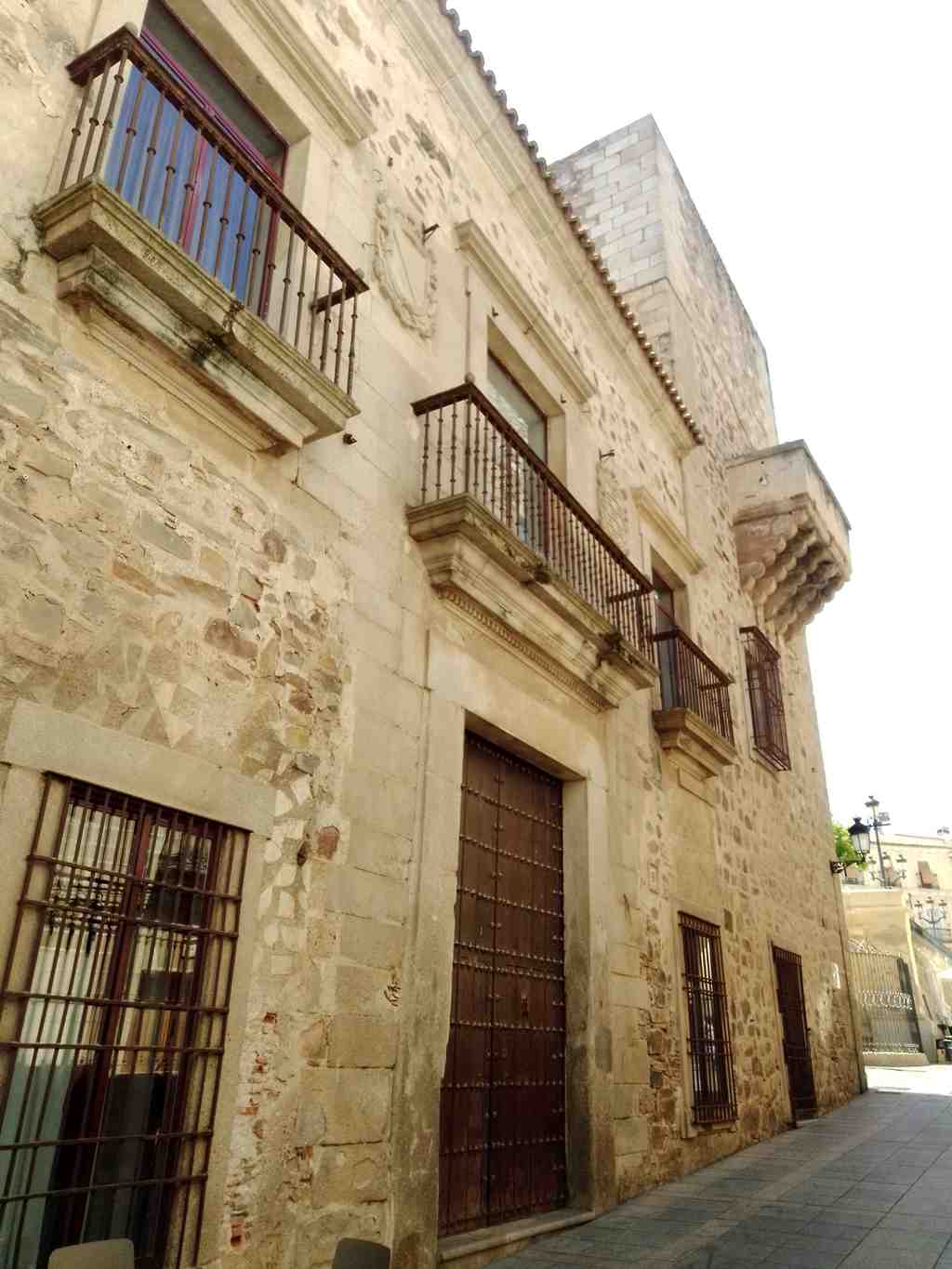
Right ahead of you, look for a sturdy stone facade with high, iron-barred windows, classic balconies, and a heavy wooden door-plus a tall stone tower rising confidently at the corner where the street curves; you can’t miss it at the intersection of Plaza de la Concepción and General Ezponda street.
Welcome to the Palace of Camarena! You might think you’re about to step onto the set of a historical drama... and honestly, you wouldn’t be wrong. Take a moment to look up at those balconies-imagine silk curtains fluttering behind them, and maybe a noble or two peering out, with secrets hidden behind those walls thicker than a medieval stew.
This palace, believe it or not, wasn’t even supposed to be called Camarena! Originally, it was the stronghold of the powerful Carvajal family, and its oldest part, the mighty tower with its sturdy defensive overhang-called a “machicolation,” perfect for keeping out nosey neighbors or the odd invading army-dates all the way back to the fifteenth century. Picture knights clanking up and down these streets in the armor of Cáceres’ medieval heyday, while the Carvajals plotted and planned inside these walls.
Now, fast-forward to the seventeenth century. The place is in need of a facelift, and along comes Pedro de Carvajal Ulloa. He’s got grand ideas, and some impressive family pride. Pedro introduces one of the treasures of this palace-a magnificent stone patio, inspired by classical Tuscan styles, right at the heart of the building. Life in the palace revolved around this patio; just imagine the echo of footsteps under stone arches, the murmured conversations, and the soft light filtering in through the high windows. Each arch and column tells the story of secret plans, family feasts, and yes, probably a squabble or two about who got the corner room.
But our story doesn’t end there! By the late eighteenth century, another Carvajal, Diego de Carvajal y Flores, and his wife Ana María de Ulloa y Vasconcelos, gave the palace its now-chic neoclassical look. If this palace were a person, it would have just traded its dusty old cloak for a sharp new jacket. The main facade you see today-with its large, balanced windows and proud family crests-is their work. Imagine the couple overseeing the construction, perhaps arguing over which family shield to carve above the door. Their renovations added a stylish orderliness to the chaos of earlier centuries and made sure everyone who passed by would know exactly whose house this was.
Suddenly, it’s the nineteenth century-cue the arrival of Gonzalo Carvajal y Arce. He inherits the grand title of Marquess of Camarena la Vieja, and thus, the Carvajal palace gets a new name and a whisper of new prestige. The stories these walls could tell! It was only in this era that the palace truly began to be called by the Camarena name, but until the twentieth century, it remained the beloved home-well, castle really-for generations of Carvajals.
Then came the modern age and, like all good stories, the palace had to adapt or risk fading into memory. By the late twentieth century, the last of the Carvajal heirs sold their ancestral home. The building underwent a dramatic transformation by architect Gerardo Ayala, who carried out a grand renovation between 1986 and 1989. He reimagined the palace as a place of creativity and learning, turning it into the headquarters for Extremadura’s Official College of Architects and the Ateneo, a cultural hub. Ayala even stretched the old tower a bit taller and opened up a loggia-a sort of gallery of arches-overlooking the bustling Plaza de la Concepción. The palace, once a fortress against the outer world, now welcomes the city with open arms.
And so, here you stand at a monument officially recognized for its cultural importance since 1992-a place that has echoed with the footsteps of lords, ladies, architects, and artists. If you listen carefully, you might just catch the whispers of centuries gone by, and if you’re lucky, maybe even a ghostly Carvajal still annoyed about the new loggia! Keep those eyes sharp and your imagination ready-every stone has a story here in Cáceres. Ready for the next stop? Let’s march on!




