
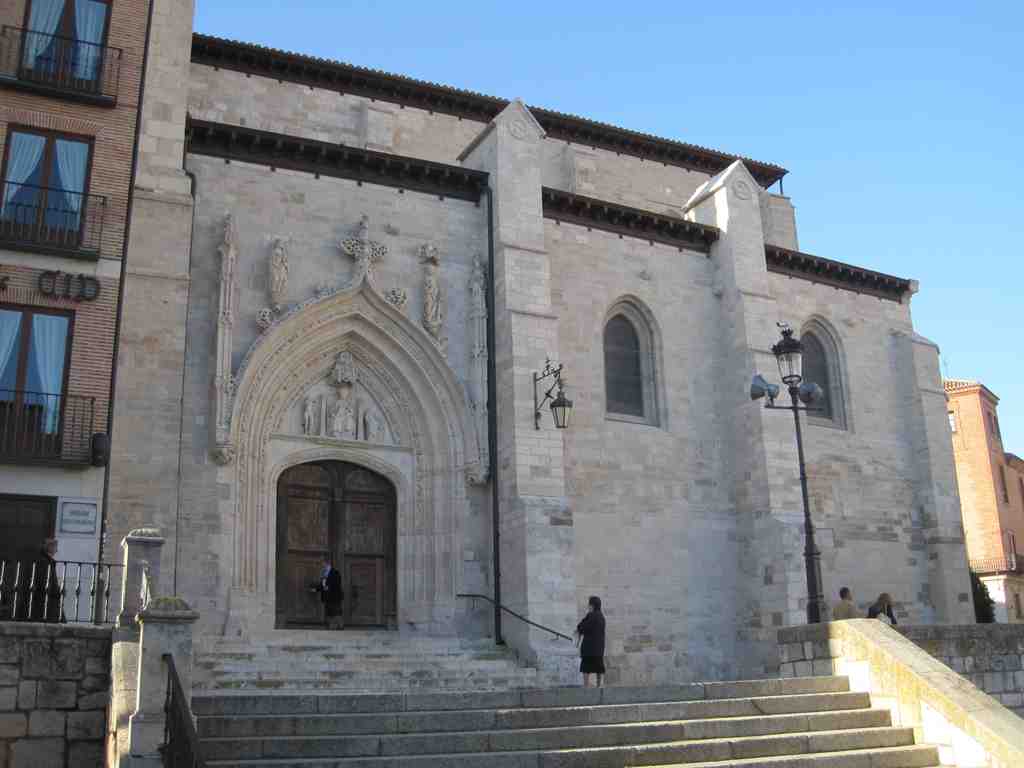
Looking ahead, you’ll spot San Nicolás de Bari by its striking pale stone facade and tall wooden doors at the top of a wide stone staircase, framed by gothic arches and delicate carvings-just follow the steps up and you can’t miss it.
Now, let’s imagine you’re standing outside here back in the early 1400s. Church bells are ringing, echoing down Fernán González street, and pilgrims from the Camino de Santiago shuffle past, their boots clicking on the cobblestone. San Nicolás de Bari was built in 1408, replacing a much older Romanesque church, and believe me, it caused quite a stir with its ambitious design!
When you step inside-well, not just yet-picture being knocked off your feet by a colossal altarpiece. This isn’t just any old altarpiece: it’s 15.5 meters tall and made entirely of creamy, porous limestone; huge, luminous, and wildly different from the wood-carved altarpieces found across Spain. Master craftsmen Simón de Colonia and his son Francisco poured their talent into it-at the request (and hefty payment) of a rather generous merchant named Don Gonzalo Lopez de Polanco. Just imagine Don Gonzalo’s pride, showing all his wealthy friends this masterpiece paid for long before Netflix or Instagram could show it off for him!
This church doesn’t just stop at jaw-dropping altarpieces. It’s home to Gothic tombs, Renaissance arches, and artwork bought thanks to the Polanco family’s deep purses. There’s even a whisper of mystery-how did they transport so much delicate stone from Hontoria de Cantera without a single truck in sight? If you listen closely, you might still hear, craftsmen at work shaping the only stone retable of its kind in all of late medieval Burgos.
After centuries watching over travelers and townsfolk, San Nicolás de Bari was crowned a National Monument in 1917. Not bad for a church hidden just behind a cathedral! Go ahead, soak it all in-and don’t forget to look up, because you never know what secrets those ancient stones might be keeping.




