
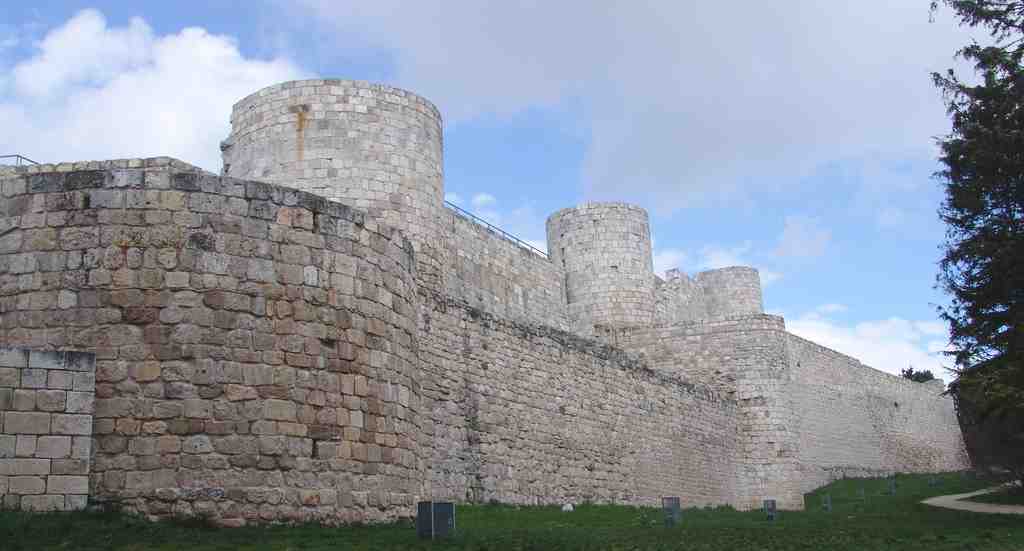
To spot the Castle of Burgos, look up the grassy hill and you’ll see immense, weathered stone walls and tall round towers rising proudly above the city, their pale blocks almost glowing against the sky.
Now, let’s step back in time-quite a bit, in fact! Imagine you’re standing on the mighty San Miguel hill, 75 meters above the city, with the wind whipping around ancient towers. Believe it or not, humans were gathering up here as early as 2000 B.C. They weren’t building castles yet, but they did leave traces of the very first Burgos settlement, right under your feet! Fast forward through the centuries, past beaker-wielding prehistoric peoples, iron-toting tribes, and suddenly, you’re in the midst of Roman times, watching the first stone walls take shape.
But the real excitement boomed in the medieval era! You see, in the 9th century, Burgos was a constant tug-of-war between Christian and Muslim forces. Great rulers like Alfonso III and Count Diego Porcelos swooped in to claim it, fortifying these walls so heavily that medieval travelers wrote about the overwhelming feeling of safety within. Picture knights in shining armor, banners snapping in the breeze-oh, and a fortress that made everyone else just a bit jealous. “Whoever holds this castle,” they used to say, “holds the kingdom of Castile!”
Transformations came along with every king and conqueror. Alfonso VIII made it more stylish, giving it a touch of the Mudéjar flair, while Henry IV fancied it up with palatial halls and chapels befitting true royalty. If you close your eyes, you might hear elegant music drifting out from grand chambers, or, maybe, the rather less elegant clanking of armor as guards changed shifts.
But what’s a castle without a bit of siege drama? In 1474, Ferdinand the Catholic himself tried to bring these walls down by cutting off the water supply. Miners dug tunnels beneath your feet, hoping to collapse the castle or find the well. Speaking of the well-now there's an engineering marvel! It’s over 60 meters deep, swirling with a spiral staircase of three hundred thirty-five steps and glowing with a faint, enchanted light from scattered skylights. According to legend, whoever dared descend would feel they had stepped into a realm of magic and mystery.
The Castle of Burgos wasn’t just a fortress or palace, though-it had a dark side as a state prison. Imagine the cold, thick walls echoing the footsteps of famous prisoners, like García II of Galicia or Alfonso VI of León and Castile. And then, there’s the tale of Infante Frederick, doomed by his own brother to die in a chest lined with sharpened irons-a story so grim, even the walls might sigh if they could.
With the march of time, gunpowder replaced swords and bows. The castle even became Spain’s first gunner training school! Just try to picture 20 quintals of fresh gunpowder made each day-(Don’t get too close, unless you want your eyebrows singed.) The palace remained home to kings like Alfonso X, John II, and Henry III, their royal footsteps eventually replaced by whispers as the castle began to lose importance.
But the hush didn’t last forever. Cue the Napoleonic Wars and… BOOM! June 1813, the French retreating from Burgos rigged the whole fortress with explosives. The resulting blast shook the city, destroying the castle, shattering church windows, and leaving some unfortunate French soldiers trapped in the rubble. Where you stand now, the earth trembled, and a thick, smoky silence spread across the ruins.
Even after its destruction, the castle kept up with technology-believe it or not, it was part of a semaphore line, sending coded messages across the country long before texts or tweets.
Today, with time’s passing, the castle is both playground and museum-an open-air echo of poets, soldiers, kings, and prisoners. Beneath your feet, tunnels twist and turn, hinting at secret adventures and mysterious history. So as you gaze at these battered stone walls under the open sky, let your imagination fill the gaps, and remember: every stone has a story here on the hill above Burgos.




