
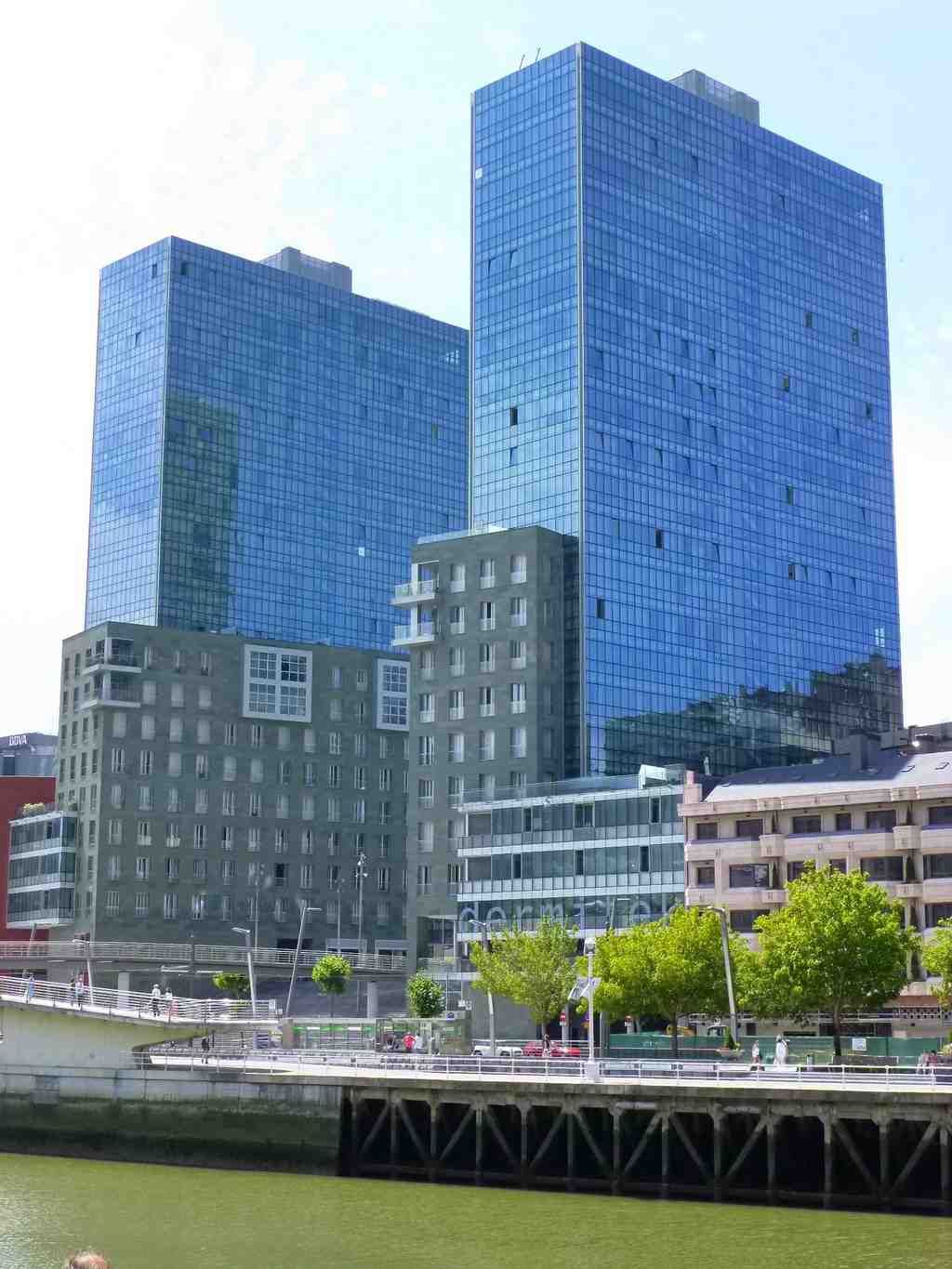
Directly in front of you, you’ll spot two giant, sleek towers of blue-tinted glass rising above the river-just look up, and the reflections on their shimmering façades will catch your eye.
Welcome to Isozaki Atea-or, as it’s known in English, the Isozaki Gate! Now, as you stand here beside the river, try to picture yourself standing before a massive doorway to the twenty-first century. Designed by the renowned Japanese architect Arata Isozaki, along with local architect Iñaki Aurrekoetxea, this striking complex is much more than just a pair of glass towers. Look closely: there are actually seven buildings here, but those two twin towers are the real stars, stretching 82 meters high with twenty-three stories each. That’s roughly the height of twenty giraffes stacked on top of each other, but don’t try this at home-giraffes hate paperwork.
You might be surprised to learn that this futuristic spot was once home to a rather dull old customs warehouse-hardly the kind of thing to get your sightseeing senses tingling. Private initiatives had tried to bring new life to the area, but none could quite pull it off. Meanwhile, the city had a bigger puzzle: how do you knit together the bustling daily life of the city center with the old industrial heart along the river? To make things trickier, the nearby footbridge, Zubizuri, designed by Santiago Calatrava, didn’t quite solve the connection. Bilbao always turned its back on the river like a moody teenager. There was even a pesky fourteen-meter height difference between river and city to overcome-like Bilbao’s own city-sized hurdle race.
Cue the hero’s entrance-Isozaki's design! The solution wasn’t just towers, but a monumental staircase, almost fifty meters wide, inspired by grand European plazas like you’d find in Rome. Now, instead of keeping apart, the riverfront and the city center are connected by this bold new gate-a true entranceway to modern Bilbao. And those two glass towers? They’re not just pretty faces. With 317 apartments and loads of commercial space, they’re home to UNESCO Etxea and several cultural organizations. And the price of living here? Well, let’s just say if you find spare change in the couch, keep checking-it could take a while to reach 800,000 euros.
Of course, it wouldn't be a Bilbao building without a touch of drama! Remember that Zubizuri bridge? Isozaki’s new plans meant cutting into Calatrava’s creation-and the famous architect took the city to court, furious at the changes to his work. The city stood its ground (and saved on a few expensive glass repairs), but in the end, a judge said Calatrava’s rights had been damaged-though the bridge connection stayed.
Since then, Isozaki Atea has stood as Bilbao’s sparkling invitation to the future, bridging the divide between the industrial and the everyday. As you look up at those glass surfaces, you’re not just seeing skyscrapers-you’re looking right at the city’s new face, where international visions and local pride meet above the river.




