
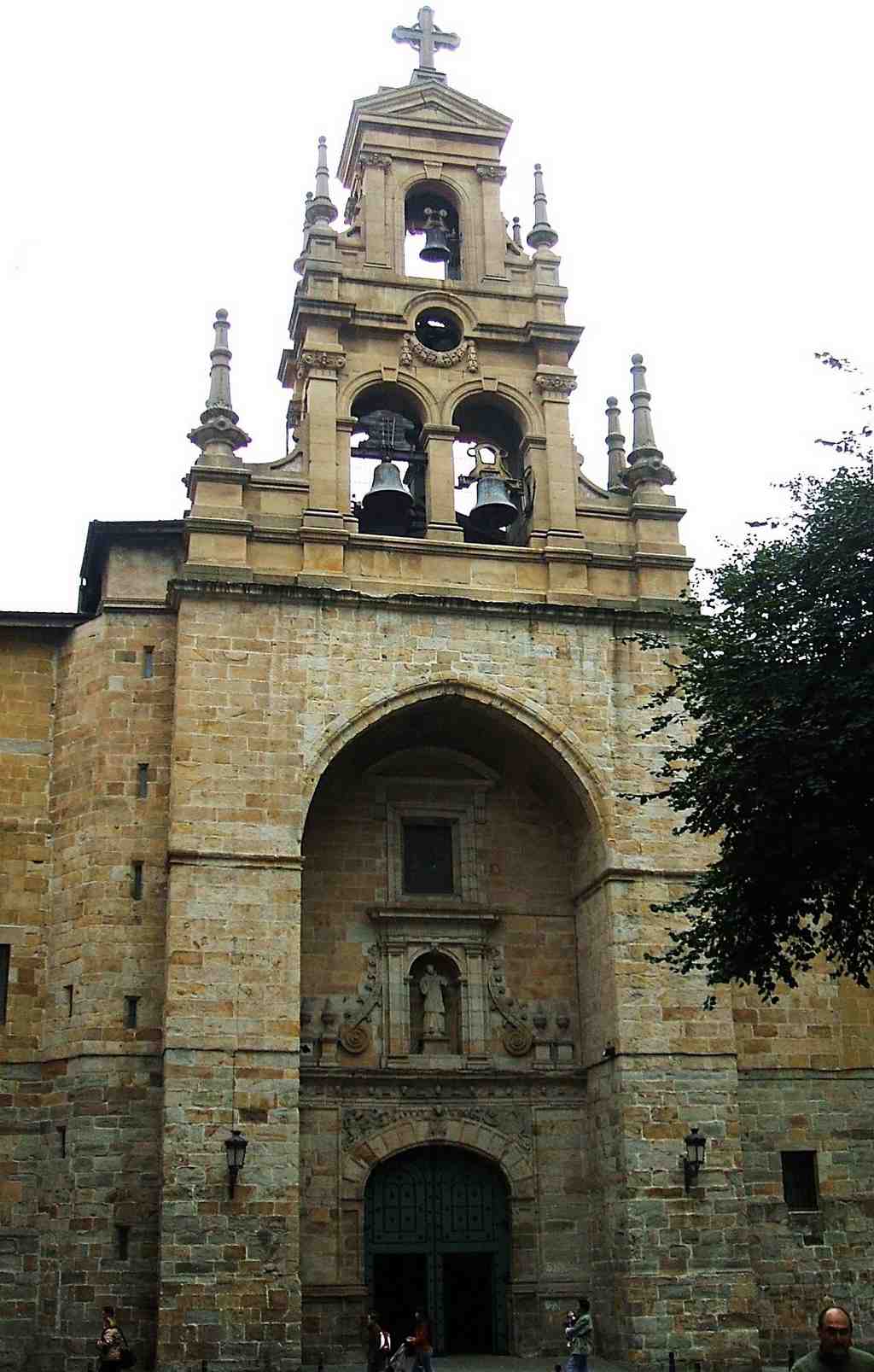
To find the Church of San Vicente de Abando, look for a grand Renaissance stone building right in front of the Albia Gardens, topped with an elegant bell tower that quietly peeks above the neighboring modern constructions.
Picture yourself standing here in bustling Bilbao, with the city’s hum swirling around you. Imagine stepping back in time, over 400 years ago, when this was just the tiny anteiglesia of Abando, its heart beating right where the peaceful Albia Gardens rest today. Now, before you stands the majestic San Vicente de Abando, a place whose stones have witnessed centuries of prayers, secrets, and-let's be honest-a few impatient wedding guests.
Let’s go all the way back to the late 12th century. The very first church here, built in 1190, was a Gothic creation-think tall arches, mysterious shadows, and knights probably running late for mass. This original house of worship was funded by the noble lords of Ayala and Salcedo, whose generosity set off a chain of church building that would last for centuries. Fast forward to 1549, and the townsfolk decided it was time for an upgrade: enter Juan de Arratia and a team of stonemasons ready to leave their mark. They got to work, replacing the medieval church with the Renaissance marvel you see today, finally wrapping things up by the mid-1600s. Well, good things take time-and apparently a few generations!
You’re looking at what may be the finest example of a columned Renaissance "hall church" in the entire Basque Country. Step a little closer and look up: eight mighty cylindrical columns, so smooth you might be tempted to give one a hug (just watch out for the parish priest). These columns rise up to support a forest of vaults overhead, each webbed with stone ribs, locking together like puzzle pieces and bathing the nave in filtered, almost magical light. The church is perfectly rectangular-no hiding spots or secret corners for misbehaving choir boys-just 37.9 meters long and 28 meters wide, pure and symmetrical.
But the drama isn’t only inside. Peer at the main façade, built in 1556 from solid Axpe and Arrigúnaga stone. The old Gothic side door is still here too, tucked away amidst later additions and topped by a small sculpture of Our Lady of Sorrows, perhaps keeping an eye out for tardy parishioners. Unmistakably perched above the main door, you’ll see a stately neo-baroque bell tower and spire added in 1901-designed by José María Basterra in a moment when Bilbao’s architects decided that “bells and whistles” should be taken literally.
Step inside with your imagination: five golden altarpieces gleam, although they’re newer, designed in a rich but slightly theatrical style-let’s just say the original artists couldn't have imagined so much gold leaf! The main altarpiece, the work of local craftsman Juan Blas de Hormaeche, mixes neoclassical flair with baroque drama. Meanwhile, tucked away in various chapels and nooks, you’ll find treasures like statues by Higinio Basterra, a bronze relief of Lost Souls by Lorenzo Fernández de Viana, and a heartbreakingly beautiful Virgin Dolorosa, carved to dress in mourning for centuries of parish grief.
The church has its tales of both tragedy and gratitude, such as the plaque inside honoring the survivors of the Steamship Fernando, wrecked off Portugal in 1943-when a shipwreck earned its own prayer niche, you know Bilbao was closely tied to the sea.
If the air feels a little learned, you might be sensing the presence of Antonio de Trueba, the famous Basque writer whose remains rest within these walls. And by the baptismal font, it’s easy to imagine the little feet of Sabino Arana-a founding father of Basque nationalism-being dipped in centuries past, as sunlight poured through modest rounded windows.
So here, at San Vicente de Abando, you’re not just seeing bricks and mortar; you’re standing at the crossroads of medieval hope, Renaissance ambition, maritime gratitude, artistic devotion, and the endless stories of Bilbao’s heart. And remember, if you hear the bells after you leave, that’s just San Vicente reminding you to come back and visit-he’s a bit clingy, but only in the best way!




