
Welcome to Plaça de Catalunya, where you can easily spot the landmark by its massive expanse of paved stone featuring a central star-shaped mosaic and large circular fountains.
Barcelona is a city that constantly consumes its own history to reinvent itself. To step into the future, it repeatedly tears down its past, wiping the slate clean to make room for grand new visions. That dramatic reshaping started right here, when the ancient, suffocating city walls were finally demolished to let a modern metropolis breathe.
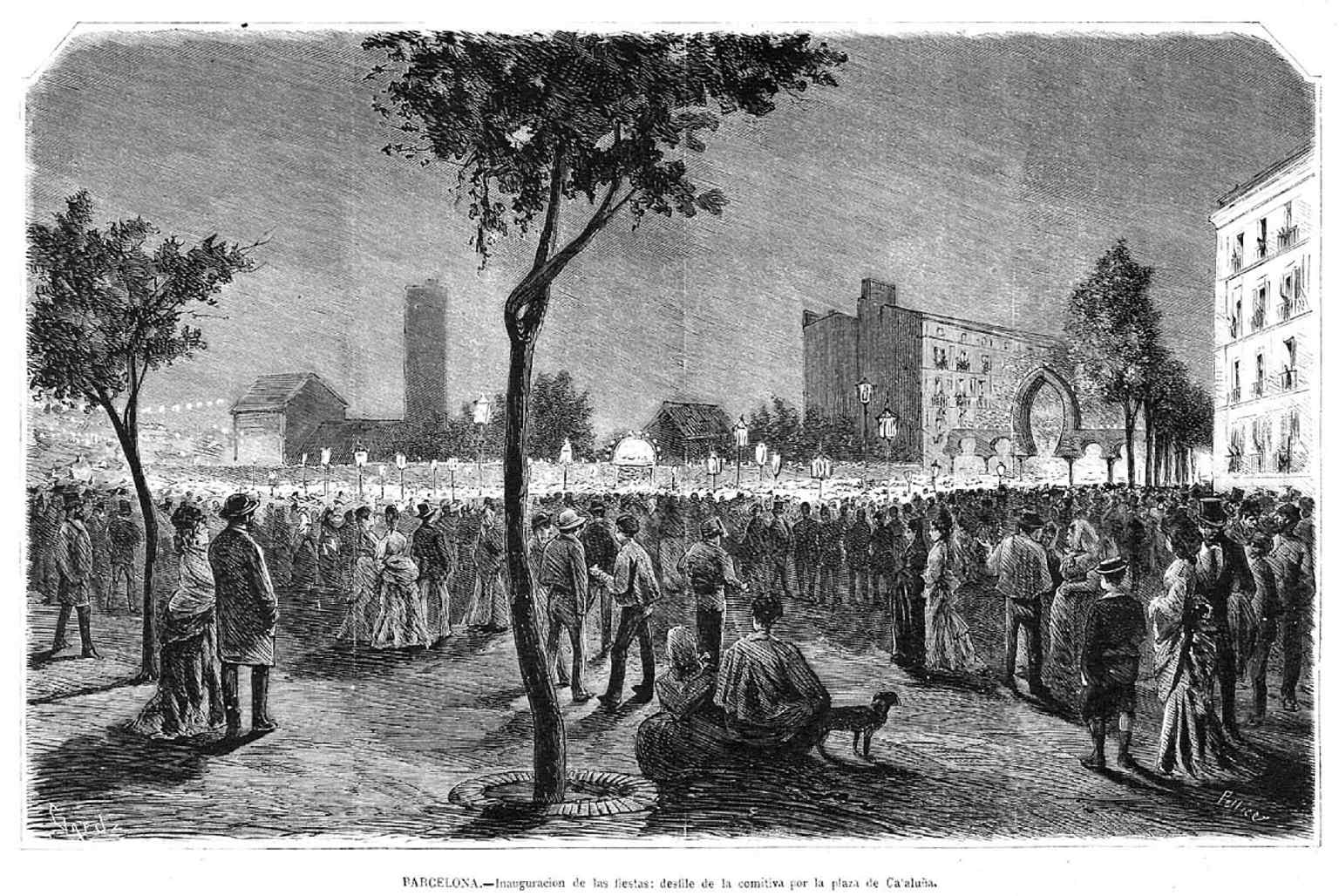
Until the mid-nineteenth century, the ground you are looking at was just a dusty dirt field located directly outside the main gates. When the walls were toppled, this space naturally became the bridge between the tangled, medieval alleys of the old town and the Eixample, the vast, grid-like expansion district that defines modern Barcelona.
Before the grand monuments arrived, this spot was home to a massive nineteenth-century cafe called La Pajarera, meaning The Birdhouse. It was a sprawling rectangular hall where up to seven hundred artists and intellectuals would gather to argue and dream. Eventually, the city cleared it out to build the plaza we see today, largely driven by the grand international exhibitions of 1888 and 1929. Interestingly, the 1929 exhibition also brought the plaza's most famous residents. The local police chief actually lured a flock of pigeons here by dropping a continuous trail of grain from a distant park, playing a sort of feathered Pied Piper to give the square a classic Renaissance feel.

But the plaza has also seen intense destruction. During the Spanish Civil War in 1936, the luxurious Gran Hotel Colón was seized by militias and turned into a heavily armed fortress draped in giant portraits of Lenin and Stalin. Across the square, anarchist operators took control of the Telefónica communications building. They held so much power they would simply disconnect phone calls between government presidents if they decided the politicians were talking nonsense. Eventually, this standoff exploded into a bloody internal conflict known as the May Days. The famous British writer George Orwell, who was fighting in the local militias, found himself pinned down near here as machine-gun fire swept across these exact paving stones.
The cycle of ruin and reinvention even reaches beneath your feet. During the war, secret tunnels were excavated to smuggle explosives. In 1940, an ambitious businessman transformed those dark, unfinished weapons corridors into the Avenue of Light, Europe's very first underground shopping mall. At its peak, sixty thousand people strolled its subterranean halls daily. However, the dream of a vast underground city slowly decayed, and the tunnels eventually became an abandoned shell before closing completely in 1990.

From sweeping historical battles to bustling modern commuters, this square anchors the entire city. Let us leave the wide open space behind and dive straight into the historic streets. Head down the famous tree-lined avenue known as the Ramblas, and in about nine minutes we will arrive at our next stop, the magnificent La Boqueria market.






._AFB.jpg)
