
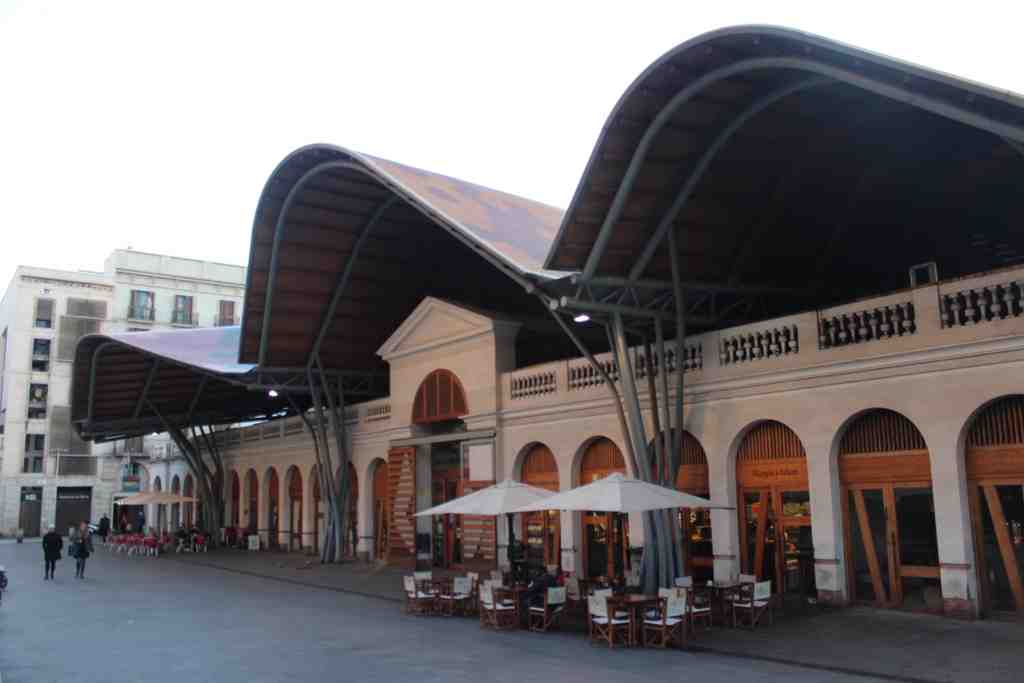
Notice the building on your right, where a row of traditional white stone arches is dramatically overshadowed by a massive modern wavy roof supported by twisting metal pillars.
This is the Santa Caterina Market, the oldest covered market in the city. But to understand this place, we have to look past that striking roof and dig into the ashes underneath it. You see, this spot was originally a thirteenth-century Dominican convent. That came to a violent end during the same wave of anti-clerical riots in 1835 that we heard about earlier. An angry mob stormed the convent and set it ablaze. The monks fled for their lives as centuries of history, including a massive library, went up in smoke. The city government, practicing a policy of state confiscation, decided not to rebuild. Instead, they cleared the ruined cloisters and built the neoclassical market you see the bones of today.
For a long time, this place was the gritty heart of neighborhood survival. During the harsh years following the Spanish Civil War, marked by extreme rationing, these stalls and the narrow alleys around them became an epicenter for the black market. Underneath the counters, desperate locals and cunning smugglers traded basic food items at astronomical prices, just trying to outlast the economic collapse.
Fast forward to 1997, and the city decided it was time for an upgrade. They brought in a husband and wife architectural team, Enric Miralles and Benedetta Tagliabue, who designed that incredible undulating roof. It is covered in a massive mosaic of over four thousand square meters, using a technique called trencadis, where broken ceramic shards are pieced together to form patterns. The colors represent the vibrant fruits and vegetables sold inside. But it is not just pretty. Those complex parabolic curves act as a natural ventilation system, pulling hot air up and out so the market stays cool without heavy air conditioning.
But pushing into the future is rarely simple, especially when the foundations of your new vision are built on literal ruins. When the construction crews started digging, they hit a massive archaeological jackpot... uncovering the medieval convent foundations, a Roman necropolis, and a Bronze Age settlement. Four thousand years of history were sitting right under the produce aisle. The city mandated that the ruins be preserved, which triggered a logistical nightmare and delayed the grand opening by four long years. The stall owners had to survive in a temporary tent outside, and sadly, many family businesses did not make it.
The project also suffered a profound personal tragedy. In the year 2000, Enric Miralles was diagnosed with a brain tumor and passed away at just forty-five. His wife, Benedetta, had to finish the monumental task alone. When she finally opened the doors in 2005, the market became not just a marvel of modern urban life, but a vibrant tribute to her late husband.
Feel free to step inside if they are open... the market operates Monday through Saturday, though it is closed on Sundays. Next, we are heading toward a true jewel of Catalan music, the Palau de la Musica Catalana, which is just a five-minute walk away.




