
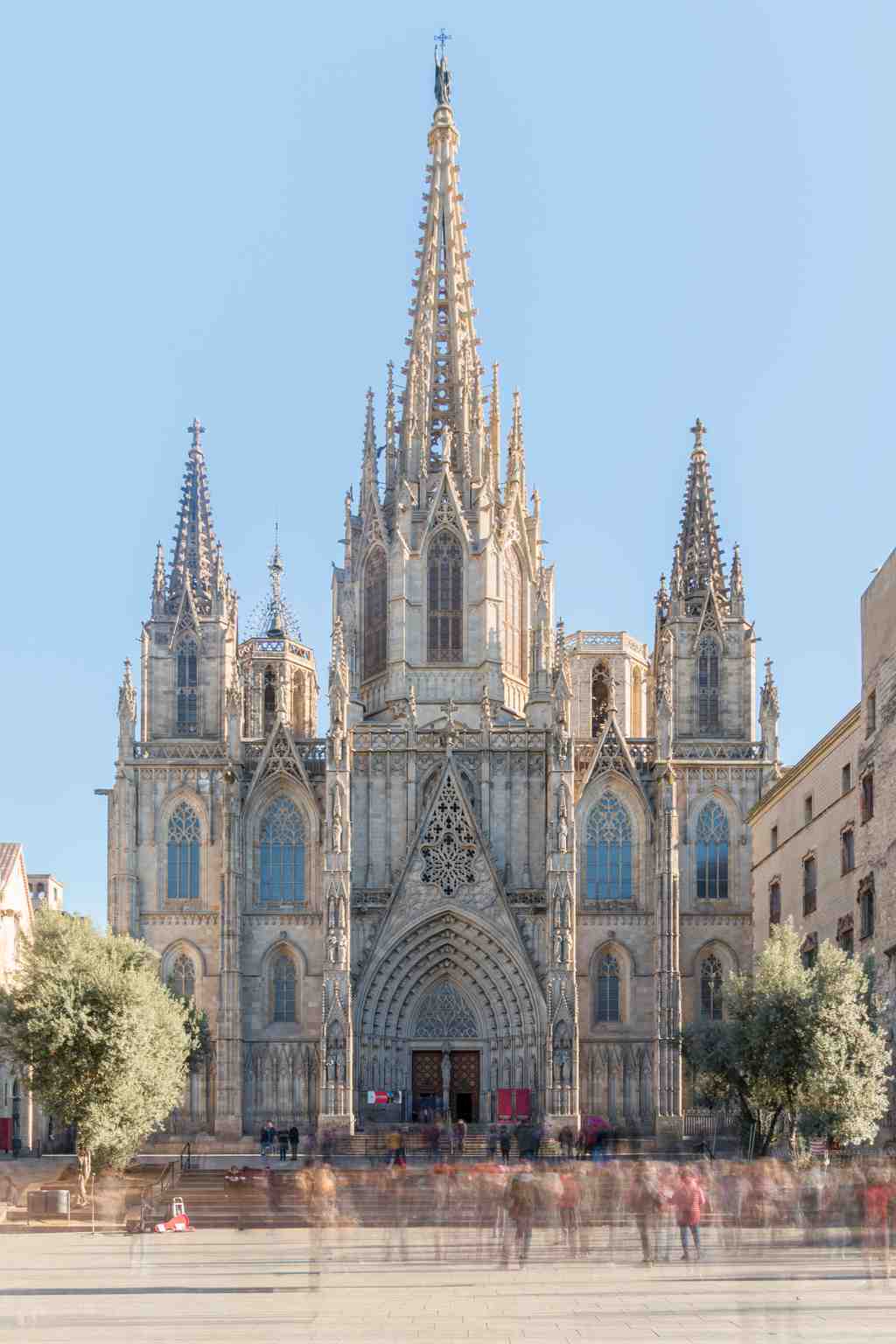
Look up at the towering pale stone facade defined by its soaring central spire, intricate pointed arches, and a dense array of statues standing guard along its vertical lines.
It is easy to assume you are looking at an untouched relic from the Middle Ages. But the truth is much more complicated. This grand stone face is actually a Neo-Gothic addition from the late nineteenth and early twentieth centuries, bankrolled by a local banker to give the building a more dramatic profile. You can see exactly how much this skyline changed by checking the historic before and after image on your phone.
This building is a masterclass in how newer generations overwrite the old. The current cathedral sits on the bones of a Romanesque church, which was built over a Visigothic church, which itself sat atop an early Christian basilica. Each era buried the past to build its own vision of the future.
But dig down to the bedrock of this site, and you will find the story of Santa Eulalia. She was a thirteen-year-old girl during the Roman era who bravely protested the persecution of Christians. The local governor responded with unthinkable cruelty, subjecting her to thirteen different tortures, one for each year of her life. She was thrown into a barrel lined with broken glass and nails, rolled down a hill, and finally crucified on an X-shaped cross, which is now the emblem of the diocese. Her crypt lies beneath the main altar to this day.
If you take a moment to look closely at the cloister, the open courtyard attached to the cathedral, see if you can spot the white geese wandering the grounds. There are always exactly thirteen geese kept there in honor of Eulalia's age. Beyond their spiritual symbolism, these highly territorial birds actually served a very practical purpose, acting as a noisy, squawking alarm system against night-time intruders.
The clash of history and progress is just as striking inside. The interior features a soaring nave, the main central hall of the church, where the side aisles are nearly as tall as the center, creating a vast, echoing cavern. You can get a sense of this massive interior scale by looking at the image on your screen.
During the Spanish Civil War in 1936, this entire ancient structure nearly vanished into ash. Armed anarchists arrived to burn it down, but an anarchist poet convinced the mob that the architecture belonged to the people. That appeal to modern ideals, combined with a wild rumor that five thousand heavily armed priests were hiding in the labyrinthine crypts, saved the building.
The cathedral is open daily for visits, though the hours are slightly shorter on Sunday afternoons. Let us walk away from this Gothic majesty now and head toward the vibrant stalls of the Santa Caterina Market, about a five-minute walk away.




