
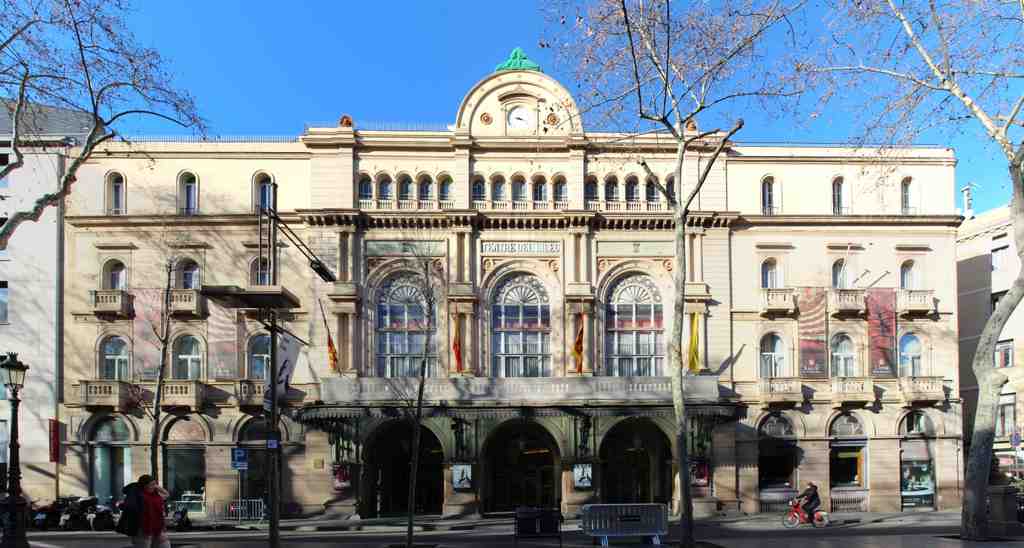
Look to your left and you will spot a grand, tan stone building defined by three prominent arched windows in the center, a rounded clock pediment at the top, and a distinctive green roof ornament crowning the structure. This is the Gran Teatre del Liceu, Barcelona's oldest active theater, and frankly, it is a miracle it is still standing. If buildings have nine lives, this opera house has used up quite a few of them.
When it was built in 1847, it was funded by private citizens rather than a monarchy, which is why you will not find a royal box inside. But they built it right on top of a former convent. According to local lore, the displaced religious figures left behind a curse, dooming the theater to repeatedly burn down. Looking at its history, you might start to believe it.
The first devastating fire hit in 1861, leaving only the facade and a few halls intact. They rebuilt it. Then, during the opening night in 1893, an anarchist threw two bombs from the upper gallery down into the stalls, the main ground floor seating area. Twenty people were killed. The death toll would have been worse, but one bomb miraculously failed to detonate because its fall was broken by a victim. The theater rebuilt again, leaving the seats of the victims conspicuously empty for years as a memorial. Some staff even say they still hear phantom singing and whispers near those private boxes.
But the curse was not finished. In 1994, a workman's blowtorch sparked a fire that raged completely out of control. Huge balls of fire shot into the air, incinerating the instruments in the orchestra pit. Crowds stood weeping in the street, including the famed Catalan soprano Montserrat Caballé, who considered the Liceu her second home.
Yet again, the city refused to let the music die. They rebuilt it, merging the surviving historical architecture with state-of-the-art technology. You can see how the energy outside the theater has evolved over the years in the app's before and after image. Over a century later, La Rambla remains a bustling thoroughfare past the iconic Gran Teatre del Liceu, capturing the shift from early 20th-century pedestrians to modern-day tourists.
My absolute favorite moment of modern resilience happened here in 2020. To mark the end of the strict pandemic lockdown, the Liceu reopened not for humans, but for an audience of 2,292 house plants. A string quartet played Puccini to a sea of green leaves, and afterward, the plants were donated to local healthcare workers. That is the essence of this place, an institution forever caught in a dance between honoring its tragic history and embracing wild, forward-thinking reinvention.
If you want to look inside, the theater is usually open to visitors Monday through Saturday until seven, though it closes at two on Saturdays and is entirely closed on Sundays. For now, we are going to keep moving. Just ahead, look for the narrow street leading off La Rambla, which will take us to our next stop, Palau Güell, about a three-minute walk away.




