
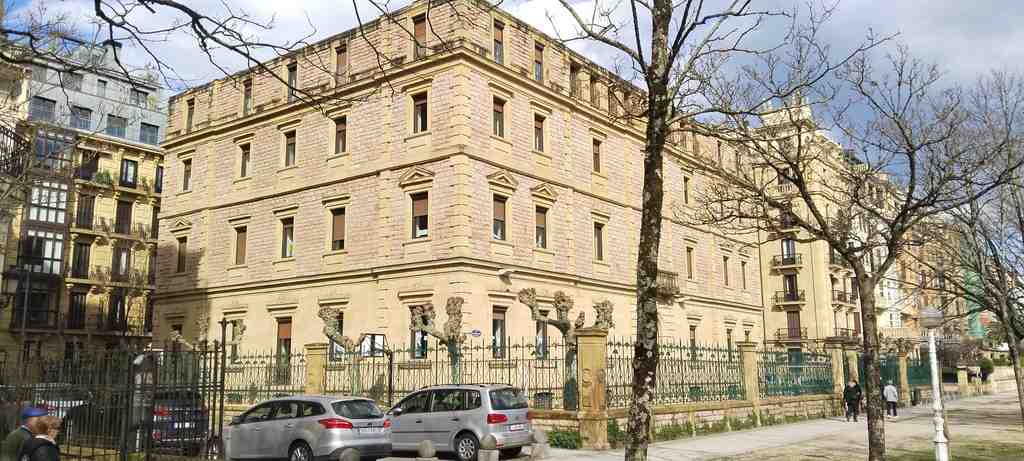
On your right, notice the broad pale stone façade, its neat rows of rectangular windows, and the little angel fixed to the wall above the spot where the old turning hatch once stood.
This was the San José Children’s Asylum, and here the word “asylum” meant a charitable childcare home, not a medical institution. Ramón Cortázar designed this larger building at number thirty-three Prim Street, and workers laid its first stone on the ninth of September, nineteen oh one. When the city inaugurated it on the twenty-fourth of August, nineteen oh three, San Sebastián staged the occasion with remarkable ceremony: King Alfonso the Thirteenth arrived with the queen mother, the Princes of Asturias, the Infanta María Teresa, and a full line of local and provincial authorities waiting beneath the portico.
That tells you something important about the city taking shape here. Public care and public image moved together. The Town Hall funded the asylum, wealthy Donostiarra philanthropists added donations, and the result served both compassion and prestige: a building that cared for poor families, while also proving that San Sebastián could look modern, organised, and magnanimous.
The story began more modestly. The first San José asylum opened in eighteen ninety-one in a much smaller place at San Marcial twenty-eight, on the corner of Fuenterrabía. People credited the initiative to the widow of Elósegui, with support from several local families, and the records give a particularly vivid place to Sister Nieves Petitjean, the prioress who pushed the project forward with the help of her family’s fortune. When that first site became too cramped, the eleven ladies of the asylum board did not drift into polite helplessness. They pressed the Town Hall for a larger plot, argued that demand had outgrown the old premises, and helped force the move here beside the Urumea.
Inside, the work was practical, relentless, and deeply modern. Mothers with little money could bring their children at seven in the morning and collect them at night. The asylum fed them, washed them, taught them, and watched over them through the day. In its early years it could receive as many as four hundred children, aged roughly two to fourteen, under the care of five Daughters of Charity and additional staff.
And here is the question the building quietly asks: what tells you more truth about a city, the splendour it likes to display, or the care it puts in place for those with the least?
From August of nineteen oh two, this house also joined the Gota de Leche, literally the “Drop of Milk,” an early child welfare service that supplied prepared milk and pediatric support. Milk came through the Fraisoro network, and doctors such as Juan José Celaya and later Felipe Errandonea helped shape that system. So this was not only shelter. It was nutrition, hygiene, and preventive medicine, wrapped into one institution.
That little angel on the façade marks an older, starker reality. Beneath it stood the torno, a turning hatch where an infant could be left anonymously. When the city closed it in nineteen sixteen, Gipuzkoa lost one of the last material signs of that form of child abandonment.
The building’s life did not remain gentle. After the Nationalist takeover of San Sebastián in September nineteen thirty-six, authorities requisitioned the old asylum and used it as a women’s prison. Later, it returned to education, and it continues in that role as San José Ikastetxea.
For all the pomp of its inauguration, the truest image may be the simplest one: mothers arriving at dawn, children staying all day, and a proud city proving itself through daily care as much as grand architecture. When you are ready, walk about five minutes to María Cristina Bridge. If you wish to come back, the site generally keeps weekday hours from nine thirty to four thirty and closes on Saturdays and Sundays.




