
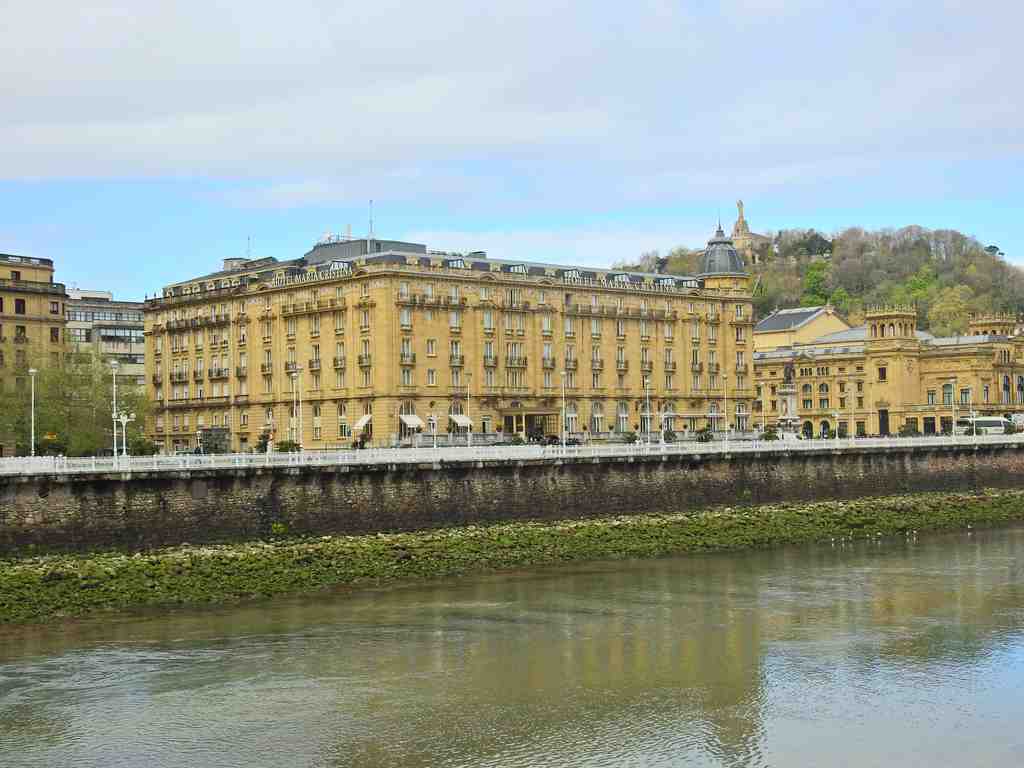
On your right, the Hotel María Cristina shows itself in pale stone, with a long symmetrical façade of tall windows and wrought-iron balconies, all lifted by a dark mansard roof pricked with neat dormer windows.
There is something wonderfully calculated about this building. It does not simply offer rooms. It presents San Sebastián to the world.
At the start of the twentieth century, local business leaders understood that a fashionable resort needed more than scenery. In nineteen hundred and two, a group of ambitious Donostiarras created the Sociedad de Fomento, a private development society that set out to reshape the city’s image in a very public way. Their great idea was bold and rather theatrical: build a luxury hotel and a grand theatre together, so culture and hospitality would arrive as a pair.
They studied several locations, including the edge of La Concha, then chose the gardens of Zurriola by the Urumea. The city council agreed to give up that land, but attached a condition with real foresight: after seventy years, both the theatre and the hotel would pass into municipal ownership. That is the cleverness of this place in one stroke. Private money created prestige, but the city made sure the prize would one day belong to the public.
The hotel itself came from Charles Mewes, the architect behind several Ritz hotels in Europe, including Madrid and Paris. Francisco Urcola directed the project here, while also shaping the neighbouring Victoria Eugenia Theatre. Construction on both began in nineteen hundred and nine, and in nineteen twelve Queen María Cristina attended the inauguration. From that moment, the pair announced that San Sebastián intended to stand among Europe’s refined resort cities, not as a provincial imitation, but as a confident equal.
Its early glory matched the city’s belle époque, when the royal summer presence and the disruptions of the First World War turned San Sebastián into a gathering place for the wealthy. Yet this hotel has never belonged only to luxury. In July nineteen thirty-six, at the opening of the Civil War, political violence briefly turned it into a kind of improvised stronghold. Much later, in twenty twenty, the hotel of film stars took in recovering covid patients. Even here, glamour has never entirely escaped history.
And then there is the folklore. Trotsky stayed here. So did Mata Hari, Maurice Ravel, Coco Chanel, Audrey Hepburn, Alfred Hitchcock, Steven Spielberg and Mick Jagger. During the film festival, the hotel became part of the performance itself, its closeness to the theatre allowing stars to move between bedchamber and spotlight with almost absurd ease. One of the people who knew that ritual best was Miguel Ángel Aldazábal, the doorman who began work in nineteen ninety. He opened the door to Jerry Lewis and Peter O’Toole in his first days, and over the years became nearly as familiar to festival followers as the celebrities he welcomed.
The building changed shape in the nineteen fifties, when a new wing gave it a U-shaped plan instead of its original L. In nineteen eighty-two, just as that old municipal clause intended, the hotel passed to the city council. Later renovations restored its five-star status, and in two thousand and twelve a major refurbishment refreshed the belle époque air without erasing its character.
So as you stand before this polished façade, one question lingers: did San Sebastián build a hotel for guests, or a monument designed to persuade the wider world that the city belonged on the grand European stage?
We leave that polished answer now and walk toward power in a sterner language: the Provincial Palace of Guipúzcoa.




