
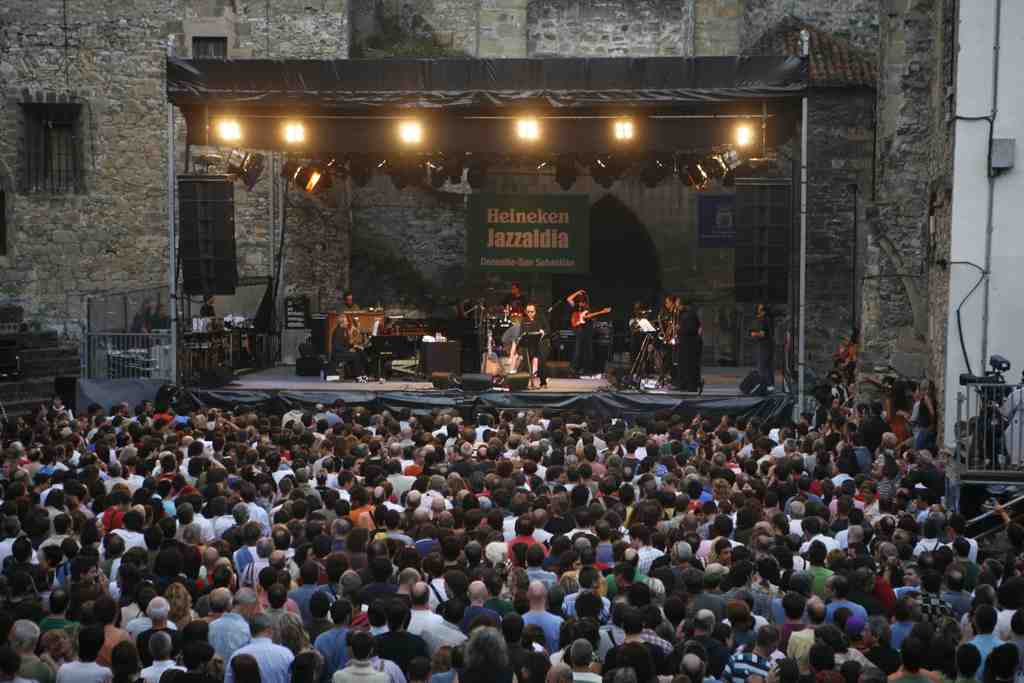
On your right, look for a compact stone square with steep stepped sides and high masonry walls, a surprisingly theatrical hollow carved into the old city.
Jazzaldia is not a monument in the usual sense. It is something more interesting: a festival that taught San Sebastián to treat the whole city as a stage. What once belonged mainly to elegant interiors now spills across beaches, terraces, theatres, and plazas, until music feels woven into the streets themselves.
The festival began in nineteen sixty-six, and that matters. Jazzaldia is the oldest jazz festival in Spain and one of the oldest in Europe, and it has continued without interruption ever since. The first edition lasted only two days, the tenth and eleventh of September, with an international amateur contest and just one professional act, the guitarist Mickey Baker. The following year, the organisers shifted it to July, where it has remained.
But here is the turn in the story: behind all the polish, Jazzaldia started with scarcity and a quiet streak of defiance. In that first edition, while Franco’s regime still restricted public expressions of Basque culture, the festival included a demonstration of txalaparta, an ancestral Basque percussion instrument played by striking wooden boards in rhythm. That single gesture tied an imported art form to local roots. From the beginning, this was never just fashionable entertainment.
Its soul settled in Plaza de la Trinidad, the festival’s most storied setting. Musicians adore it because the audience sits so close, almost breathing with the band. Yet closeness brought pressure. When Charles Mingus played here in nineteen seventy-four, the organisation still operated with a kind of inspired precariousness. Mingus did not even have his own double bass to hand, so the musician Jimmy Leary lent him one. Even so, the concert blazed with such force that it changed the festival’s future. Crowds swelled; the city had to think bigger. Jazz moved from this intimate square to sports halls and the velodrome, not because the spirit had faded, but because too many people wanted in.
And that is the real revelation. San Sebastián did not simply decorate itself with culture; it engineered public desire around it, then kept widening the circle. Jazzaldia now spreads through roughly a dozen venues, with close to a hundred concerts, some ticketed, many free. The vast gatherings on Zurriola Beach and the terraces of the Kursaal opened the festival to younger audiences and enormous crowds. In two thousand and twenty-four, attendance reached about one hundred and eighty-five thousand.
There are delicious human footnotes too. In nineteen seventy-five, an amateur British group called Last Exit slipped into the contest almost unnoticed. Its blond young bassist was Gordon Sumner, long before the world knew him as Sting. Miles Davis came later and reportedly diverted his taxi through the city hunting for one very particular fur coat before vanishing into hotel seclusion. Even Van Morrison, not famous for warmth, called his nineteen ninety-nine concert here one of the best of his career.
Soon we’ll make for the Victoria Eugenia Theatre, where San Sebastián gave performance an even grander frame. If you fancy carrying the jazz mood into the evening, the nearby venue linked to this stop usually opens from Tuesday to Sunday and closes on Mondays.




