
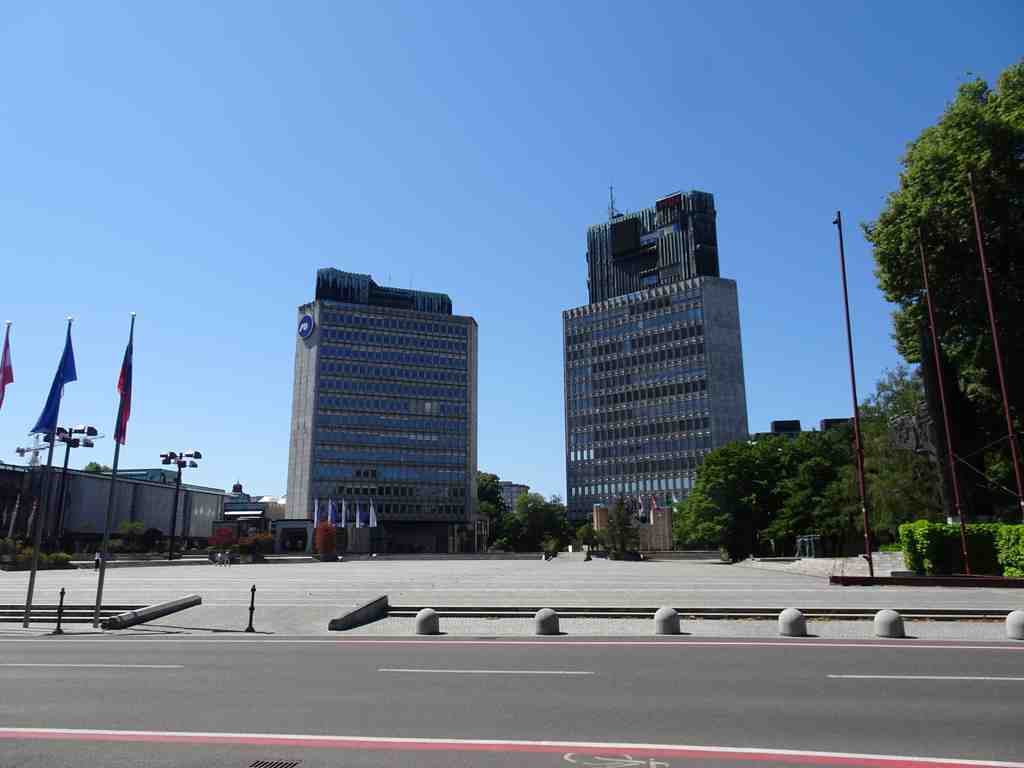
On your right, Republic Square opens up as a wide granite-and-concrete plaza framed by sharp-edged modernist blocks and two uneven rectangular towers that rise like mismatched bookends.
This is the largest square in Ljubljana, and it was built to feel bigger than the city’s old scale would normally allow. In the second half of the 20th century, architect Edvard Ravnikar designed it not as a cozy urban room, but as a statement. Ravnikar had studied under Jože Plečnik, Ljubljana’s master of classical detail, and also absorbed the bold modern ideas of Le Corbusier. Here, he tried to fuse architecture and city-planning into one stage set for public life.
But Republic Square is also a lesson in Vision vs. Reality. Ravnikar’s 1960 competition entry imagined this space as the “Ljubljana Gate,” a symbolic entrance to the capital. Two identical skyscrapers were supposed to stand here, 26 floors each, over 100 meters tall, like a pair of pillars. Political pressure and Yugoslav economic reforms in 1965 squeezed that dream down to what you see now: two towers, not twins at all, and not nearly as tall. The result was TR2 at about 60 meters and TR3 at about 69, later filled by Ljubljanska Banka and government offices. If you want a clearer sense of how the square reads from above, glance at the image on your screen.
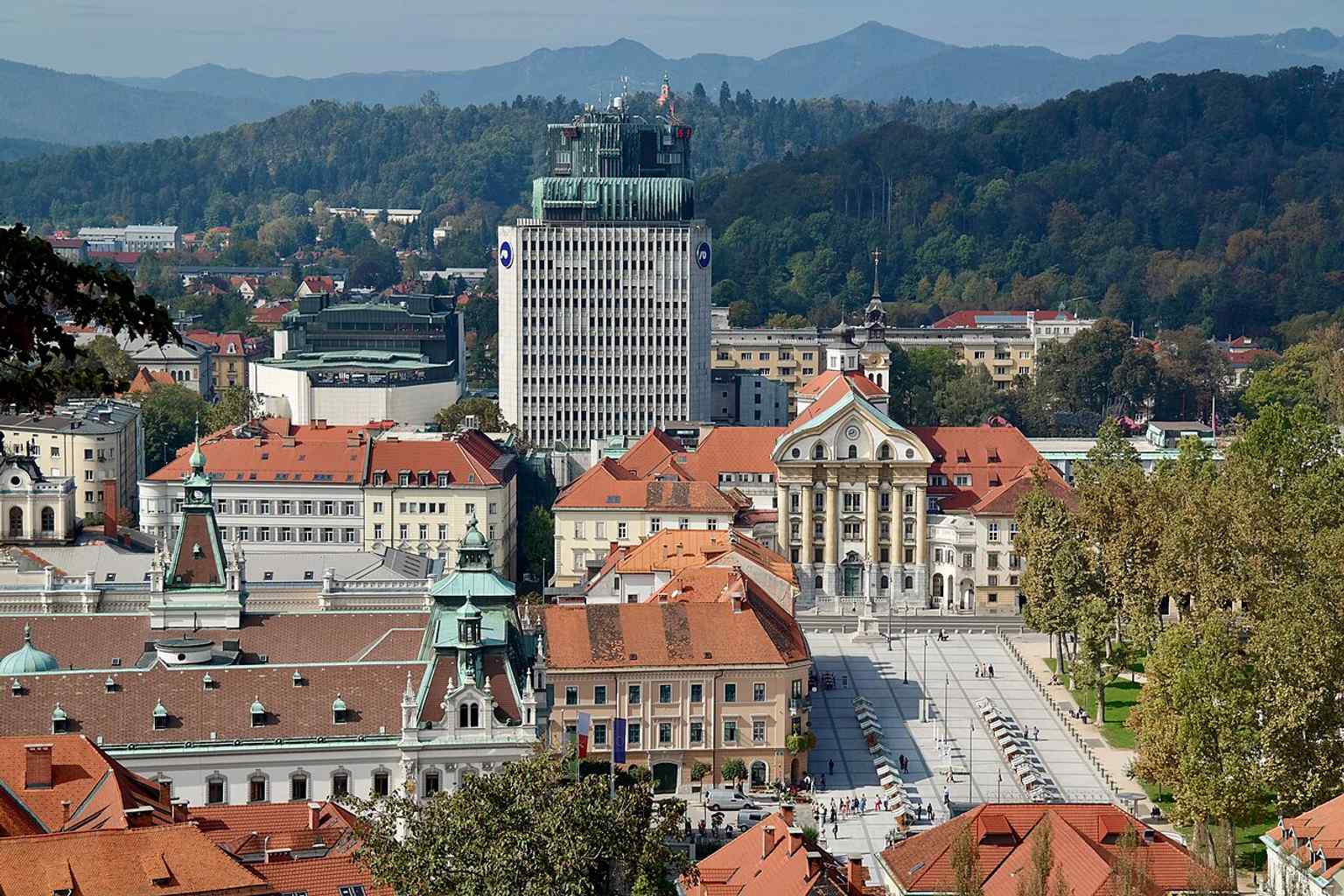
Before any of this modern geometry, this ground was the Nunski vrt, the Nunnery Garden of the Ursuline Monastery... centuries of quiet green in the center of town. The construction took more than twenty years and replaced that calm with an “open design”: multiple buildings, underground passages, smaller atriums. Ravnikar even tried to soften the severity with small touches-birch trees, and stair details cut in “lace” patterns, like a reminder that human hands still mattered in a concrete world.
Now, take a moment to scan the breadth of the square from where you’re standing. Try to picture those two equal, towering giants Ravnikar wanted-this whole place turned into an actual gate you’d pass through, not just an open field between institutions.
And then there’s the weight at the center of the story: the Monument to the Revolution by sculptor Drago Tršar. Its creation became a grueling ten-year ordeal. Tršar first built a massive 32-ton gypsum model in his studio, then it had to be sliced into 240 sections-each roughly a door-sized slab-so the pieces could be sent to Zagreb for bronze casting. Austerity measures halted the project in 1965; it only reawakened a decade later, and when it finally arrived here in 1975, budget cuts stripped away Ravnikar’s planned water curtains and background elements. The bronze mass was left to speak for itself.
For years afterward, the irony was hard to miss: this symbolic ground became a central car park. Only in 2014 was it renovated into the pedestrian space you’re standing in now, officially protected as a national monument.
When you’re ready, let your eyes settle on the building that anchors the square’s northern edge-the seat of modern power. In about a 2-minute walk, we’ll meet it up close at the National Assembly.





