
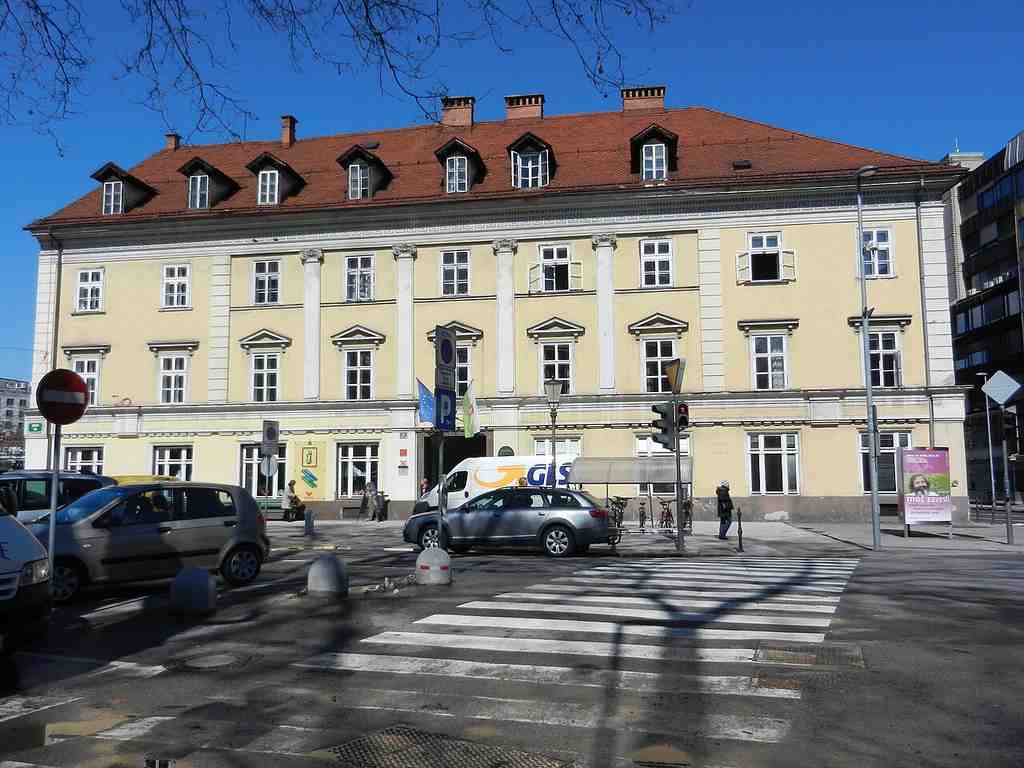
Look to your left for a large, pale yellow rectangular building with a red tiled roof punctuated by small windows projecting from the slope, easily spotted by the flat white decorative columns stretching across its upper facade. This is Mahr House, and it has worn many faces over the centuries.
It actually began its life as a simple granary to store wheat. But by the middle of the nineteenth century, it had been transformed into one of the city's most elite hotels. During the Spring of Nations in 1848, the hotel even served as a makeshift royal residence for an exiled Spanish prince. You can imagine the local gossip when a royal baby was baptized right here in the hotel. It was a place of high society, hosting famous astronomers, Austrian field marshals, and the poet France Prešeren, who worked in a law office downstairs.
But the building's most defining era began in 1855, when it was purchased by Ferdinand Mahr. He needed a permanent home for the trade school founded by his predecessor, Jakob Franc Mahr. Jakob had established the school with a grand goal of modern trade education. He wanted to build a cosmopolitan center that looked far beyond local borders. And his visionary ambition worked. The school became an international beacon, drawing future merchants from Italy, Croatia, Greece, and Bohemia. They came here to learn not just ledger books, but the fine art of cross cultural communication. To match this serious academic prestige, Ferdinand completely altered the building in 1865, adding two massive upper floors to give the structure a strict, imposing presence, effectively erasing the glamorous hotel of the past.
For decades, it was the premier institution of its kind in the Austrian Empire. But history moves fast, and institutions that fail to adapt are often left behind. The school primarily taught in German, which had long been the language of commerce. However, the Slovenian national identity was rapidly growing. This led to a sudden upheaval in 1909. The government opened a new, state run trade school in Ljubljana that taught entirely in Slovenian. Almost overnight, the local students abandoned Mahr's classrooms. In a single year, their numbers plummeted from one hundred fifty nine to a mere thirty nine. It was a financial blow the proud institution never truly recovered from.
The school limped along until 1918. When it finally closed its doors forever, its end mirrored the collapse of the Austro Hungarian Empire itself. The grand classrooms that once trained the Mediterranean's merchant elite were quietly partitioned into mundane offices for the city's water utility. The old world order had ended, and this once visionary space had to adapt to a far more ordinary reality. Today, the ground floor serves as a tourist information center, which is open Monday through Friday from eight AM to five PM.




